
A Liberal Atheist Who Supports and Studies Israel
The Violence Against Jews in Britain That Everyone Is Excusing
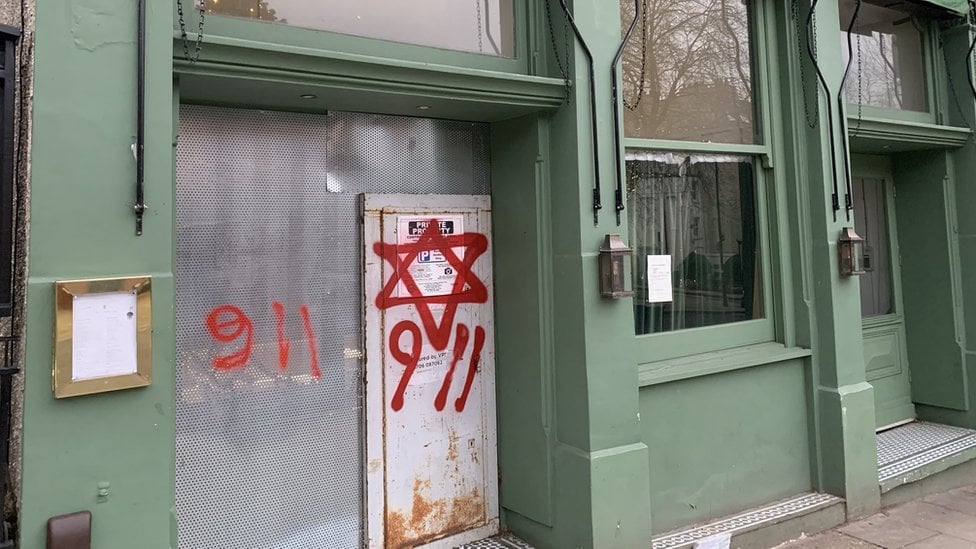
Antisemitic graffiti on a synagogue in London. Photo © Garry Knight, licensed under CC BY 2.0, via Wikimedia Commons.
Violence against Jews in Britain is no longer exceptional or rare—it is persistent, documented, and regularly excused. In recent years, Jewish communities across the UK have faced physical assaults, vandalism of homes and synagogues, and, most vividly, a terror attack outside a synagogue in Manchester. Still, the response from politicians and much of the media has been to downplay, and send attention elsewhere.
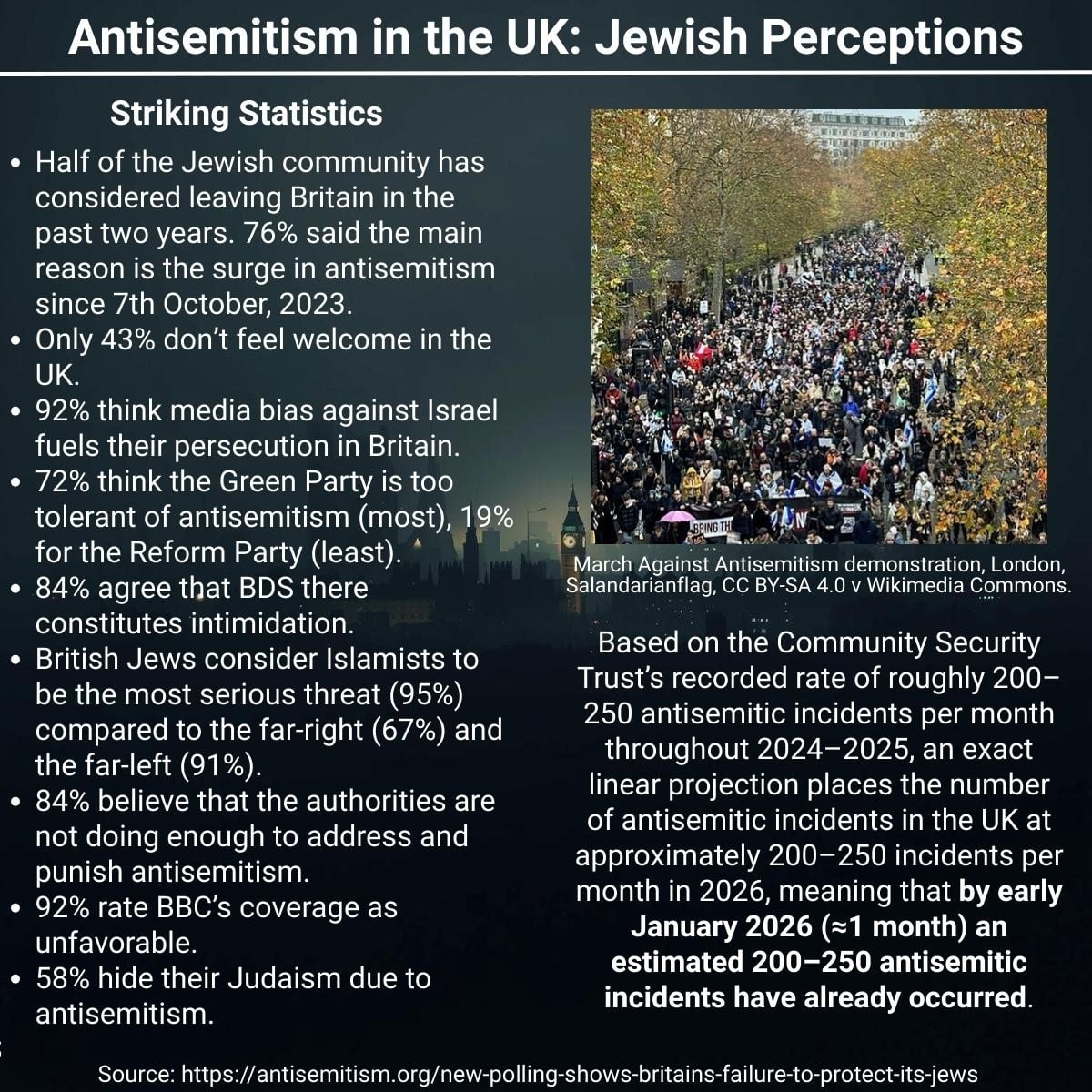
The data makes this evasion difficult to defend. After October 7th, 2023, antisemitic incidents in the UK spiked dramatically, with more than a thousand recorded in just weeks, with dozens of physical assaults—a year-on-year increase measured in multiples. These were not online insults or offensive statements alone, but Jews being attacked and told to hide their identity for their own safety. And yet, much of the public conversation insisted on treating this as peripheral, or somehow unrelated to antisemitism itself.

What makes this moment so troubling is not only the rise in violence, but the logic being applied. The reflex to blame Jews appeared when Israeli football fans were accused of provoking violence, only for reports to show the attacks were pre-planned by an organized Islamist group—information European police officials acknowledged had been known by authorities. When Jews are attacked, the focus shifts to explanations that would be unthinkable in other situations: geopolitical grievances, historical animosity, and immigration issues. Any other form of persecution would never be treated this way. And I’m saying this as a Gentile.
—Violence that would otherwise trigger outrage is re-framed as complicated. In effect, Jews in Britain are being told that their safety must compete with other priorities—and is often expected to lose.
The institutional response to this drastic increase has been uneven at best. Police leaders have repeatedly warned Jewish communities to avoid certain areas, remove religious symbols, or stay home during protests—advice rarely given to other minorities. In London and other major cities, demonstrations where antisemitic chants were recorded had almost no response, and law enforcement often appeared hesitant, or at least, slowly applied. The implicit message was impossible to miss: public order concerns outweighed Jewish safety.
This double standard becomes clear when antisemitic violence is compared with other hate crimes. Attacks on other groups are rightly judged as bigotry, full stop. Context is not offered as relief; grievance is not treated as explanation. Yet when Jews are targeted, especially since the start of the Gaza War, violence is routinely framed as an effect of the political atmosphere, protest anger, or social unease—as though British Jews were representative of a foreign conflict rather than those entitled to protection. The result has real consequences. When violence is excused, it spreads. When intimidation is tolerated, it normalizes. And when Jews are told—explicitly or implicitly—that their fear is inconvenient, trust in the police erodes.
—Britain is not facing a crisis because antisemitism is invisible; it’s facing it because it’s overt and mishandled.
None of this is controversial. A society that cannot name violence against Jews as antisemitism is not confused—it has failed. Britain does not lack data or precedent; it lacks the willingness to apply principles consistently when Jews are targeted. Antisemitism in Britain is not hiding in the shadows. It is visible when police are telling Jews to not look “Jewish,” in public debates that treat Jewish safety as a liability, and in the quiet expectation that Jews put up with it for the sake of everyone else. This is how normalization works—not through straight-forward lies, but through excuses.
If Britain wants to claim it cares about Jews, the standard must be simple and universal: violence against Jews will be handled like any other kind. Anything less is impermissible.
A society that debates whether Jews deserve protection has already decided they do not.
Related Topics
Related Posts