


Political Analyst - Columnist
The virtue of not sitting on the fence
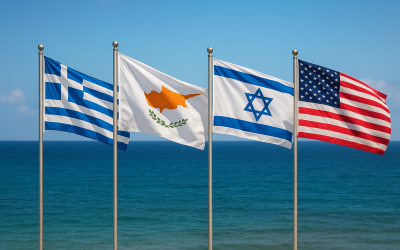
We are going through one of the most turbulent periods in modern history – and this is something that you already know. The October 7th, 2023, attack on Israel by Hamas shaped a new way of thinking in Israel as well as in the neighboring Greece and Cyprus. The unprecedented brutality and the immunity which Hamas members are still enjoying today in Turkey says more about the elephant in the room: The undermining role of cunning factors in a problematic area of the world and the importance of a stable ally in an unstable region.
What have we seen in the last few months? First of all, the US struggle to impose peace and stability in Gaza has now reached a new level. President Trump’s plan for security, reconstruction and gradual transition to a new phase of political governance was approved by the United Nations Security Council on Monday, November 18th. Greece, as a non-permanent member of the Security Council, voted for this plan and was saluted by the US President together with the other members who voted positively. Of course Hamas is against this plan. But at the same time Israel stated its unwavering stance against any future founding of a “Palestinian State.”
As the above develops Turkey is continuously playing the role of the cunning “peacemaker”. The asylum and support that Erdogan’s country offers to the Hamas officials is a great thorn in the side of Israel and the wider region. At the same time, Turkey wants to contribute to peace by sending to Gaza some vehicles of road construction machinery with the Turkish flag on them and also by promoting its preferred guidelines for a Palestinian state next to Israel, something that will never be accepted by the Jewish state.
Cutting to the chase, let’s state the main point. Some international factors believed that in the light of the fragile ceasefire in Gaza, Israeli-Turkish relations would almost immediately know a new beginning. Turkey, which is also playing an influential role in the new Syrian regime, which is led by the ex-jihadist Ahmed Hussein al-Sharaa, is always in need of new fighter jets, preferably the American F-35.
Regarding this situation, we witnessed two interesting events in the last two days.
Firstly, Israel’s ambassador to the United States, Yehiel Leiter, stated that Israel opposes the sale of US F-35 fighter jets to Turkey, citing security concerns, while expressing little objection to a similar potential sale to Saudi Arabia. Although the experienced diplomat acknowledged Turkey’s significance for the NATO alliance, he added that Israel cannot accept Turkish troop involvement in Gaza or Syria, a position, he said, the US respects.
Secondly, the Israeli Deputy Foreign Minister Sharon Haskell praised the importance of the Greek-Israeli relationship. In a briefing for Greek journalists that took place at the main building of the Israeli Foreign Ministry in Jerusalem, Ms. Haskell described Greek-Israeli relations as “extremely important”, especially for the defense sector in which there are feverish processes, with armaments at the forefront.
Let’s not forget that the same applies to the Cypriot-Israeli relationship, with a relentless, mutually beneficial projects and defense support Israel provides to the Republic of Cyprus.
Of course, we know that in international relations, conditions change frequently. Nevertheless, one has to admit that Greece has played a pro-Israel part since 2010 with an unchanged official attitude, and this is well respected by Israel. Standing at a crucial point in the Eastern Mediterranean, Greece and Cyprus, together with their Jewish partner, are forming a powerful energy, defense and financial group supported by the US.
In times of instability, the steadfast stance of those who don’t sit on the fence looking at both sides is doubly valued by those who know how to see the big picture.
And that’s something that counts.