
The Void at the Center: A Key to the Jewish-Western Divide
For millennia, the relationship between Jewish civilization and the broader currents of Western culture has been marked by a persistent, often violent, friction. We’ve analyzed this conflict—historically dubbed the “Jewish problem”—through every conceivable lens: theological, sociological, economic, and political. But what if the core of this enduring schism lies deeper? What if the incompatibility is not a matter of what we believe, but of the very psychological architecture we use to construct reality itself?
A compelling, if provocative, framework from psychoanalytic theory suggests just that. Using the ideas of French psychoanalyst Jacques Lacan, we can understand this conflict as a structural clash between two irreconcilable psychic operating systems. One, the Jewish system, is a civilization of the Symbolic—of language, law, and abstract structure. The other, the dominant force in Western culture, is a civilization of the Imaginary—of images, spectacle, and the fantasy of wholeness. This is not a dispute over dogma; it is a fundamental collision of two different ways of being human.
The Bulwark Against the Image
From its very foundations, Jewish thought can be seen as a sophisticated system designed to subordinate the seductive power of the image to the abstract authority of the word. The Imaginary register is the realm of the ego, of mirrors and fantasies; it’s the logic of “seeing is believing.” Jewish tradition builds a formidable “bulwark” against this.
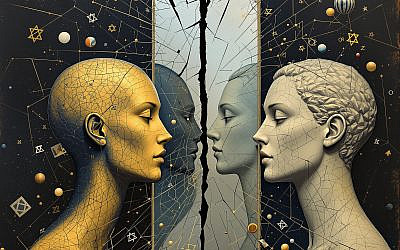
Consider the very technology of the Torah. Biblical Hebrew, as an abjad script composed of consonants, makes passive viewing impossible. To read it, one must be an active participant, already initiated into the Symbolic order of the oral tradition (mesorah) to supply the vowels and unlock its meaning. The text itself insists that meaning is found not in the visible marks, but in the abstract law that governs them.
This principle is expanded into a total life system by Halacha. Jewish law is an all-encompassing “fence” of words and rituals that mediates every moment of existence, interposing the abstract grid of the Symbolic between the individual and the world. The most explicit articulation of this is, of course, the Second Commandment’s absolute prohibition against making a graven image. This is the foundational act of barring the Imaginary, establishing a relationship with the divine that can only exist through language, covenant, and law—the very materials of the Symbolic.
This entire structure is organized around a central, structuring absence. The architectural embodiment of this was the Temple in Jerusalem. The entire complex, a series of boundaries and rituals, led to the Holy of Holies—a chamber that was, crucially, empty. It contained only the Ark of the Covenant, which itself held the shattered fragments of the first tablets, the remnants of a traumatic, unmediated encounter with the divine at Sinai. This “void at the center” is the psychoanalytic key – the system is built not to deny or fill a foundational lack, but to contain it, to structure meaning around it.
The Civilization of the Spectacle
In stark opposition stands the logic of the West, beginning with Rome. The Roman Empire was the ultimate civilization of the Imaginary. Its power was not abstract but spectacular and visible: the military triumph, the gladiatorial arena, the uniformed legion, and the deification of the Emperor as a figure for mass identification.
To the Roman ego, the Jewish system was fundamentally indigestible. An unseen God, an abstract Law, and a Temple whose holiest spot was empty were absurdities. The historian Tacitus famously recorded his shock upon entering the conquered Holy of Holies and finding it vacuum. This emptiness was a profound challenge to a worldview built on visible power. The destruction of the Temple can be read not just as a military act, but as the Imaginary ego of Rome violently trying to annihilate a Symbolic order it could neither assimilate nor comprehend.
Into this conflict, Christianity introduced a revolutionary synthesis. It proposed not the containment of the ultimate trauma—death—but its conquest. The Resurrection is the ultimate “Imaginary event”: a visible, tangible body that triumphs over the formless, terrifying void of death. To a Roman world obsessed with spectacle, this was the most potent image of all. The “Good News” was precisely that the void at the center, which Judaism held open, had now been filled. It was the ultimate fantasy: the fantasy that the traumatic core of existence no longer holds power.
Antisemitism as Existential Terror
This structural analysis offers a chilling but powerful lens through which to understand the unique pathology of antisemitism. If Western culture is an Imaginary fantasy of wholeness built on the repression of a central lack, then the Jew—by virtue of a system that enshrines that very lack—becomes a living, structural reminder of everything the West has tried to forget.
This is where the psychoanalyst Julia Kristeva’s concept of the “abject” becomes terrifyingly relevant. The abject is that which we violently cast out to create a “clean” identity—the corpse, the taboo, the bodily fluid. It horrifies us because it reminds us of the formless, material reality from which we emerged and to which we will return, threatening the borders of our stable sense of self.
By insisting on the abstract Law and the “void” of the Real, the Jew becomes the abject of Western civilization. The antisemite’s hatred, then, is not mere prejudice; it is a primal terror. It is the violent horror of an ego built on the spectacle of wholeness when confronted with the irrefutable evidence of the void. The violence is a desperate, pathological attempt to physically annihilate the reminder of the “corpse” upon which the antisemite’s own fragile identity is built.
Questions for Our Time
This framework is not meant to be a definitive history, but a tool for examination. It reframes the long, often painful, dialogue between Jewish and Western thought not as a simple disagreement over beliefs, but as a deep, structural incompatibility.
It invites us to ask new questions. In our current age, a hyper-Imaginary world saturated with social media, deepfakes, and 24-hour news spectacles, does this structural tension become even more acute? Does this psychoanalytic lens help explain the unique persistence of Jewish identity, a system designed to withstand the pressures of assimilation into image-based cultures?
Understanding this fundamental split—between a reality structured by the Word and one captivated by the Spectacle—may not “solve” the problem, but it offers a more profound way to comprehend the forces that have shaped our history and continue to shape our world. It suggests that the deepest conflicts are not fought over what we see, but over the very void that seeing tries to conceal.