
The Wall That Remembers: Persian Esthers and the Colours of Ibim
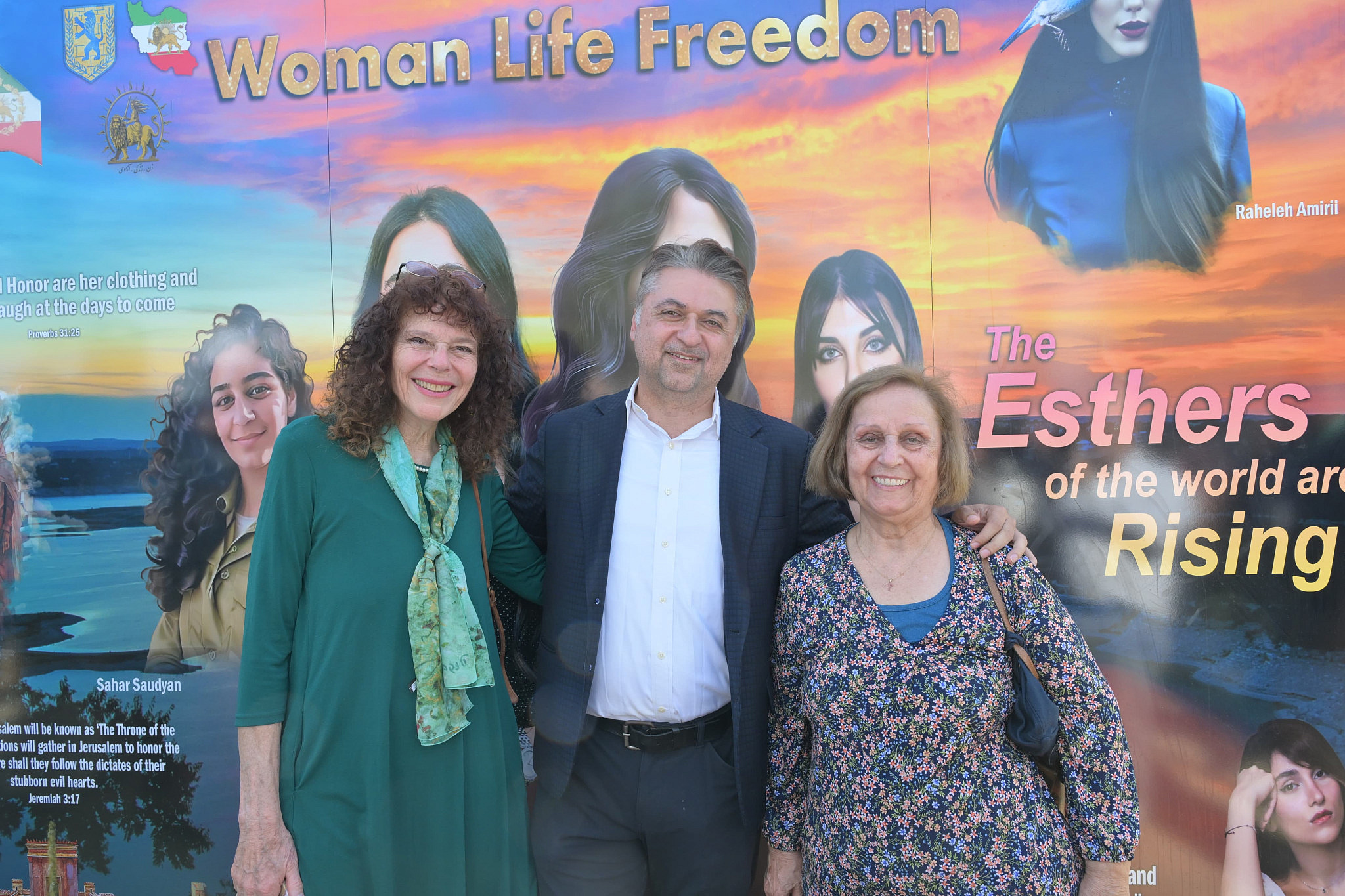
There are places in Israel where even the air seems to remember. Ibim is one of them. A small community a few minutes from the Gaza border, it has lived with the knowledge that on 7 October 2023 the fields and roads around it were transformed into killing grounds: burnt-out cars, unanswered telephones, the sudden, obscene intrusion of death into ordinary domesticity. That sort of experience lingers, like smoke in the curtains. And yet, this week, something as simple and audacious as colour has returned to one of its walls.
On that wall, Iranian-American artist, documentary maker and indefatigable human-rights advocate Hooman Khalili has unveiled his nineteenth Woman Life Freedom mural at the Sha’ar HaNegev Regional Council in Ibim. It is not merely a piece of public art; it is a great, bright, shouting contradiction of the idea that Persians and Jews, Israelis and Iranians, are condemned to permanent enmity. The mural insists upon the opposite: that their destinies are intertwined and that they stand, shoulder to shoulder, against the same darkness.
Across the surface of this Ibim mural, six faces emerge, each a chapter in a single, painful book. There is twenty-two-year-old Shirel Haim Pour, a young Persian Jewish woman whose life was cut short by Hamas on 7 October, her story stitching together the anguish of Persian and Jewish communities in one terrible thread. Beside her appears another Persian Jewish woman, Sahar Saudyán, also murdered that day as she stood in defense of her country. Their presence on a wall that looks towards the very frontier from which terrorists crossed is not accidental. The faces stare back across the landscape from which death came, and they do so without flinching.
Alongside them is the now-iconic visage of Mahsa Amini, the Kurdish-Iranian woman whose killing at the hands of Iran’s so-called morality police in 2022 detonated the Woman Life Freedom uprising and revealed, to anyone still inclined to doubt it, the cruelty at the heart of the Iranian regime. Nearby, we encounter the figure of Yalda Dokhtiare, invoked as a symbol of Persian womanhood itself – its resilience, grace and quietly indomitable beauty – and Raheleh Amirli, who stands in the mural for the artistic and intellectual spirit of Iranian women, that legion of poets, filmmakers, musicians and scholars whose gifts so often go uncredited or are driven underground. Completing this sextet is Parastoo Ahmadi, who speaks for the disappeared, the imprisoned and the nameless: all those women whose “crime” was to imagine that their lives belonged to them.
Khalili has described these figures as “the Esthers of the world who are rising up” – women who, like Queen Esther in ancient Persia, step into danger so that others might live. In Ibim, they are more than portraits. They are an indictment: of regimes, militias and ideologies that feed upon the bodies of women and the terrorizing of civilians, and of those who still seek to romanticize such movements as “resistance”.
The geography of the work is as eloquent as its iconography. This mural does not hang in some safely gentrified quarter of an art-soaked metropolis, where it might be photographed, Instagrammed and then promptly forgotten. It stands within earshot of Gaza, on the skin of a community that knows what sirens sound like at three in the morning. To choose Ibim is to say that solidarity with Iranian women is not a fashionable accessory, but a moral position taken in a place that understands violence all too well.
Across the expanse of color, Khalili has inscribed two verses from Jeremiah. One declares that “at that time Jerusalem shall be called the throne of the Lord” (Jeremiah 3:17); the other promises, startlingly, “I will set My throne in Elam” (Jeremiah 49:38). Elam is ancient Persia. To place these two verses side by side is to assert that the spiritual destinies of Jerusalem and Persia are not parallel lines but converging paths. Any ideology that demands hatred between Jews and Persians is, in that light, not an expression of fidelity to scripture but an act of rebellion against it.
This, of course, is not a wholly new friendship. Khalili’s work is animated by the conviction that the bond between Persians and Jews is as old as the Book of Esther and as contemporary as an unveiled woman on a Tehran street. Queen Esther herself – a Persian Jew – risked everything at the court of a Persian king to save her people from destruction. Cyrus the Great, founder of the Achaemenid Empire, is remembered in Jewish tradition as the ruler who allowed the exiles to return and rebuild the Temple in Jerusalem. When we are told, by the shriller voices of our time, that Iran and Israel are existential enemies, it is worth recalling that their shared story did not begin with the Islamic Republic, and need not end with it.
For the past twenty-one months, Khalili has been quietly, and then not so quietly, daubing that story onto the walls of cities. His Woman Life Freedom movement has given rise to eighteen murals across Israel, from Jerusalem and Tel Aviv to Nazareth and Haifa, as well as four in the United States, with this Ibim installation now taking the count to nineteen. On these walls we have seen Mahsa Amini, schoolgirls poisoned for daring to show their hair, blinded protesters, imprisoned artists such as rapper Toomaj Salehi. Each work becomes a kind of visual embassy of a free Iran – one that stands in friendship with the Jewish people rather than in thrall to those who threaten them. And this is hardly the end of it. New projects are being prepared for Washington, DC, and for American university campuses, and in due course the movement will make its way to New York and California. I have been deeply touched to learn that I am to be included in one of these murals, a small but humbling reminder that this is not merely a Persian or Jewish drama, but fundamentally a human one.
The Ibim mural is also a minor masterpiece of what one might call brushstroke diplomacy. It did not appear by magic. It was brought into being through close collaboration with two senior figures at Israel’s Ministry of Foreign Affairs: Dan Oryan and Ran Natanzon, who have worked persistently to ensure that support for Iranian women is not relegated to the realm of private sympathy, but expressed as public policy. Israel, it bears repeating, is the only country in the Middle East that has consistently and openly stood with the women of Iran in their struggle against theocratic oppression. That is not a slogan; it is a matter of record.
At the unveiling, that message was given an added layer of resonance by the presence of a delegation of Christian leaders, invited by Israel’s Foreign Ministry to witness the event first-hand. There, beneath a wall dedicated to Persian women, Jews and Christians stood together, some in skullcaps, some in clerical collars, offering prayers and blessings. In a region too often caricatured as a seething clash of religions, the sight of these men and women standing shoulder to shoulder, facing a mural of Iranian women and reciting psalms and prayers for their liberation, was quietly revolutionary.
Khalili spoke movingly about that moment. “Faith is the one language the regime can’t censor,” he reflected. “When Jews and Christians pray together for the women of Iran, something breaks in the spiritual architecture of tyranny. The mullahs can control television; they can block the internet; they can terrorize journalists. What they cannot do is stop the prayers rising from Jerusalem, from Ibim, from churches and synagogues all over the world.” Later he observed that radicals “want us to believe religion inevitably divides. But in every city where one of these murals rises, Jews and Christians stand side by side, lifting up the names of Persian women. That is how we answer both antisemitism and anti-Persian hatred – with a faith that refuses to be weaponized.”
For a man whose childhood was marked by the kindness of a Presbyterian church in California, and whose life has been shaped by the quiet tenacity of belief, these are not rhetorical flourishes; they are hard-won convictions. In Khalili’s hands, faith is neither a cudgel nor a partisan badge, but a language of solidarity, a way for people who might otherwise pass one another wordlessly in the street to say, “I will not abandon you.”
One of the things that makes the Woman Life Freedom murals so unsettling to extremist narratives is their stubborn specificity. They do not deal in abstractions – “the masses”, “the resistance”, “the oppressed”. They offer instead individual faces and stories: a soldier on the Gaza border, a young woman stopped in Saqqez for a loose headscarf, a schoolgirl poisoned in her classroom, a musician facing the gallows for his lyrics. Yet together these faces compose a single, unmistakable statement: radicalism, whether draped in the black of the Revolutionary Guards or the green of Hamas, is at war with women’s bodies, with minorities and, frankly, with civilization itself.
What, then, is such a mural doing in a place like Ibim? It is doing what art at its best has always done: reordering our moral attention. It reminds policymakers that behind every statistic there is a human face; it offers ordinary citizens an image to hold in mind when the news cycle reduces the suffering of others to scrolling text; it creates the possibility of unexpected coalitions, between Persians and Israelis, Jews and Christians, secular activists and people of faith, who discover that they are, in fact, on the same side.
Art alone cannot free the women of Iran, just as no single wall painting can heal the wounds of 7 October. But art can change the weather of our thinking; it can make certain kinds of indifference harder to sustain. If the Ibim mural whispers anything to us, it is that the fight against Islamist radicalism and authoritarianism is not some cinematic clash of civilizations, but the patient, sometimes perilous defense of civilization itself, undertaken by people who refuse to be enemies simply because a regime insists that they must be.
So when images of this wall begin to circulate – as they surely will – it would be a pity to treat them merely as attractive content to be admired and then forgotten. They are an invitation. An invitation to support Iranian dissidents and women’s-rights activists whose lives hang in the balance. An invitation to insist that our own governments match their fine words with concrete action in support of the Woman Life Freedom movement. An invitation to build alliances, across confessions and communities, that are difficult for radicals to fracture.
Above all, the mural in Ibim proclaims that Persian and Jewish destinies are bound together, that courage can outstare terror, and that, from Jerusalem to ancient Elam, from the border with Gaza to the streets of Tehran, the last word should not belong to men who glorify death, but to the women who dare to demand – with disarming simplicity – woman, life, freedom.