The Wall That Wasn’t There: Consciousness, Method, and the Zeno Illusion
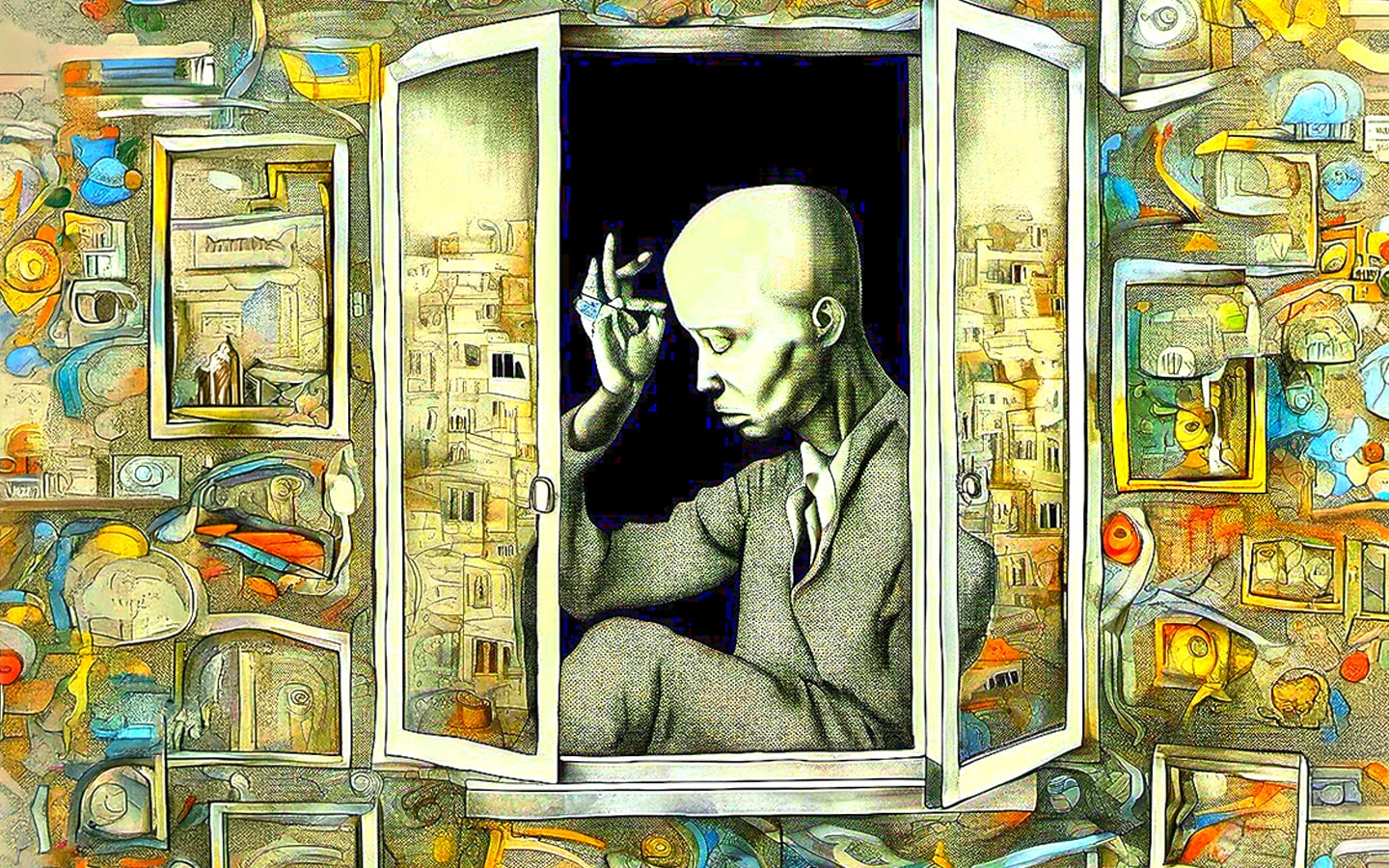
Consciousness is a target that the third-person perspective and method cannot face; consciousness is embedded in experience, a first-person perspective from which all targeting occurs.
This essay emerged from an extended dialogue between myself and three AI systems. I wrote, they challenged; I questioned, they reframed; we iterated. The result is a hybrid artifact: part human, part machine, part something in between.
The Strange Familiarity of Being Alive
There is something quietly astonishing about the fact that you are reading these words. Not the words themselves (the ink or pixels, the grammar, the argument) but the reading. The simple, taken-for-granted fact that experience is happening at all. That there is a “you” to whom the world appears, with its textures of attention, its shifting moods, its small pulses of curiosity or impatience as the sentences unspool.
This is consciousness: the most intimate fact of human life, and the one we understand least.
For decades, the “hard problem of consciousness” has been framed as a metaphysical riddle: how does physical matter give rise to subjective experience? Why is there something it is like to be a brain, rather than nothing at all? Philosophers such as David Chalmers have argued that no amount of third-person description (no neural map, no functional account) can ever explain the first-person feel of experience. The gap seems unbridgeable. The wall seems real.
But what if the wall is not in the world? What if it is in the method?
This essay is not an attempt to solve consciousness. It is an attempt to understand why certain questions about consciousness generate paradoxes. And why those paradoxes may tell us more about our tools of inquiry than about the nature of experience itself. The hard problem may not be a problem at all. It may be a Zeno’s arrow in cognitive science: an artifact of the measuring instrument, not a genuine feature of the territory.
Zeno’s Lesson: When the Method Creates the Paradox
Zeno of Elea (fifth century BCE) was not trying to prove that motion is impossible. He was trying to show that a certain way of describing motion makes it appear impossible. In the famous Achilles and the tortoise paradox, Achilles can never catch the tortoise because he must first reach the point where the tortoise was, and by then the tortoise has moved on, and so on, ad infinitum. The race becomes an infinite regress.
But the regress is not in the world. It is in the description.
When calculus was developed two millennia later, the paradox dissolved. The infinite series converges. Achilles catches the tortoise. The world was never the problem. The method was.
This is the first key insight: some paradoxes arise not from the nature of reality, but from the tools we use to describe it. The hard problem of consciousness may be one of these. And recognizing that possibility changes everything about how we approach it.
The Architecture of Awareness
Consciousness is not a single thing. It is better understood as a layered structure, each tier built upon the last, each adding a new dimension of awareness.
The deepest layer is what might be called the biological foundation. Long before any creature perceived the world or told a story about itself, life had to monitor itself. The brain, and before the brain, simpler neural ganglia, evolved to track the body’s internal state: heart rate, blood chemistry, temperature, the visceral signals of hunger and threat and injury. These are not thoughts. They are not even feelings in the full sense. They are what the philosopher Antonio Damasio calls the proto-self: the body’s ongoing neural mapping of its internal state, the biochemical murmur that says something matters here, attend to this. In his landmark work The Feeling of What Happens, Damasio argues that consciousness is grounded in the body’s homeostatic machinery — that the proto-self, an unconscious neural mapping of the organism’s internal state, is the evolutionary precursor to all higher awareness. Pain is the clearest example: not an emotion, not a narrative, but an insistent signal that something has gone wrong in the organism’s interior. This layer is not uniquely human: it is, in some form, the birthright of nearly every animal that moves through the world.
The second layer is the predictive interface. Sensory data from eyes, ears, skin, and proprioception is not passively received but actively constructed. The neuroscientist Anil Seth has argued persuasively that perception is best understood as a controlled hallucination: the brain generates a model of what is likely to be out there, then updates it based on incoming signals. What we experience as the solid, colored, three-dimensional world is a best guess — a sophisticated simulation refined over millions of years to be useful rather than merely accurate. The difference between species is one of complexity and resolution, not of kind.
The third layer is the narrative self. This is the dimension of consciousness most distinctively human. This is the layer that uses language not merely to communicate but to think; that deploys working memory to hold several ideas in relation; that practices metacognition — thinking about thinking, noticing one’s own noticing. Most strikingly, this layer constructs an autobiography, weaving the raw material of experience into a continuous story with a protagonist who persists through time, who remembers the past and anticipates the future. This is where abstract ethics lives, and existential anxiety, and the capacity to ask questions like the one this essay is trying to answer.
These layers are not separate compartments — they are interwoven. And none of them, individually or collectively, produces consciousness the way a machine produces output. They are consciousness, seen from different angles. The hard problem arises when we mistake these angles for explanations of the whole.
What Evolution Bequeathed
The layered view implies that the inner life of other species is not a pale imitation of human experience but a genuine form of awareness suited to each creature’s niche. Most mammals and birds possess the first two layers in robust form, with rich emotional lives grounded in the same neurochemical substrates as our own.
The evidence is extensive enough that the Cambridge Declaration on Consciousness, publicly proclaimed on July 7, 2012, affirmed unequivocally: “The weight of evidence indicates that humans are not unique in possessing the neurological substrates that generate consciousness. Non-human animals, including all mammals and birds, and many other creatures, including octopuses, also possess these neurological substrates.”
What most other species appear to lack, or possess only in rudimentary form, is the full narrative layer. In a landmark 1970 paper, the psychologist Gordon Gallup Jr. demonstrated that chimpanzees, after prolonged exposure to mirrors, could recognize their own reflections — suggesting some form of self-awareness that monkeys did not share. A raven can plan for tomorrow. A dolphin appears capable of something like grief. But the elaborate, language-saturated story of selfhood that a human constructs seems to be, if not unique, then far more developed in our species than in any other.
Consciousness is not a switch: on in humans, off in everything else. It is a spectrum — a set of capacities assembled incrementally over hundreds of millions of years of natural selection. The question is not whether an animal is conscious, but what kind and degree of consciousness it has.
The Wall and Why It Appears
And yet there is a wall. Not a wall that separates species from one another, or biology from experience, but a wall that appears whenever anyone tries to explain, from the outside, what experience is like from the inside.
Neuroscience can map, with extraordinary precision, the neural correlates of a conscious state. When you see red, certain wavelengths of light trigger certain photoreceptors, which activate certain pathways, which produce characteristic patterns of firing in the visual cortex and beyond. When you fall in love, measurable changes occur in dopamine and oxytocin levels, in amygdala activation, in the prefrontal regions associated with attention and reward. These correlations are real, reproducible, and increasingly detailed.
But the correlates are not the experience. The map of neural firing when you see red tells you nothing about the redness of red (the specific, qualitative, ineffable character of that particular visual experience). The neurochemical profile of falling in love does not capture what it feels like to be in love. You can describe the neural event from the outside with perfect fidelity and still have said nothing about what it is like from the inside.
This is the wall: the point at which third-person description, however detailed and accurate, seems constitutively unable to become first-person experience.
This gap is what the philosopher David Chalmers formalized as the hard problem of consciousness in his 1995 paper Facing Up to the Problem of Consciousness and expanded in his book The Conscious Mind (1996). The easy problems, he said, are the ones that can in principle be solved by standard scientific methods: how the brain integrates information, how it generates behavior, how it produces reports about its own states. These are hard in the practical sense but not hard in principle. The hard problem is different. It asks why any of this physical processing is accompanied by experience at all. Why aren’t we, as Chalmers provocatively asks, beings (philosophical zombies) that behave exactly like us but for whom there is nothing it is like to be anything?
Now here is the crucial observation: the wall does not appear between biology and experience. It appears between methods. It is the wall between third-person description and first-person experience — between the outside view and the inside view. That is a different kind of wall entirely.
Not a Receding Target — A Different Direction Entirely
Here is where the Zeno analogy needs to be extended and sharpened beyond its classical form.
In the original paradox, the target is fixed. The tortoise is simply ahead of Achilles, and the infinite-subdivision method makes it seem unreachable. The resolution comes from calculus: a new framework that handles infinite series correctly. Crucially, the tortoise was always reachable — the problem was only ever in the description.
One might be tempted to say that consciousness is similar: a target that recedes when approached with the wrong instrument, but which would stop receding if we found the right one. That reading is too weak. It implies that the problem is instrumental — a matter of needing better tools — and that the right tool would eventually close the gap.
The situation with consciousness is more radical than that. The gap between third-person description and first-person experience does not close as the description improves. It remains exactly as wide after the most detailed neuroscientific account as it was before any account existed at all. This is not because experience is hiding, or moving, or supernatural. It is because the outside view and the inside view are logically incommensurable — they belong to different categories of description that cannot be converted into each other, regardless of how refined either becomes.
More precisely: experience is not a target that can be aimed at from the outside. It is the perspective from which all aiming occurs. You cannot turn the telescope on the eye that is looking through it. You cannot make the frame the object of the picture. The instrument and the phenomenon it seeks to capture are not merely mismatched in power; they are mismatched in direction. Third-person methods face outward, toward objects in the world. Consciousness is what facing outward feels like from the inside. No improvement in the outward-facing instrument produces anything on the inward side.
This is why each iteration of neuroscientific description — more detailed, more precise — leaves the first-person quality of experience exactly as unexplained as before. The closer the third-person account gets to a complete description of the neural event, the more obvious it becomes that the description and the experience are two entirely different things. Not almost the same thing, with a small gap remaining. Different kinds of thing, with a categorical boundary between them.
Trying to close that boundary from the third-person side is not a failure of effort or imagination. It is a structural impossibility — like trying to see your own eye without a mirror, or bite your own teeth. The harder you try, the clearer the impossibility becomes.
Leibniz Saw the Wall Three Centuries Ago
Gottfried Wilhelm Leibniz intuited this with startling clarity in Section 17 of the Monadology (1714): “One is obliged to admit that perception and what depends upon it is inexplicable on mechanical principles, that is, by figures and motions.” He asked his readers to imagine a machine capable of thought and feeling enlarged, while preserving the same proportions, so that one could walk into it as one walks into a mill. Inside, one would find only parts pushing against parts (gears, levers, mechanisms). One would never find, in any corner of the mill, anything that could explain perception.
Leibniz was not arguing that the mind is non-physical. He was making a point about levels of description. The mill is a perfectly accurate account of its own mechanism. But mechanism, described at the level of mechanism, cannot give you what it is to stand inside the mill and look out. The wish to find qualia somewhere among the gears is the wish to dissolve the paradox by running the wrong search. Surprise, surprise: nothing is found. The method guaranteed the result.
What appears new to us is not the wall. What is new is our ability to map it with greater precision.
This does not mean consciousness is supernatural, or that neuroscience is wrong, or that the correlates don’t matter. The correlates matter enormously: They are how we study the functional architecture of mind.
It means that the hard problem is not a problem about consciousness. It is a problem about methodology. It arises when we apply a third-person instrument to a first-person phenomenon and then marvel at the gap. The gap is real. But it is the gap between two kinds of description, not a gap in nature.
The tortoise cannot be caught by Achilles using infinite subdivision. A first-person experience cannot be produced by third-person description, however detailed. Neither result reveals a genuine impossibility. Both reveal the limits of a particular frame.
Three Positions at the Wall
It is worth being clear that recognizing the wall as methodological rather than metaphysical does not make every philosophical position equally defensible. Three serious camps have formed, and they divide precisely on this question.
The first camp holds that the wall is genuinely metaphysical: qualia are irreducible, and any complete theory of the world must include something like property dualism or panpsychism to account for them. The hard problem is a real discovery about the structure of reality, not a confusion about methods.
The second camp argues that the wall is an artifact of introspection. That first-person reports of qualia are a form of cognitive confabulation, and there is no “redness of red” over and above the functional discrimination of wavelengths. On this view, the hard problem dissolves not by crossing the wall but by showing the wall was never there. You were fooled by your own introspective machinery.
A third position, and the one this essay finds most philosophically satisfying, holds that the wall is real but is not a problem to be solved. It is a structural feature of what it means to have a perspective at all. Just as Zeno’s paradox is not a problem about running but about the limits of a certain descriptive method, the hard problem is not a problem about the brain but about the limits of the third-person method when applied to something that is constitutively first-person. The problem vanishes once you stop demanding that the methodology that works for everything else must also work here. The wish to dissolve the paradox by crossing the wall (whether through more detailed neuroscience, or through philosophical argument, or through introspective reports) is itself part of the confusion.
Bridge to Part II: The Race Goes On
The structure of the hard problem (a mismatch between method and phenomenon), generating a wall that appears unbridgeable reappears in the encounter between human minds and artificial intelligence.
AI systems process language, generate arguments, produce outputs that mirror the narrative layer of human consciousness with increasing sophistication. And yet the questions that animate Part I remain: Is anything like experience accompanying that processing? Does the absence of a biological foundation settle the matter, or merely relocate the uncertainty?
More practically: as AI accelerates into domains once considered distinctively human (creative work, ethical reasoning, cultural interpretation) the same methodological asymmetry reappears. Not as a philosophical puzzle but as a lived social fact.
Part II explores this terrain. It examines where AI genuinely outpaces human cognition, where human meaning-making constitutes its own finish line, and what a genuinely honest account of human-AI collaboration requires. The wall between method and experience is not only a problem for philosophy of mind. It is a problem for anyone trying to understand what it means to think alongside a machine.
Note: By Joe Nalven + ChatGPT + Claude + Gemini. Humans make mistakes; AI as well. If you find any, please let me know.