

The War on Dialogue
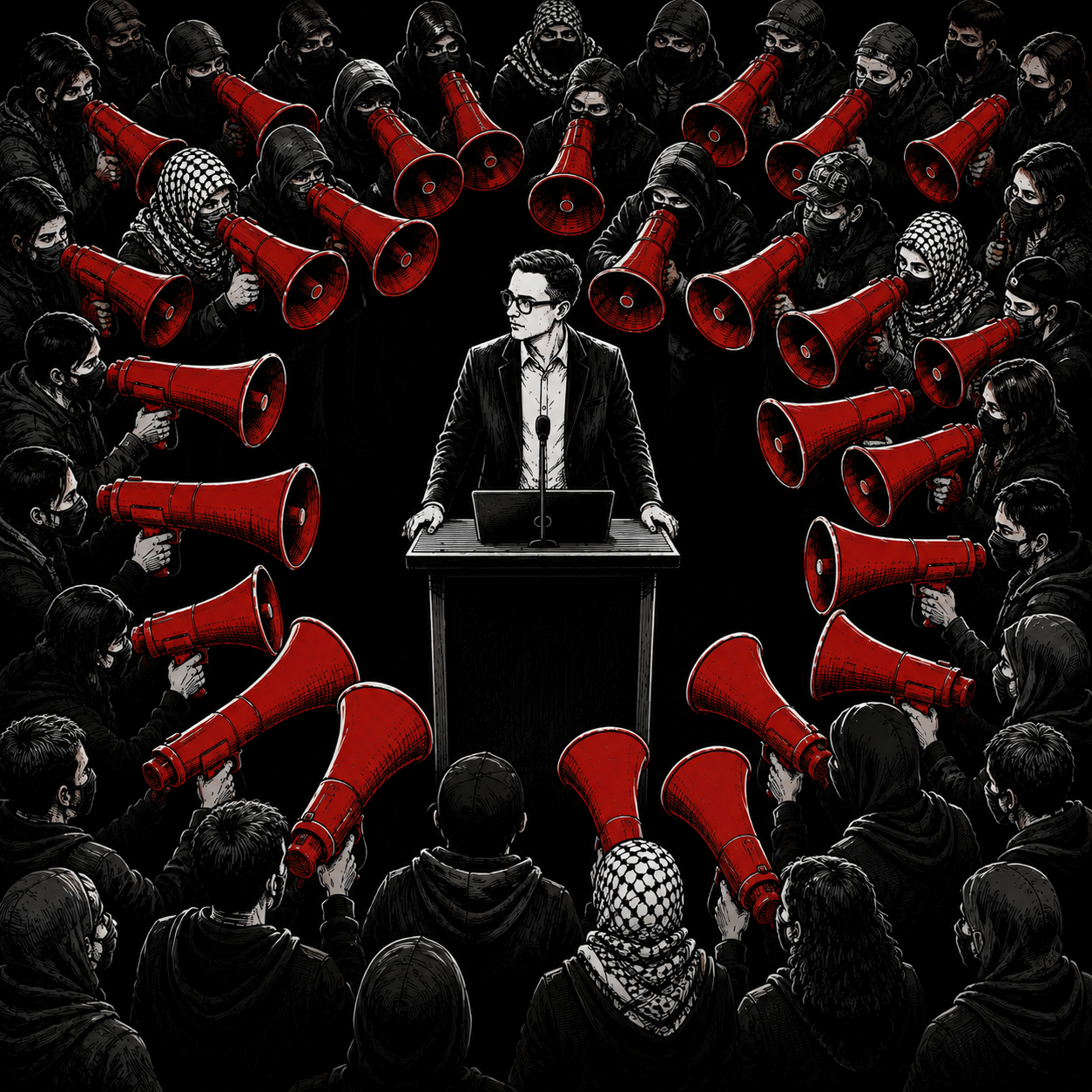
Minutes into his lecture, the physicist’s voice disappeared beneath a wall of chants, shouts, and obscenities. Though he repeatedly invited the protestors to stay, listen, and engage with him afterward, they refused. They had not come to listen. They had not even come for the lecture itself. It was February 2024, and they were there for one thing and one thing only: to prevent an Israeli from being heard. When campus police said they could not remove the disruptors, university officials removed the lecturer instead. The lecture ended. The protestors’ goal had been achieved.
The irony was almost too perfect to be true. The visiting professor had traveled to the University of Nevada, Las Vegas, to discuss black holes—regions of space so dense that nothing, not even light, can escape their gravitational pull. Instead, the lecture was swallowed by an ideology that, like the phenomenon he had come to explain, consumed every possibility of dialogue. No light—not even the faintest glimmer of understanding—was allowed to escape.
What happened in Las Vegas was not an isolated incident. Instead, it was the clearest expression of a tactic that had been spreading across North American campuses for years. Long before protestors turned a lecture on physics into a referendum on the Jewish homeland, students had learned that they did not need to defeat ideas they opposed. They needed only to ensure those ideas were never heard.
In 2018, protestors at the City University of New York School of Law disrupted a constitutional-law professor delivering a lecture on free speech. In 2019, protestors at the University of Pennsylvania shut down a panel featuring a former acting ICE director. In 2020, Harvard Law School students disrupted a recruiting event hosted by a law firm that represented ExxonMobil. In 2021, protestors at the Massachusetts Institute of Technology pressured the university to cancel a distinguished geophysicist’s lecture because of his unrelated views on academic hiring. In 2022, protestors at Yale Law School drowned out a bipartisan discussion on civil liberties with shouting, pounding, and personal insults. With dialogue giving way to disruption, students learned that winning arguments no longer mattered. The loudest voices no longer won because they were right. They won because no one else could be heard.
Nowhere, however, did this tactic become more pervasive than in the months following the October 7 Massacre. Merging with what I call American Intellectual Antisemitism—an ideology that recasts Jewish peoplehood as supremacy, treats Jewish self-determination as uniquely illegitimate, and elevates hostility toward Jewish collective existence into a moral virtue—this preexisting culture of campus illiberalism gave rise to a mass movement committed not to persuasion, but to silencing. Their goal was never to change minds. It was to make sure no one else’s mind could be changed.
Like a black hole consuming everything drawn into its orbit, protestors targeted not merely supporters of the Israeli government, but anyone who recognized Israel’s right to exist. Rejecting not merely a particular Israeli policy but the very legitimacy of Jewish self-determination, they embraced the doctrine of anti-normalization—the belief that engaging with anyone who recognizes Israel’s legitimacy normalizes what they regard as an illegitimate state. With debate treated as betrayal and dialogue as surrender, their objective was to render belief in Jewish self-determination so morally corrupt that it could no longer be openly discussed, publicly defended, or even respectfully debated. Anti-normalization became the mechanism through which American Intellectual Antisemitism enforced ideological conformity. The logic was simple: if reality refuses to cooperate, silence reality.
Not even the Palestinian voices the movement claimed to champion were spared. Rather, adherents of American Intellectual Antisemitism targeted Arab, Muslim, and Palestinian advocates who condemned violence and defended coexistence, treating moderation itself as morally suspect. In their moral universe, peacemaking was not a virtue but evidence of disloyalty. Moderation, in turn, became more threatening than extremism because it left room for doubt—and doubt is fatal to ideological certainty.
Consider, for example, Bassem Eid, a Palestinian journalist and human-rights advocate who has spent decades criticizing Hamas’s terrorism, exposing corruption within the Palestinian Authority, and challenging the intellectual dishonesty, political extremism, and destructive consequences of the Boycott, Divestment, and Sanctions movement. After the University of California, Riverside, moved his lecture off campus, protestors from the school’s chapter of Students for Justice in Palestine followed him to the relocated venue, determined to silence one of the most consistently outspoken Palestinian advocates for human rights. His Palestinian identity mattered less than his refusal to repeat the approved ideological script.
Then there was Dalia Ziada, an Egyptian Muslim writer who was forced to flee her home country after condemning Hamas for the October 7 Massacre. Invited to the University of Maryland to participate in a panel dedicated to respectful, future-oriented dialogue, Ziada became the target of a sustained and coordinated campaign to cancel the event. Student protestors circulated petitions, gathered outside the venue, attempted to block attendees from entering, and shouted in an effort to drown out the discussion. Driven from Egypt for denouncing Hamas’s atrocities, she now found herself facing another campaign of ideological intimidation—this time on an American university campus—for refusing to abandon that same moral conviction.
Yet perhaps most revealing was the protestors’ treatment of Ahmed Fouad Alkhatib, a Palestinian-American peace advocate and the author of Hamas and Its Two Million Hostages, an indictment of Hamas and its violent ideology. Despite losing more than thirty members of his extended family in the Israel-Hamas war, Alkhatib continued to advocate for a future in which both Israelis and Palestinians could exercise their right to self-determination. For that, activists who had never set foot in Gaza denounced him as a traitor and repeatedly disrupted his lectures on American college campuses. Refusing to abandon dialogue or reject Israeli humanity, his offense was never that he ignored Palestinian suffering. It was that even unimaginable personal loss had failed to radicalize him against Israel’s existence. Within the distorted moral universe of American Intellectual Antisemitism, his refusal to hate was treated as a greater offense than Hamas’s willingness to murder.
Together, these cases revealed something essential about the ideology of American Intellectual Antisemitism. Anyone who challenged the movement’s worldview—even Palestinians, Arabs, and Muslims speaking from personal experience—was no longer treated as a partner in dialogue, but an obstacle to be removed. In the war against dialogue, moderation was not collateral damage. It was one of the movement’s primary targets.
This strategy succeeded not only because protestors embraced it, but because university administrators repeatedly rewarded it. By refusing to discipline protestors who disrupted events, administrators taught students that ideological extremism carried greater influence on campus than respectful dialogue. Each canceled event, relocated lecture, or removed speaker—typically justified by vague references to “security concerns”—reinforced the same lesson: disruption works. The university was teaching political effectiveness, not free inquiry. With disruption becoming leverage, intimidation becoming strategy, and censorship becoming the path to ideological victory, too many universities taught students how to suppress, rather than confront, opposing ideas.
Universities often describe themselves as marketplaces of ideas. But markets function only when ideas are free to compete with each other. Just as economic markets use competition to reveal the value of goods, intellectual markets use competition—through criticism, debate, and the constant challenge of competing perspectives—to test the strength of ideas. By exposing weak arguments and refining stronger ones, that process brings us ever closer to the truth. Universities cannot live up to their own professed mottos—from Harvard’s Veritas and Yale’s Lux et Veritas to Northwestern’s Quaecumque sunt vera, Johns Hopkins’ Veritas vos liberabit, and Brandeis’ Emet—unless they permit genuine intellectual competition.
Such competition requires dialogue, and dialogue requires the willingness to hear ideas we reject. Once a university teaches students that preventing a conversation is morally superior to having one, it ceases to function as a university at all. When dialogue is suppressed, truth is not protected. It is prevented from emerging.
It is no accident that American Intellectual Antisemitism chose the university as one of its first battlegrounds. Control what may be discussed in the classroom, and you eventually shape the boundaries of public life beyond it. Every war on dialogue is ultimately a war against truth. And when truth falls, freedom soon follows.
*
American Intellectual Antisemitism: The Anti-Jewish Movement Tearing Through Our Universities (Wicked Son/Post Hill Press) is now available for pre-order.