Host, Echoes of Jewish History Podcast
The War Over Israel Is Also a War Over Truth
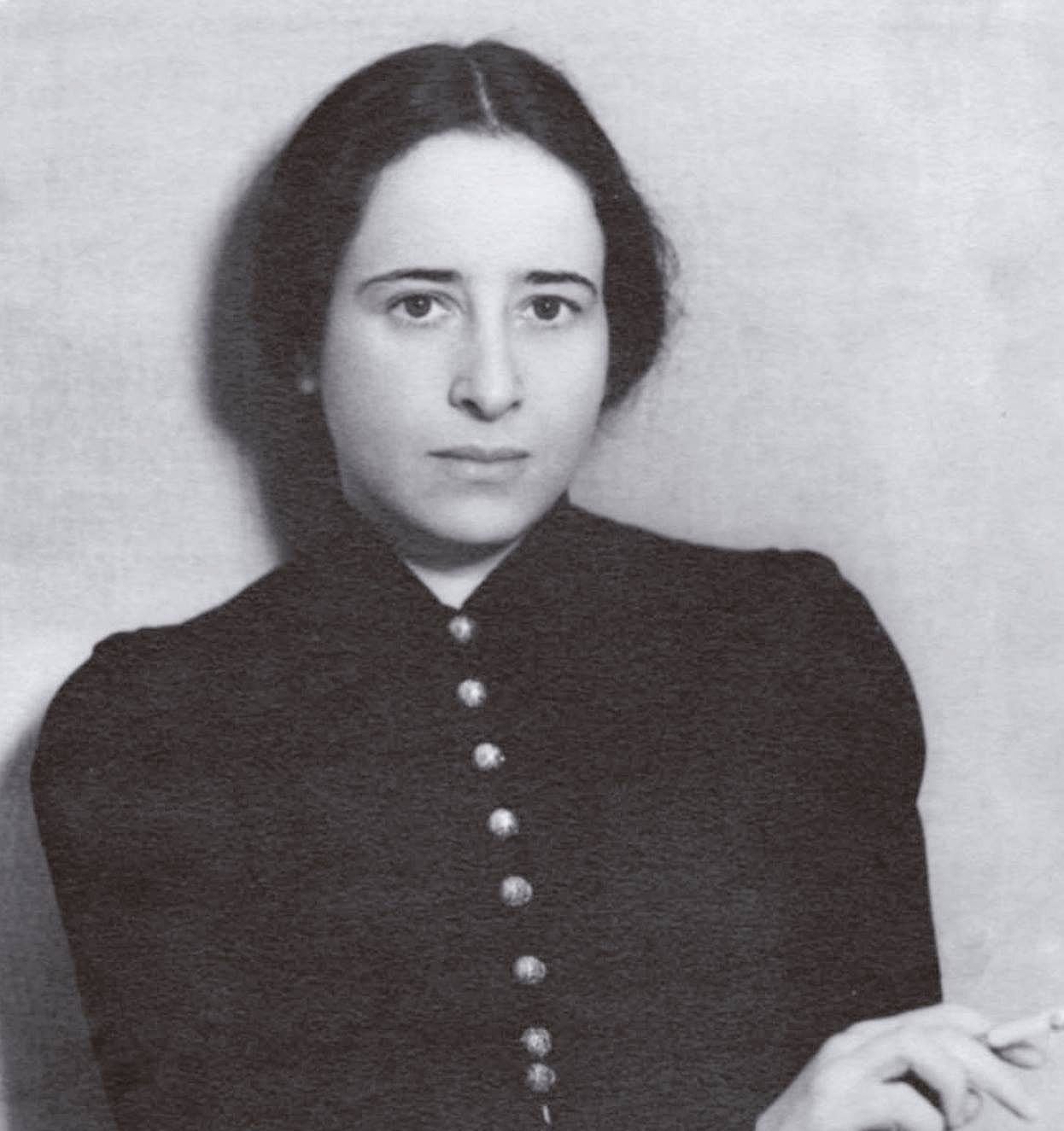
Hannah Arendt in 1933. Source: Wikimedia Commons
Every civilization depends upon an invisible foundation. It is not military strength, economic prosperity, or technological innovation. Those are expressions of a civilization’s vitality, not its source. Beneath them lies something far more fundamental: a shared confidence that reality exists independently of ideology and that facts, however inconvenient, deserve allegiance before political loyalty.
When that confidence erodes, societies do not merely become polarized. They lose the capacity for self-government.
This was the central warning of Hannah Arendt, one of the twentieth century’s most penetrating political philosophers. Having witnessed the collapse of European civilization and the rise of totalitarianism, Arendt understood that the greatest danger to a free society was not simply propaganda or political deception. Governments have always lied. Political movements have always manipulated language. Her deeper concern was the gradual destruction of the distinction between truth and falsehood itself.
In her essay Truth and Politics, Arendt argued that factual truth is uniquely vulnerable because it depends upon institutions and citizens willing to defend it. Facts cannot defend themselves. They require historians committed to evidence, journalists committed to verification, courts committed to testimony, and ordinary citizens willing to distinguish what happened from what they wish had happened. Once those institutions abandon that responsibility, public life begins to drift away from reality and toward ideology.
Arendt’s insight has become unsettlingly relevant in the twenty-first century. We inhabit an information ecosystem in which every event is interpreted before it is investigated, every image is detached from its context within moments of appearing online, and every tragedy becomes an opportunity for competing narratives seeking emotional dominance rather than factual clarity. The danger is not merely misinformation. It is the slow replacement of evidence with identity. Citizens no longer ask whether a claim is true; they ask whether it reinforces the worldview of their political community.
This is the point at which the conversation about Israel transcends Israel itself.
Criticism of governments is indispensable to democratic life, and Israel, like every democracy, must remain open to scrutiny. But criticism and factual distortion are fundamentally different enterprises. When incomplete accounts become accepted history, when emotionally compelling images are allowed to substitute for careful investigation, when context disappears because it complicates a preferred narrative, and when corrections receive only a fraction of the attention devoted to the original falsehood, the damage extends far beyond Israel’s international reputation.
The standards by which democratic societies establish truth begin to erode.
Israel has become one of the defining case studies of our information age because it exposes a deeper question confronting every liberal democracy: do we still believe that evidence should take precedence over ideology? If one conflict can be understood primarily through selective facts and inconsistent evidentiary standards, then no future conflict will remain immune from the same temptation. The mechanisms that distort reality against one nation inevitably become available for use against another. The target may change; the method endures.
This is precisely the danger Arendt foresaw. She observed that the ultimate triumph of propaganda is not convincing everyone to believe a particular falsehood. It is persuading people that objective truth no longer exists, leaving them cynical toward every institution and every source of authority. Once citizens cease believing that facts are knowable, public trust dissolves. Journalism becomes indistinguishable from activism. Universities are viewed through partisan suspicion. International organizations lose their credibility. Democratic deliberation gives way to tribal affirmation.
The consequences are profound because democracy is sustained not simply by elections or constitutions but by what Arendt called a common world: a shared reality within which disagreement remains possible. Citizens may hold radically different political convictions while still agreeing on the basic facts from which those disagreements begin. Without that common foundation, politics ceases to be an exchange of arguments and becomes a contest of competing mythologies.
This is why the debate surrounding Israel matters even to those with no personal connection to the Jewish state. The question is not whether Israel should be criticized. It should. Every democracy should. The question is whether criticism remains anchored in the discipline of evidence or becomes untethered from factual reality. Once the latter becomes acceptable, the casualty is no longer one nation or one conflict. It is the public’s confidence that objective truth retains authority over political passion.
The Jewish historical experience lends this warning particular urgency. Ours is a people whose history has repeatedly been shaped by myths presented as facts, accusations repeated until they acquired the appearance of truth, and narratives that justified exclusion, persecution, and ultimately extermination. The lesson of Jewish history is therefore not merely that lies are dangerous. It is that societies willing to subordinate truth to ideology eventually endanger everyone, including themselves.
The debate before us is larger than Israel. It is larger than the Middle East. It is nothing less than a civilizational question: whether free societies still possess the moral discipline to acknowledge facts that challenge their preferred narratives.
If they do not, Israel will not be the final casualty.
The casualty will be reality itself.
Related Topics
Related Posts