The War Within Islam.
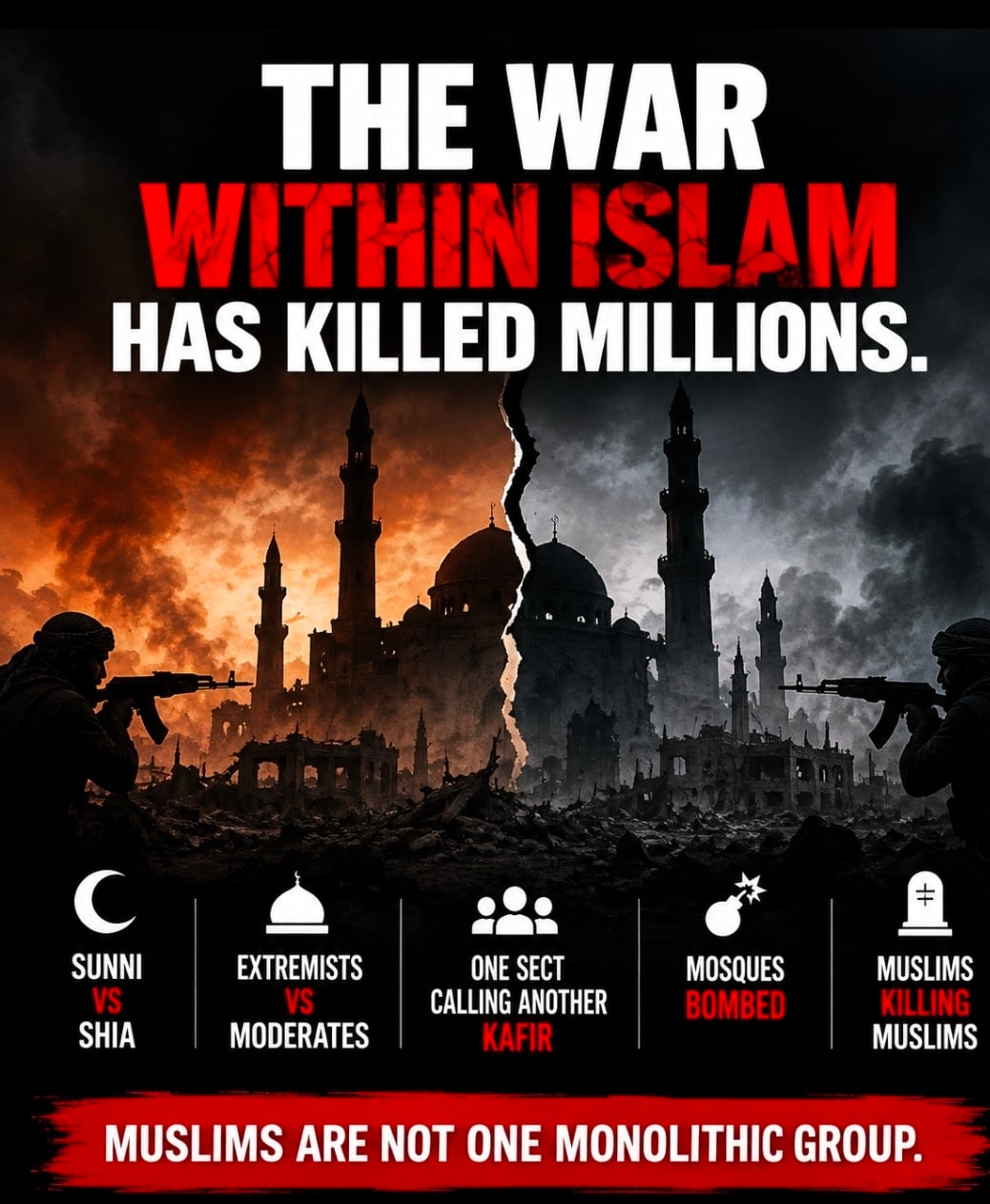
The War Within Islam: Muslims Must Confront the Bloodshed in Our Own House
People in the West frequently make a fundamental mistake when they speak about Islam: they talk about “the Muslims” as though nearly two billion human beings constitute one religious, political and ideological bloc.
We do not.
The Muslim world contains deep divisions of theology, sect, jurisprudence, culture, ethnicity and politics. And some of those divisions have been soaked in blood.
As a Muslim, I believe we need the courage to say something uncomfortable: before we blame every tragedy in Muslim societies on outsiders, colonialism, Israel, America or the West, we must confront the wars we have fought against one another.
Muslims have killed Muslims on a catastrophic scale.
The roots of Islam’s most famous sectarian division reach almost to the beginning of Muslim history. After the death of the Prophet Muhammad in 632, disagreement developed over political and religious succession. Those disputes eventually hardened into the Sunni-Shia divide.
Then came Karbala.
In 680, Husayn ibn Ali, grandson of the Prophet Muhammad, was killed with members of his small party by forces of the Umayyad ruler Yazid near Karbala in present-day Iraq. For Shia Muslims, his death became one of the defining tragedies of Islamic history and remains central to religious memory more than thirteen centuries later.
But history did not remain in the seventh century.
Over time, struggles for political power became intertwined with competing interpretations of Islam. Empires used sectarian identity. Rulers used religious scholars. Religious scholars legitimized rulers. Political conflicts were recast as battles between truth and heresy.
The names changed. The pattern survived.
Today, one of the most destructive manifestations of that mentality is takfir — declaring another Muslim to be an unbeliever.
Once a person is no longer considered a fellow Muslim, the psychological barrier against persecuting or killing that person becomes dangerously easier to cross.
We have seen the consequences.
In Iraq, the destruction of Saddam Hussein’s regime in 2003 was followed by an increasingly vicious struggle involving Sunni insurgents, al-Qaeda-linked jihadists, Shia militias, political factions and foreign powers. The 2006 bombing of the al-Askari shrine in Samarra helped trigger an especially brutal cycle of Sunni-Shia killing. The Council on Foreign Relations describes Iraq’s conflict as one in which sectarian identity became deeply entangled with struggles over political power and the collapse of state authority.
Then ISIS arrived.
ISIS did not reserve its brutality for Christians, Yazidis or Westerners. It murdered Muslims on an enormous scale as well. Shias were branded apostates. Sunnis who rejected ISIS authority could also be executed as traitors or unbelievers. Even al-Qaeda eventually regarded ISIS as extraordinarily extreme.
Syria provides another warning.
What began in 2011 as protests against Bashar al-Assad’s government evolved into an extraordinarily complex civil war involving dictatorship, revolution, jihadism, regional competition, foreign military intervention and sectarian mobilization. Sunni extremist organizations used anti-Shia rhetoric, while Iran and Hezbollah mobilized on the other side of the conflict. Sectarian identity did not create every cause of the Syrian war, but it became one of the forces that intensified it.
Yemen presents another variation. Its war cannot honestly be reduced to “Sunni versus Shia.” It involves state collapse, regional rivalry, tribal politics and outside intervention. Yet the confrontation involving the Zaydi Shia Houthi movement, Sunni Islamist forces, Saudi Arabia, Iran and other actors has repeatedly acquired a sectarian dimension.
And then there is my birthplace, Pakistan.
I know this problem personally because Pakistan has lived with the poison of sectarianism for decades.
Shias, including Hazara Shias, have been murdered because of their identity. In 2013 alone, Human Rights Watch documented more than 400 Shias killed in targeted attacks in Pakistan, including devastating attacks against the Hazara community in Quetta.
Ahmadis face another form of exclusion. Pakistan’s legal system itself restricts Ahmadis from identifying publicly as Muslims, while extremist organizations have targeted their communities and places of worship. Human Rights Watch documented continued killings and persecution of Ahmadis in 2025.
This is where Western observers need to understand something important.
There is no single “Muslim community.”
There are Muslim communities.
A Sunni cleric in Saudi Arabia does not automatically speak for a Shia family in Iraq. A Pakistani Deobandi does not necessarily share the theology of a Barelvi. A Sufi, Salafi, secular Muslim, Islamist, Ahmadi, Ibadi and culturally Muslim immigrant may have profoundly different understandings of religion and society.
Even within Sunni and Shia Islam there are enormous differences.
Pew Research Center demonstrated just how deep those differences can become. In a major international study, substantial numbers of Sunnis in several Middle Eastern and North African countries did not even recognize Shias as fellow Muslims. Yet in other regions, large numbers of Muslims simply described themselves as “just Muslim,” demonstrating that sectarian hostility is neither universal nor inevitable.
That distinction matters.
I am not arguing that Islam commands Muslims to kill one another.
It does not.
Nor am I arguing that Sunnis and Shias have spent fourteen centuries permanently at war. They have often lived alongside one another, prayed together, traded together and intermarried. CFR notes this long history of coexistence as well.
My argument is about what human beings have done with religious identity.
When political ambition, authoritarianism and extremism combine with the conviction that God belongs exclusively to our faction, theology can become ammunition.
And Muslims need to confront this without excuses.
Across modern conflicts in Iraq, Syria, Afghanistan, Yemen, Pakistan and elsewhere, millions have died. It would be intellectually dishonest to label every one of those deaths a “sectarian killing.” These wars had multiple causes.
But it would be equally dishonest to pretend that sectarian hatred, takfir and competing claims to religious legitimacy did not help fuel enormous amounts of that bloodshed.
Muslims frequently demand that non-Muslims distinguish ordinary Muslims from extremists.
That is a legitimate demand.
But we must apply the same intellectual honesty inside our own house.
We must distinguish faith from fanaticism.
We must reject the cleric who casually declares another Muslim kafir.
We must reject the militant who believes killing another sect brings him closer to God.
We must reject governments that manipulate sectarian identity for political power.
And we must stop pretending that every wound in the Muslim world was inflicted by somebody else.
The first step toward reform is not humiliation.
It is honesty.
The victims buried in Baghdad, Damascus, Quetta, Kabul and countless other places deserve that honesty.
Muslims are not one monolithic group.
But there is one principle around which every Muslim should be able to unite:
No Muslim should have to die because another Muslim decided that his version of Islam was the only one God permitted to exist.
— Mansoor Laghari