
Singing the song of self, peoplehood, and humanity—where every life still matters in the chorus of war.
The warning came after the explosion

Galina stopped speaking.
We were in the middle of our weekly Zoom call with Ella and Galina, my colleagues in Ukraine, when a missile exploded in Galina’s neighborhood.
The explosion was loud. There were several aftershocks.
There had been no warning.
And then, after the explosion, the air raid alert sounded.
After the explosion.
Galina was visibly startled. She explained that they were no longer receiving the advance warnings they had relied upon. She believes this is connected to recent restrictions affecting satellite communications. I cannot independently establish why the warning failed that day.
But I know what I witnessed. An explosion, a colleague startled by its force, and a warning that came too late.
To say I was horrified and heartbroken is an understatement.
I keep thinking about how close I might have come to watching people I know, respect, and care deeply about be killed in front of me.
There are no words for that.
My grandmother would have called this a shande—a disgrace.
And I can hear her saying it.
Because there are moments when what is happening goes beyond politics. When the question is not which side of a political debate we are on, but what we are willing to accept happening to other human beings.
This goes beyond politics
In recent weeks, the Trump administration has made decisions affecting Russian energy sanctions while serious questions have emerged about Ukraine’s access to American intelligence, military satellite communications, and the air-defense missiles needed to protect its cities.
President Zelenskyy has warned about the consequences of these developments. American officials dispute reports that intelligence sharing was suspended, and the circumstances surrounding communications restrictions remain contested.
I understand that people disagree about foreign policy, sanctions, military assistance, and the path toward peace.
But I cannot separate these discussions from what I witnessed on my computer screen.
When a missile explodes in a civilian neighborhood before people receive a warning, this is not an abstract debate about foreign policy. It is a matter of human lives.
Whatever our political differences, we have a moral responsibility to ask what happens to civilians when the systems they depend upon for protection become less reliable.
Those questions deserve answers.
And the people whose lives hang in the balance deserve better.
What the headlines cannot tell you
Nearly five years into Russia’s full-scale invasion, Ukraine’s cities are being worn down by repeated attacks.
Power stations are destroyed, repaired, and attacked again. Water and sewage systems are threatened. Public transportation is disrupted. Schools, hospitals, playgrounds, and apartment buildings are no longer places where people can simply assume they are safe.
Each repair is made to infrastructure already weakened by years of destruction. Each new attack makes recovery more difficult.
In some communities, daily life increasingly resembles a siege. Not necessarily because the city is surrounded, but because the systems that make ordinary life possible are being steadily damaged.
And another winter is approaching.
When you read that thousands of people are without electricity, I think about an older woman living several floors above the ground who cannot use the elevator or carry water up the stairs.
When you read about another night of missile and drone attacks, I think about the older adults who cannot reach a shelter, or who are simply too exhausted to try again.
And now, when I read about gaps in air raid warnings, I see Galina’s face.
I hear the explosion.
I remember the warning that came afterward.
The headlines tell us what happened. They rarely tell us what it means to live with what happened.
And still, they show up
Ella, Galina, and our coordinators are not watching this war from a distance.
They live with the same sirens, blackouts, water shortages, and sleepless nights as the older adults they serve.
They worry about their own families. They work around power outages and disrupted communications. They make difficult decisions about when it is safe to travel.
And still, they show up.
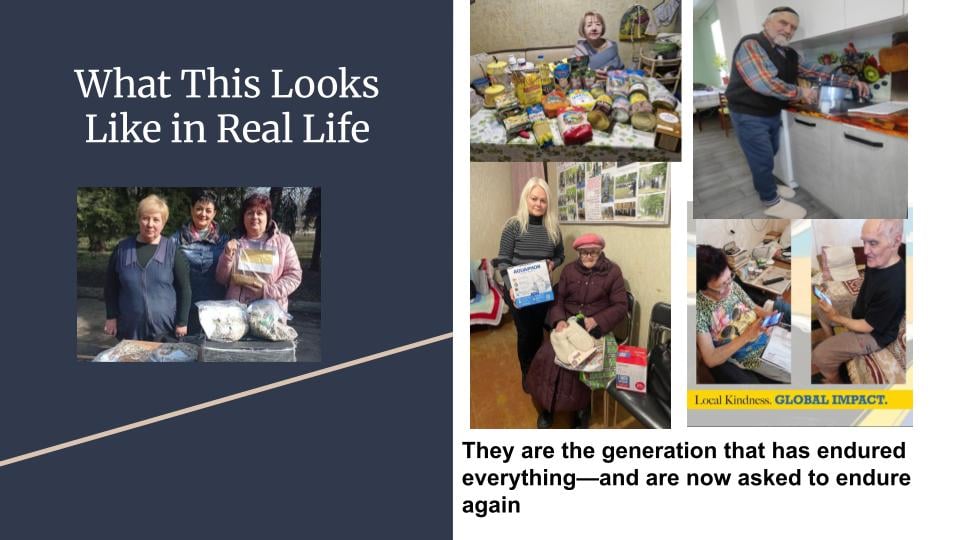
They check on older adults living alone. They arrange medical consultations, deliver medications, identify urgent needs, and find ways to help when other assistance is unavailable or insufficient.
We speak so often about the extraordinary resilience of Ukrainians.
But I worry that resilience has become something the rest of the world simply expects of them.
An 85-year-old should not have to demonstrate extraordinary courage to obtain medication, find clean water, or stay warm.
Our coordinators should not have to be heroes every day.
They deserve safety, security, and the ordinary comforts of life that so many of us take for granted.
What we can still change
We cannot stop the missiles. We cannot restore Ukraine’s power grid or determine the decisions being made in Washington and Moscow.
But we can change what it means for someone to live through this war.
We can relieve some of the fear and anxiety. Provide warmth, food, medication, and medical care. Help someone prepare for another winter of blackouts and uncertainty.
And perhaps just as importantly, we can make sure someone doesn’t feel forgotten.
Many of the older adults we serve are isolated, physically and socially. Some cannot leave their apartments. Others have been displaced, losing their homes, their communities, and the people they once depended upon.
Some are eligible for assistance that never quite meets their needs. Others are simply overlooked.
They fall into the space between the help that is available and what it actually takes to live with dignity.
We call that the aid gap.
You help us bridge it.
When a telehealth consultation identifies a medical problem, your support helps us make sure that treatment doesn’t end with a diagnosis. When an unexpected emergency arises, you give our coordinators the flexibility to respond. And when someone has spent another frightening day alone, your support makes it possible for a familiar voice to call and ask, “How are you doing? What do you need?”
These may seem like small things against the enormity of this war.
But they are not small to the person receiving them.
A realist, with a tendency toward hope
I have always described myself as a realist, with a tendency toward hope.
This week, that hope has been tested.
I am angry. I am heartbroken. And I refuse to accept that what I witnessed should ever become ordinary.
But I also refuse to believe that we are powerless.
I see hope in Ella and Galina, who continue their work despite the danger. In our coordinators, who show up for people who need them even as they face the same uncertainty.
And I see it in you.
Your compassion becomes something tangible: a doctor’s consultation, a delivery of medication, warmth during a blackout, a reassuring voice.
We cannot stop the war. But together, we can make life better for someone living through it.
You may not be able to change the headlines. But you can change what happens to someone living behind them.
And for that, I am deeply grateful.
Debbie
Executive Director
Action for Post-Soviet Jewry

Sources and Further Reading
For readers who would like to understand the recent developments and their humanitarian consequences:
- Reuters, October 19, 2026 — U.S. intelligence sharing with Ukraine and conflicting statements from American and Ukrainian officials.
- Reuters, October 15, 2026 — Reported restrictions affecting Starshield satellite communications.
- Associated Press, October 19, 2026 — Russian attacks on Ukraine’s power grid and concerns about advance warnings.
- United Nations, October 16, 2026 — Civilian casualties and intensifying attacks on Ukraine’s energy infrastructure.
Related Topics
Related Posts