
Learning The Lessons Of History
The Warning Signs We Recognize Only in Hindsight
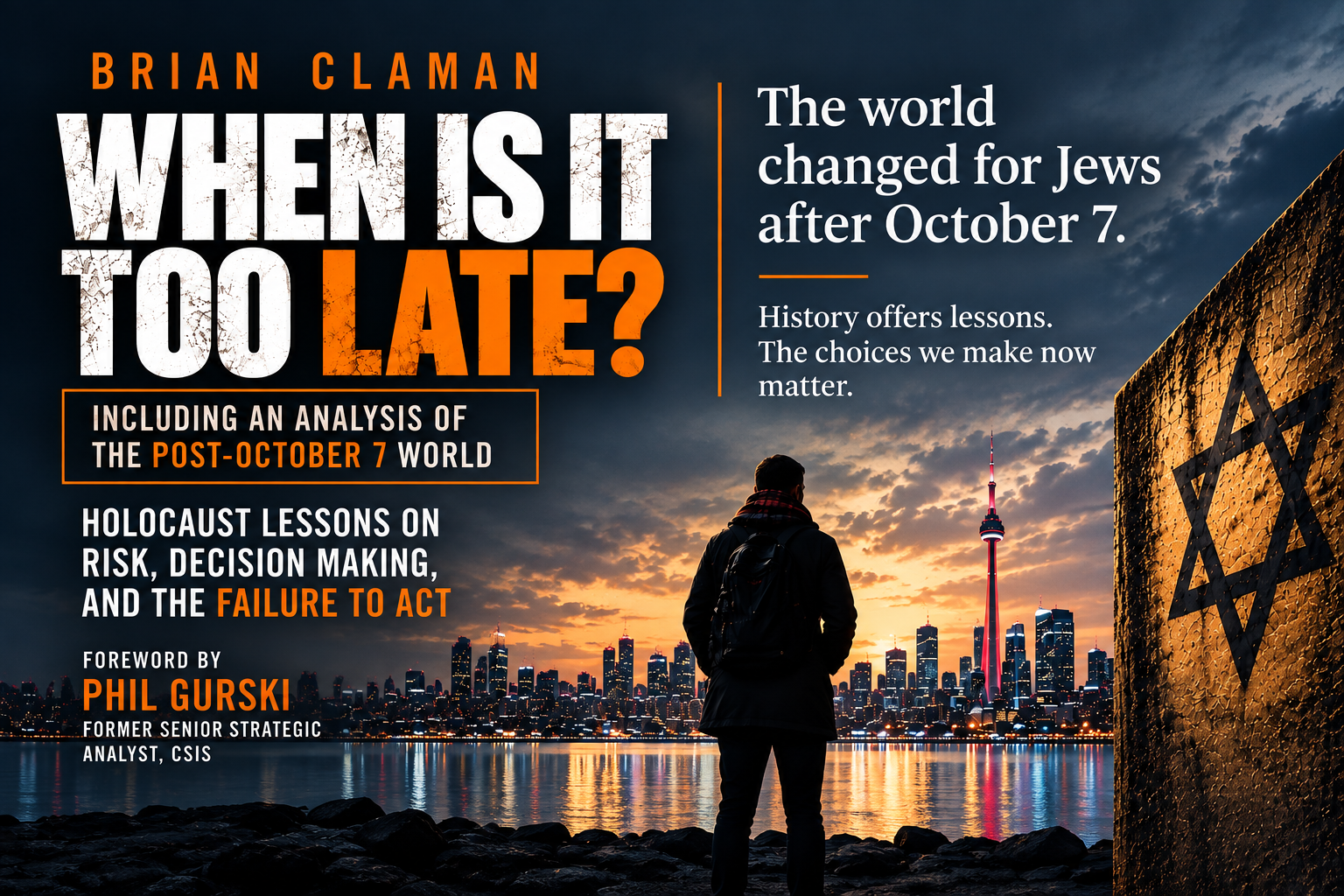
There is a question at the heart of my book, When Is It Too Late? Holocaust Lessons on Risk, Decision Making, and the Failure to Act, that is deliberately uncomfortable:
When does concern become danger—and when does waiting become a decision?
I wrote the book because I believe we sometimes misunderstand how serious threats develop. We look back at history knowing how the story ended, which can make the warning signs appear obvious. They were rarely as obvious to the people living through them.
The Holocaust did not begin with Auschwitz. It developed over years through rhetoric, exclusion, discriminatory laws, intimidation, violence and, eventually, systematic mass murder. At every stage, individuals, governments and institutions had to interpret what they were seeing with incomplete information. Some recognized the danger. Others underestimated it. Some believed circumstances would improve. Others understood that something was terribly wrong but waited.
That is what interests me.
When Is It Too Late? does not argue that history simply repeats itself. It doesn’t. Nor do I believe that every disturbing development should be compared with the 1930s. Those comparisons can actually weaken our understanding of history.
The more useful lesson is about how human beings respond to risk.
We tend to wait for certainty. We want more evidence. We reassure ourselves that the worst outcome is unlikely. Institutions can be reluctant to act because acting has consequences—financial, political, professional and personal.
But waiting has consequences too. That is where my professional life and my family history intersect.
I have spent five decades working in security and risk management. Much of that work has involved a deceptively simple question: when you see indicators that risk is changing, at what point do you act?
My mother confronted that question under circumstances I can barely imagine. She was a Jewish teenager in Hungary when the world around her changed progressively and then catastrophically. At seventeen, she was deported to Auschwitz. She survived Auschwitz and forced labour. Most of her family did not.
For me, therefore, the Holocaust is not simply history. It is family history.
October 7, 2023, caused me to think about that history differently.
The Hamas-led attack on Israel killed about 1,200 people and resulted in approximately 250 people being taken hostage. The war that followed has caused enormous suffering for Israelis and Palestinians and an extraordinarily difficult international debate.
But something else happened that deserves attention from Jewish communities outside Israel. Many Jews began looking differently at their own communities, institutions and sense of security.
Here in Canada, that concern is supported by measurable changes. Statistics Canada recorded 920 police-reported hate crimes targeting Jewish people in 2024. Jewish people were the targets of roughly 70 percent of police-reported hate crimes motivated by religion that year, despite representing only a small proportion of Canada’s population.
Those numbers do not mean that Canada today is Europe in the 1930s. It isn’t. But neither should history teach us to ignore changing conditions simply because they have not reached their worst possible conclusion. That distinction is central to the book.
For Jews in particular, I believe the post-October 7 world has made the question in the title more immediate. How do we distinguish between rhetoric and genuine threat? When should institutions strengthen security? When does something that once seemed unacceptable become normalized because we have become accustomed to seeing it? When should governments, universities, businesses and community organizations respond—and what are the consequences when they wait?
There are rarely perfect answers.
Risk management is not about predicting the future with certainty. It is about making reasonable decisions despite uncertainty. Sometimes that means recognizing that waiting for certainty can itself become a decision.
The Holocaust provides an extraordinary historical case study of what can happen when warning signs accumulate, institutions fail, people adapt to progressively worsening circumstances, and decisions that appear reasonable in isolation prove disastrous in retrospect.
The purpose of studying that history should not be to live in fear. It should be to become better at recognizing change.
When Is It Too Late? goes considerably further than asking these questions. It examines historical decisions, documented warning signs and contemporary evidence through the lens of risk and decision-making. The purpose is not to predict what comes next, but to provide readers with a framework for thinking about uncertainty: What should we pay attention to? What can history legitimately teach us? And how do we decide when the risk of waiting has become greater than the risk of acting?
For Jewish readers after October 7, I hope the book provides a way of thinking about what we are seeing without exaggerating it and without dismissing it. For non-Jewish readers, I believe the questions are equally relevant because the underlying issues—risk, normalization, institutional hesitation and the consequences of delayed action—are not uniquely Jewish.
I wrote this book because I believe these questions deserve serious consideration, particularly in the post-October 7 world. I don’t pretend to have simple answers. What I hope the book does is encourage readers to examine the evidence, challenge some of their own assumptions, and think more carefully about how societies recognize and respond to changing risk.
Ultimately, the book does not tell readers what to think. It asks them to pay attention.
History rarely tells us precisely when concern should become action. The challenge is recognizing when the cost of continuing to wait has become greater than the cost of acting.
When Is It Too Late? Holocaust Lessons on Risk, Decision Making, and the Failure to Act is available worldwide through Amazon and can also be special-ordered through independent booksellers.
Related Topics
Related Posts