

The West Must Confront the Muslim Brotherhood.
The West Must Confront the Muslim Brotherhood Without Turning Against Muslims
There is a distinction the West must learn to make, and quickly: Islam is a religion. Islamism is a political ideology. Failing to understand that distinction produces two equally dangerous mistakes. The first is cowardice: refusing to scrutinize Islamist movements because doing so might be portrayed as hostility toward Muslims. The second is prejudice: treating Muslims themselves as a political or security threat. Both are intellectually lazy. Both are dangerous. And both strengthen the very extremists democratic societies should be isolating.
I say this as a Muslim, an American, a U.S. Army veteran, a human rights activist, and someone who has spent much of my life confronting religious extremism. I unequivocally condemn the Muslim Brotherhood and its project of political Islam.
I also reject the notion that organizations such as the Council on American-Islamic Relations, CAIR, should automatically be treated as representative of America’s extraordinarily diverse Muslim population. They do not speak for me. And they certainly do not speak for all American Muslims.
The Brotherhood’s greatest asset is patience. The Muslim Brotherhood was founded in Egypt in 1928 by Hassan al-Banna. Its significance cannot be understood merely by looking for terrorism or overt calls for revolution. That misses the larger ideological question.
Political movements do not need to overthrow a government tomorrow to influence a society over decades. Influence can be cultivated through institutions, education, political relationships, advocacy organizations, community leadership, youth engagement, media access, and the gradual normalization of ideas.
This is precisely why democratic societies must stop thinking about extremism exclusively in terms of violence. A bomb is easy to recognize. An ideology wearing the language of democracy, civil rights, victimhood, and inclusion can be considerably more difficult to examine.
None of this means every Muslim organization, mosque, activist, or political candidate is secretly connected to the Brotherhood. Throwing around accusations without evidence is reckless. But the opposite approach, refusing to investigate ideological networks at all, is equally irresponsible. The correct response is neither paranoia nor denial. It is scrutiny.
Follow the funding. Examine institutional relationships. Study ideological histories. Demand transparency. Pay attention to what leaders say to different audiences. And above all, distinguish genuine Muslim civil-rights advocacy from attempts to shield political Islamism from legitimate criticism.
CAIR deserves scrutiny, not conspiracy theories
The same intellectual discipline should apply to CAIR. CAIR describes itself as a Muslim civil-rights and advocacy organization and has repeatedly rejected allegations linking it to the Muslim Brotherhood or Hamas. CAIR itself has not been convicted of providing material support to a terrorist organization. That should be stated clearly. But acknowledging those facts does not require us to erase the historical record.
CAIR was named as an unindicted co-conspirator in the Holy Land Foundation litigation. That prosecution exposed evidence concerning the Muslim Brotherhood’s Palestine Committee in the United States and networks associated with support for Hamas. The Holy Land Foundation and five of its leaders were ultimately convicted in federal court in a terrorism-financing case involving Hamas.
These are matters of public record worthy of serious examination. The responsible position is not to declare everyone associated with CAIR guilty of extremism. Nor is it responsible to declare every question about CAIR illegitimate. Scrutiny is not persecution. Asking questions is not bigotry. And no organization claiming to represent a community should be exempt from accountability.
Who appointed anyone to speak for American Muslims?
There is another problem that receives far too little attention. Western institutions repeatedly search for “the Muslim voice.” There is no such thing. There are millions of Muslim voices. Muslims are Sunni, Shia, Sufi, secular, traditional, reformist, conservative, liberal, Zionist, anti-Zionist, politically active and politically indifferent. We come from dozens of cultures and speak hundreds of languages.
Yet governments, universities, corporations and media institutions too often select a handful of organized advocacy groups and effectively grant them the status of community representatives. That is not representation. It is institutional convenience. And it can marginalize precisely the Muslims the West most needs to hear from: reformers, dissidents, women challenging religious authoritarianism, Muslims confronting antisemitism, Muslims defending Israel’s right to exist, and Muslims willing to challenge extremism within our own communities.
We exist. Stop pretending we do not.
Muslims are among Islamism’s first victims
Western discussions of Islamism also frequently overlook an uncomfortable reality. The struggle against Islamist authoritarianism is not a struggle between Muslims and non-Muslims. It is also a struggle within the Muslim world itself.
Muslim intellectuals have been threatened. Reformers have been silenced. Women have been punished for demanding autonomy. Religious minorities have suffered persecution. Dissidents have been imprisoned. Families have been destroyed because someone dared to challenge the political use of religion.
I know what religious authoritarianism looks like. It is not an academic abstraction to me. That is why I refuse to allow extremists to monopolize my religion, and I equally refuse to allow anti-Muslim bigots to define it. A Muslim woman should be able to walk through an American city wearing hijab without fear. A Jewish man should be able to walk through that same city wearing a kippah without fear. And neither should have to surrender their identity to satisfy someone else’s political ideology. That is pluralism.
The West needs Muslim allies, not Muslim appeasement
There is a better strategy. Western democracies should stop treating Muslim communities as fragile populations incapable of internal debate. Hold Muslim organizations to exactly the same standards expected of everyone else. Demand financial transparency. Investigate credible evidence of extremist relationships. Challenge antisemitism regardless of who expresses it. Stop giving ideological organizations automatic legitimacy simply because they claim to represent Muslims. And most importantly, build relationships with Muslims willing to defend democratic pluralism without qualification.
The West does not need to choose between accommodating Islamism and demonizing Islam. That is a false choice. There is a third path: stand with Muslims who are prepared to confront Islamism themselves.
This is our responsibility too
Muslims cannot demand that everyone else confront extremism while remaining silent when extremists claim to speak in our name. We have a responsibility. When antisemitism comes from our communities, we must confront it. When religious leaders glorify hatred, we must challenge them. When political movements exploit Muslim grievances to advance authoritarian ideologies, we must expose them. When Jews are threatened, Muslims should stand beside them. And when our fellow Muslims experience genuine hatred or discrimination, Jews, Christians and others should stand beside us.
That is the alliance extremists fear most. Not Muslims against Jews. Not Christians against Muslims. But decent people against fanaticism.
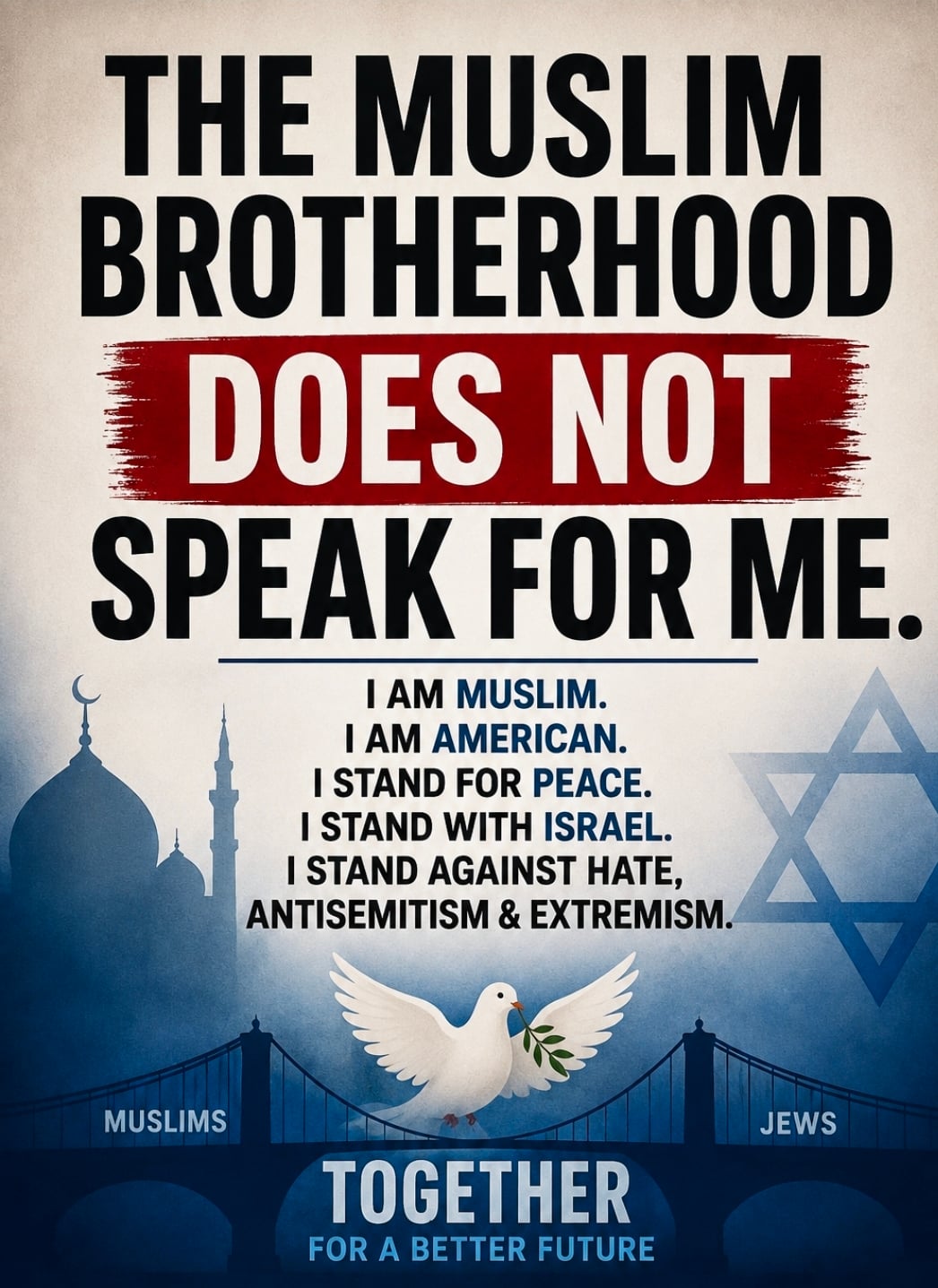
I am Muslim. I am American. I support Israel’s right to exist. I stand against antisemitism. I reject Hamas. I reject the Muslim Brotherhood’s political ideology. I reject religious authoritarianism. And I reject the idea that challenging any of these things makes someone anti-Muslim.
My faith does not require me to surrender my reason.
My Muslim identity does not require an Islamist political movement.
And my civil rights do not require any organization to appoint itself as my representative.
The Muslim Brotherhood does not speak for me.
CAIR does not speak for me.
No Islamist movement owns the Muslim voice.
The future belongs to Muslims willing to reclaim it.