The words I didn’t have
We were talking about a promotion. My boss and I were going through my responsibilities and what the next step in my role would look like. Then he stopped and asked me something else.
“I’ve worked with you for years,” he said. “And I still don’t know who you are. Who is Katya?”
He was not criticizing me. He was curious. He had noticed something for a long time and finally decided to say it out loud. Then we went back to discussing the job.
I don’t remember what we decided about the promotion. I remember that I had no answer to his question. At the time I did not even understand what he was asking. I don’t mean that I dodged the question. I genuinely could not see what he meant, or what he thought was missing. The answer came about a year later, and it came through the worst months of my life.
But the story starts earlier.
In my family, nobody talked about feelings. My parents didn’t, and neither did my grandparents. It was not concealment. That generation was never taught how — nobody had given them the skill, so they had none to pass on.
I moved to Israel from Moscow at 27. Two years later I realized I needed a therapist. Those first sessions were not about my problems. They were about learning to name what I felt — to look inward and find the word for it. I was 29 years old, and I was learning basic vocabulary. But naming a feeling to yourself, in a quiet room, once a week, is one skill. Showing it to another person is a different one, and that one I still did not have.
That, I think, is what my boss had been looking at for years. Not a person hiding something. A person keeping up a front — no anger, no irritation, conversations made of facts with the feelings left out. Not because I was withholding anything. Showing what I felt was simply not something I knew how to do.
Then, in the autumn of 2023, I no longer had that choice.
The war started. Over roughly the next three months, my relationship ended, I had to find a new apartment and move, and my mother died suddenly. Most of my Russian-speaking friendships here fell away as well. A deep enough crisis tests every friendship you have, and many of mine did not survive it. That is normal, I understand now — though at the time it was very sad.
I assumed I was about to be completely alone.
Instead, every person in my office came to talk to me — each of them separately. Every one of them offered help. They invited me for Shabbat and for the holidays. And for the first time in my life I did not keep my face under control in front of other people. I cried at work, and I knew before I did it that nobody would judge me for it. In Russia, they would have.
It took me a long time to understand why that had been so hard for me. The explanation came from my father. Not long ago I told him about a man from Russia who came up to me after my mother’s funeral. I hadn’t seen him in years. The first thing he asked me was not how I was. He asked when I was moving back — soon, he said, there would be no Israel left, with the war.
I was still angry when I told my father the story. That man, I said, has no empathy at all. My father asked: “What is empathy?” He wasn’t being sarcastic. He didn’t know the word.
That answered my question. I had not grown up among cold people. I had grown up somewhere where this vocabulary was never taught to anyone, in any generation. My father was not refusing to feel for me. He had simply never been given the skill — exactly as I hadn’t, until I started learning the vocabulary of feelings in therapy.
–
I began the conversion process about six months after all of this, and I had three reasons.
The first was that I wanted something above myself to lean on. When most of what I had built my life around came apart inside three months, I found out how little of it had been holding weight.
The second was that I wanted to build a family here, and I wanted it to be a Jewish one.
The third has to do with my great-grandmother. She was Jewish. In 1937 she fled Poland for the Soviet Union, and for the rest of her life she hid what she was. She never stopped hiding it. Her son — my grandfather — is the reason I was able to come to Israel at all, since the Law of Return covers the grandchild of a Jew. It does not make you Jewish under religious law, which passes through the mother. For that, there was one route.
I wanted to go back to the thing she had spent her life burying. It seemed to me the only thing I could still do for her.
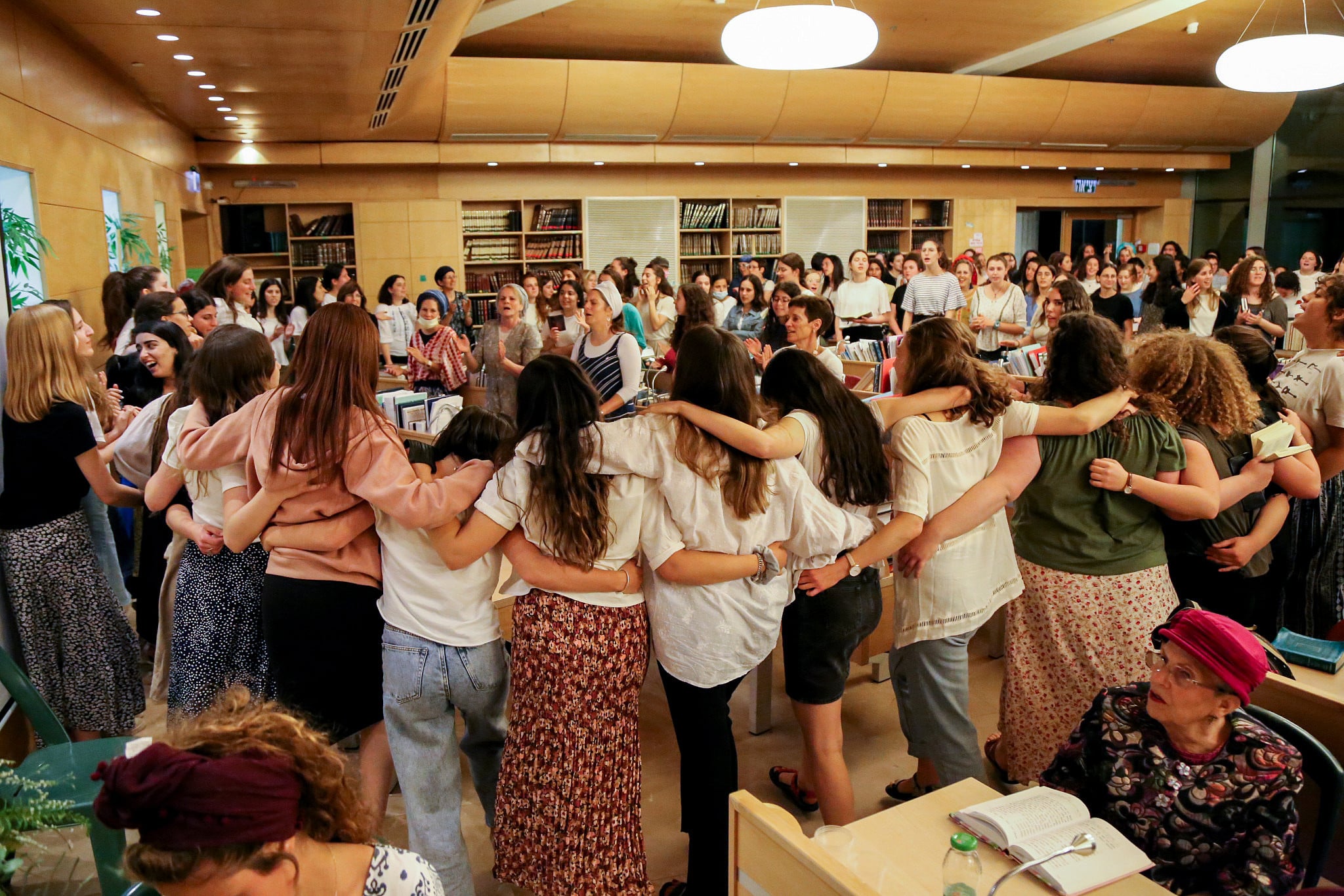
What I had not expected was what the process itself would do to me. Conversion in Israel is usually described in terms of requirements: classes, examinations, a rabbinical court. Almost nobody mentions the part that changed me, which is that you spend months among people. I met more people in those months than in all my previous years here. I found a synagogue. I found a community. And I found a family — a religious family who went through the entire process alongside me, who threw me a celebration when it was over, and who are close to me now.
And this time I did not arrive as the woman who kept everything to herself. My colleagues had already shown me that you can open up and it will not frighten anyone away. They stayed. They supported me. By the time I walked into that community, I knew how to be known.
–
This is what surprised me most about Israel, and what no book about Jewish life had prepared me for. Where I come from, being strong meant showing nothing. Here it is the opposite. People say difficult things out loud, at the table, to someone they met two weeks ago. It is not shameful to be weak in front of others. And I have never seen people close ranks around each other in a crisis the way they do here.
It works in both directions, which is what I had backwards for years. The more you open up, the more this country answers.
I never gave my boss a proper answer. There was no conversation where I sat him down and explained who Katya was. But at some point I realized that he knew, and so did everyone else — not because I told them, but because there was no longer a front to look at.
If you have moved here and are still waiting to feel that you belong, or if you are going through conversion and expect the certificate to settle it, this is what I would want to tell you. The paperwork matters. You need it, getting it is hard, and nobody should pretend otherwise. But it is not what makes you part of this place. What makes you part of it is letting people close — letting them see you as you are, not a front. I learned this in the hardest months of my life, but it is not a rule for hard times. It is how this country works every ordinary day.