The World Aunt Freda Carried
Last month, my aunt, Freda Steinberg, née Guttentag, passed away in Jerusalem, at the age of more than one hundred.
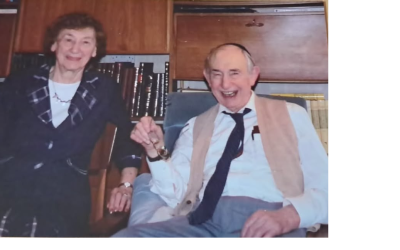
Tomorrow evening marks the yahrzeit of my father, Mechel Max Guttentag ז״ל — Aunt Freda’s elder brother. As I write about her life and passing, I find the two memories naturally intertwined. In her voice, her gestures and her quiet dignity, I often glimpsed something of my father still present. Their generation belonged to a world now largely vanished, yet through both of them its values — Torah, family, refinement and steadfastness — continue to speak.
Aunt Freda died as she had lived for more than seven decades: in Eretz Yisrael, surrounded by generations of family. To her children, grandchildren, great-grandchildren and great-great-grandchildren, she was the family matriarch — wise, dignified, humorous, refined, and deeply present in their lives.
But her passing also represents something larger. It marks the closing of another living doorway into a generation of Anglo-Jews who carried the world of British and European Orthodoxy into the emerging life of Israel — quietly, seriously, without slogans, and with deep faith.
Aunt Freda was, in many ways, a quintessential English lady. She had elegance, gentleness and dignity. She was educated, thoughtful, cultured and well read. Yet her Englishness was never merely social polish. It rested on a strong Jewish foundation.
She came from the Guttentag family of Newcastle and Gateshead, and through her mother from the Winegarten family of London — families rooted in Torah, education, communal responsibility and Orthodox Jewish life.
As a young woman, she would cycle from her parental home in Newcastle over the bridge across the River Tyne to attend lessons at the newly established seminary of Mr Kohn in Gateshead. She was among the early students of what later became Gateshead Seminary, Beis Hamedrash Lemoroth, one of the great institutions of Torah education for women in the English-speaking world.
That detail has always stayed with me. Before she became part of the story of Israel, she belonged to another story too: the reconstruction and deepening of Orthodox Jewish life in Britain before and after the war. She came from a world that valued refinement, education, family, modesty, seriousness and Torah.
In the 1940s, family recollection places her teaching in London, I believe at one of the Hasmonean schools associated with Rabbi Dr Solomon Schonfeld’s remarkable postwar educational work. That setting matters. Hasmonean was part of the great effort to rebuild Orthodox Jewish education in Britain — to give Jewish children not only schooling, but an Orthodox future. It was there, I believe, that she met Joshua Shlomo “Solly” Steinberg, from the distinguished Jewish community of Dublin. Solly shared her world of teaching, learning and quiet seriousness.
Their marriage joined not only two families, but two strands of postwar Jewish rebuilding: English Orthodox education and Irish Jewish learning and culture. When they later settled in Eretz Yisrael, they brought both with them. They lived first in Pardes Hanna and later in Haifa. Solly taught at Midrashiat Noam, the boys’ religious high school in Pardes Hanna, and later at the Technion in Haifa, where he became a professor of English for technical and academic purposes.
Like many of their generation, they did not come to Israel to observe history from a distance. They came to help build it. Their contribution was not dramatic in the public sense. They were not statesmen, generals or famous activists. They were part of that quiet, educated, constructive fabric without which no country can truly be built: families who came, settled, worked, taught, raised children, absorbed hardship, lived through wars, and made the land their home.
For the wider family in Britain, Aunt Freda and Uncle Solly became a welcoming face of Eretz Yisrael. Older cousins from the Winegarten family remembered arriving by ship at Haifa in the 1950s and being warmly received by them. On my own first visit to Israel in 1976, I remember being met at the airport by Uncle Solly and Aunt Freda, and then travelling with them for what felt like a great journey by road up to Haifa, to their home on Rechov Vitkin in Ahuza.
But the story they joined was not romantic in any shallow way. To build a life in Israel meant to share in the burdens, dangers and sacrifices of Israel. Their son Danny, then a hesder yeshivah student at Yeshivat Kiryat Arba, was called up on Yom Kippur itself. He had been leining at Minchah when the call came. He went on to serve as a tank driver in General Avraham “Bren” Adan’s division on the Egyptian front, driving a Shot tank — the Israeli-modified British Centurion.
One extraordinary episode from that war became part of our family memory. Israeli forces saw figures approaching with what appeared to be a white flag. In the tension of war, that could have meant many things. Danny noticed the black stripes and realized that the white cloth was not a flag at all. It was a tallis. The men were Jewish soldiers, escaping from a canal-side outpost, trying desperately to be recognized and rescued.
My father was deeply moved by that story. He spoke of it for years afterwards. For him, it captured something almost unbearable and yet deeply Jewish: in the dust and danger of war, the sign that saved Jewish lives was a tallis — the garment of tefillah, Jewish identity, and surrender only to Hashem.
Danny later gave his wartime diary the title Ki Chilatzta Nafshi Mimaves — “For You have delivered my soul from death.” He would say that Hashem had spared him, and that it gave his life different priorities. In that story, danger gave way to rescue. The white cloth that might have been misunderstood was recognised as a tallis, and Jewish lives were saved.
Fifty years later, the family was struck again. This time, there was no such happy ending. Aunt Freda’s grandson, Colonel Yonatan “Yoni” Steinberg הי״ד, commander of the IDF’s Nahal Brigade, was killed on October 7, 2023, as he made his way to the battle zone in the south.
In the grim Hebrew phrase that Israelis know so well, his name was the first hutar lepirsum of the war — the first fallen soldier whose death was officially cleared for publication after the catastrophe began. Before Israel had even begun to understand the scale of what had happened, the name of Aunt Freda’s grandson had already entered the roll of the fallen.
I was present at his levaya at Har Herzl the following day, October 8. It was one of the first military funerals after October 7, at a moment when the country was still in shock, still counting its dead, still trying to grasp the enormity of the attack.
As we filed past the aveilim, what had begun as family grief opened into something larger. The reality of what Israel was facing began to sink in — not as an abstraction, not as a headline, but through the tears of a family standing beside the grave of one of the first commanders to fall.
Yoni was 42. He lived in Shomria with his wife, Yiska, and their six children. He was the son of Danny, the tank driver of the Yom Kippur War. The son served in 1973; the grandson fell in command in 2023.
It is almost too much to take in. One family’s story stretches from English Orthodoxy to the building of Israel, from the Yom Kippur War to October 7, from the tallis that saved lives on the Suez front to the grandson whose name became the first official announcement of an Israeli soldier killed in the war fifty years later.
This is what “building Israel” has meant for so many families. Not speeches. Not slogans. Not ideological abstractions. It meant leaving one world and entering another. It meant building homes, educating children, accepting responsibility, living through danger, and seeing one’s descendants carry the burdens of Jewish sovereignty.
Aunt Freda herself was not a heavy or solemn person. She had humor — dry, gentle and very English. She retained her grace, wit and refinement through all the decades of her life in Israel.
In Jerusalem, in her later years, she lived near Shaare Zedek Medical Center and volunteered in the hospital shop. When my own grandchildren were born there, she would come to visit, bringing a small gift for the newborn. It was a simple family kindness, but it reflected who she was: thoughtful, present, generous-hearted and quietly devoted to family.
She also carried memory. She remembered the world of Newcastle, Gateshead and London Orthodoxy. She remembered the family homes, the Shabbat tables, the atmosphere of an earlier Jewish world. In her later years she wrote recollections of Bethune Road, the Winegarten family home in London, preserving not only facts but texture: hospitality, dignity, family feeling, and the cadence of a Jewish world now largely gone.
In that too, she belonged to a generation that understood memory not as nostalgia, but as responsibility. To remember a world properly is to carry something of its values forward.
There was a remarkable continuity here too. Aunt Freda merited to become a great-great-grandmother, as her own mother, Ray Rachel Guttentag, had before her. In the early 1990s, the Jewish Chronicle published a photograph of Ray Rachel with four generations of her direct descendants — five living generations in one family line. Aunt Freda lived to see that same blessing repeated. In a Jewish century so marked by rupture and loss, that continuity was itself a quiet victory.
Aunt Freda is survived by her children: Chana, married to Prof. Michael Tal; Ilana, married to Stanley Emerson of Toronto; Danny, married to Judy Munk of Toronto; and Shulamit — known to the family as Popsy — married to Romy Leibler. Through them, and through the generations that followed, her life continues in the most literal and blessed sense.
For me personally, Aunt Freda was one of the last living links to the world of my father and his family. Whenever I saw her, I recognised in her face, gestures and manner something of my father, her brother. After he died, I felt a particular pull to visit her. In speaking with her, I felt I was still seeing something of him alive within her. Now that link too has gone.
The Torah says of Avraham Avinu that he died “בשיבה טובה, זקן ושבע” — in a good old age, old and satisfied.
No life of more than a century is without sorrow. Aunt Freda knew widowhood, hardship, war, anxiety and, in her extreme old age, the terrible loss of her grandson Yoni הי״ד. Yet her life still had that quality of fullness: family, memory, education, dignity, humour, Eretz Yisrael, Jerusalem, and the merit of seeing generations continue after her.
There is a tendency to tell Israel’s story through its leaders and battles, its political dramas and ideological divisions. But Israel’s deeper story is also told through families like hers: families who came from elsewhere, brought with them the dignity and faith of older Jewish worlds, and planted those values in the soil of Eretz Yisrael.
Aunt Freda came from England to Jerusalem. She carried Newcastle, Gateshead, London and Dublin into the life of Israel. She helped build quietly. Her children and grandchildren carried that building forward. Some paid the heaviest price.
With her passing, another doorway into a vanished world has closed. But the generations she helped build remain.