


The World Had a Choice on Iran: Hesitation Was the Decision
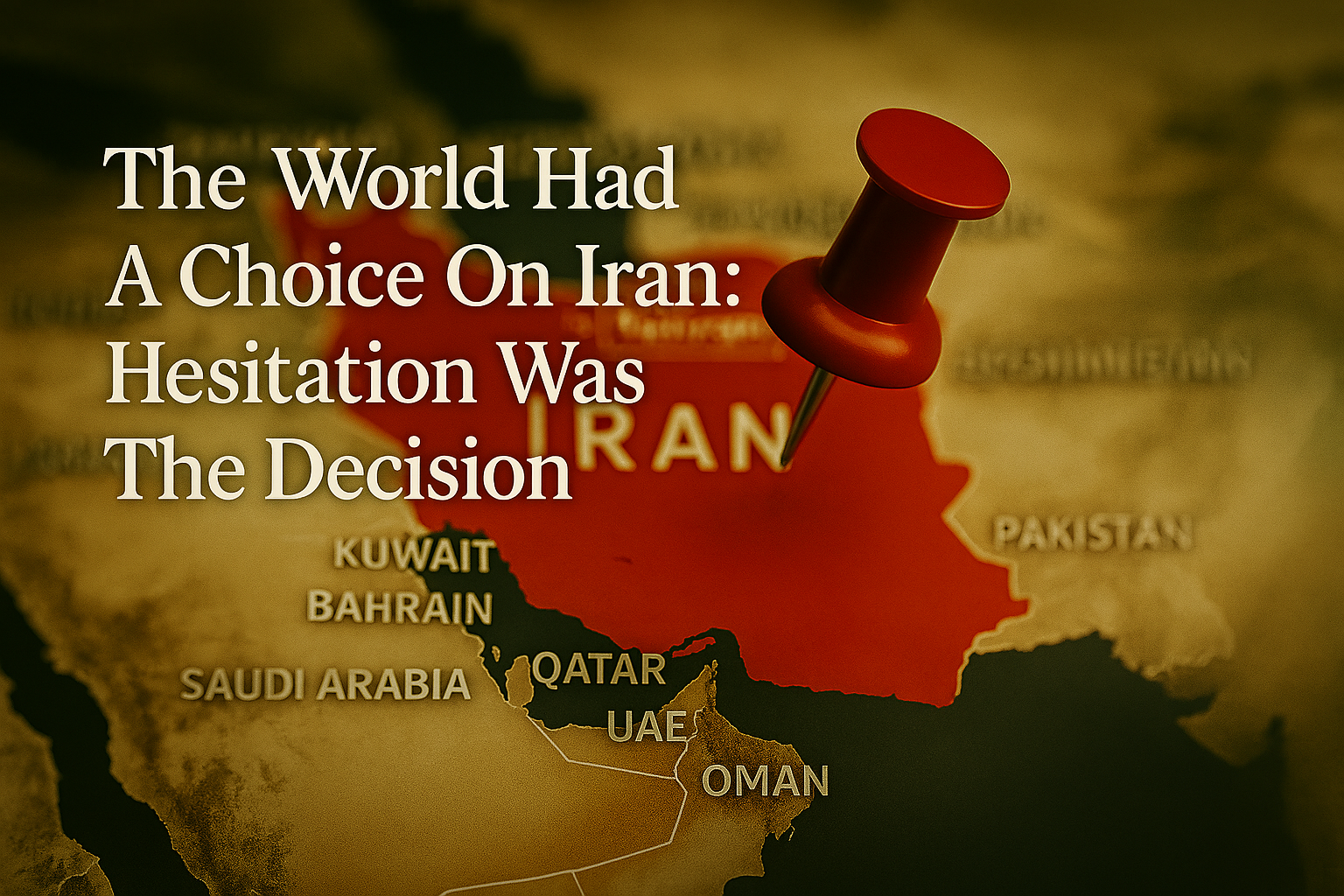
The most telling feature of today’s international order is not the aggression of regimes like Iran, but the hesitation of those who claim to oppose them. For decades, the language of collective security has been invoked with confidence and moral clarity, yet when confronted with moments that demand resolve rather than rhetoric, that confidence often dissipates. The question is no longer whether more countries should have joined military efforts against the Iranian regime. The more uncomfortable and revealing question is why they did not, and what that reluctance exposes about the widening gap between declared principles and actual policy.
The absence of a broader coalition response reflects more than strategic caution; it signals a deeper erosion of collective will. It also reflects a failure of coordination among actors whose interests, at least in principle, remain aligned. What was missing was not necessarily capability, but the formation of a coherent and sufficiently aligned coalition. A more consequential response would likely have required a grouping anchored by a critical mass of capable states, including both extra-regional and regionally situated actors, aligned around shared interests in deterrence, stability, and the protection of key economic corridors. Such an arrangement would not have depended on unanimity, but on the ability of a core set of actors to translate overlapping strategic interests into coordinated action.
For decades, the regime in Tehran has refined a model of influence rooted in asymmetric warfare and proxy networks, enabling it to project power across borders while avoiding the direct costs traditionally associated with state confrontation. A coordinated and multilateral response would have challenged that model at its core, signaling that such strategies no longer come at minimal risk. Instead, the limited scope of participation risks reinforcing the opposite conclusion: that persistent destabilization can continue without provoking a unified international reaction.
Deterrence ultimately rests not only on military capability, but on the credibility of collective resolve. When responses appear hesitant, fragmented, or selectively applied, that credibility weakens. And when credibility erodes, so too do the norms it is meant to uphold. In that sense, the failure to mobilize a broader coalition risks emboldening not only Iran’s leadership, but any actor closely observing how far the boundaries of international tolerance can be stretched.
Beyond strategy lies a human dimension that is too often reduced to abstraction. Large segments of the Iranian population have repeatedly demonstrated against authoritarian rule, often at considerable personal risk. Their demands have been met with familiar expressions of international solidarity, yet far less in terms of tangible support. Over time, statements of concern risk hardening into a form of performative diplomacy. For many inside Iran, the distance between words and action is no longer theoretical; it is experienced as a persistent and growing sense of abandonment.
A broader coalition effort would not have guaranteed political transformation. External pressure rarely produces immediate or predictable domestic change. It would, however, have signaled that the global commitment to political freedom and human rights carries real implications. In its absence, a credibility gap widens, reinforcing the perception that those challenging entrenched power structures must ultimately do so alone. A unified stance, even if limited in scope, could have reshaped that perception and strengthened the sense that international principles are, in fact, enforceable.
At the regional level, the consequences of a more coordinated approach could have been equally significant. Iran’s influence is exercised not primarily through direct confrontation, but through a network of non-state actors, with Hezbollah in Lebanon as its most prominent manifestation. This system has allowed the clerical leadership in Iran to embed itself deeply in regional conflicts while maintaining plausible deniability and strategic flexibility.
Disrupting Iran’s ability to sustain these networks would not merely weaken individual actors; it would challenge the underlying logic that has made proxy warfare an effective and comparatively low-risk instrument of state power. In Lebanon, where Hezbollah’s military and political influence is closely tied to Iranian support, even a partial reduction in that backing could have created space for a recalibration of internal power dynamics. More importantly, it could have eased the burden carried by the Lebanese population, much of which continues to face the economic, political, and security consequences of an armed organization operating beyond full state control.
At its core, this dynamic reflects an erosion of sovereignty. As long as Hezbollah retains the capacity to function as a parallel military and political structure, the authority of the Lebanese state remains constrained, fragmented, and, at times, subordinated. External support has been central to sustaining this imbalance. Weakening these external lifelines would therefore not only have targeted a single organization, but would have reinforced a foundational principle of statehood: that legitimate authority and the monopoly over the use of force must reside within the state itself.
Such a shift would also have carried significant implications for regional escalation. Hezbollah’s ability to draw Lebanon into confrontation with Israel has long exceeded the willingness of significant parts of the Lebanese population to support such conflict. Weakening the structures that sustain this capability could have reduced the likelihood of escalation driven not by national consensus, but by the strategic priorities of a single, heavily armed faction. In that sense, a broader intervention might not only have altered internal balances, but also limited the risk of a wider conflict that many in the region neither seek nor benefit from.
The implications extend beyond the immediate region into the global economy. Iran’s strategic position, particularly in relation to critical maritime corridors such as the Strait of Hormuz, gives it the capacity to influence global energy markets during periods of tension. These disruptions are rarely contained; they ripple outward, affecting supply chains, inflation, and economic stability far beyond the Middle East. While any military intervention carries immediate risks, prolonged instability imposes slower but equally significant costs. A coordinated response might have reduced these recurring cycles of uncertainty, contributing to a more predictable global environment.
Ultimately, what is at stake is not only the outcome of a single confrontation, but the credibility of the rules-based international order itself. When states repeatedly engage in actions that destabilize entire regions without facing consistent and unified consequences, the distinction between rule and exception begins to dissolve. A multilateral response would have reaffirmed that sovereignty does not provide immunity from accountability when actions extend beyond national borders in destabilizing ways. Without such reinforcement, the system risks drifting toward a more transactional and unpredictable order in which power, rather than principle, becomes the primary determinant of outcomes.
None of this is to suggest that a broader intervention would have been without risk. Escalation, unintended consequences, and the danger of entrenching conflict are real and legitimate concerns. These risks help explain the caution shown by many states. Yet the risks of inaction are no less consequential, even if they unfold more gradually. A strengthened and emboldened Iranian regime may continue to expand its regional influence, proxy conflicts may deepen, and local populations across the region, from Tehran and Beirut to Kuwait City, Abu Dhabi, Manama, and Jerusalem, may continue to bear the costs of a status quo that privileges entrenched power over long-term stability. Over time, these dynamics may not remain regionally contained, but instead generate spillover effects, including heightened security risks and indirect forms of confrontation that increasingly reach into European and American urban environments.
In this context, inaction cannot be mistaken for restraint. It is itself a strategic choice, one that signals limits, shapes expectations, and ultimately defines what is considered acceptable behavior. The absence of a coordinated response communicates just as clearly as decisive action would have done; the difference lies in what that message permits going forward.
The question, then, is not whether a broader coalition would have produced a perfect outcome. No such outcome exists in international politics. The more consequential question is what kind of world takes shape when opportunities for collective action are repeatedly deferred. At some point, hesitation ceases to be prudence and becomes precedent. And precedent, far more than intention, is what will define the conflicts yet to come.