


The world post October 7, and the calling.
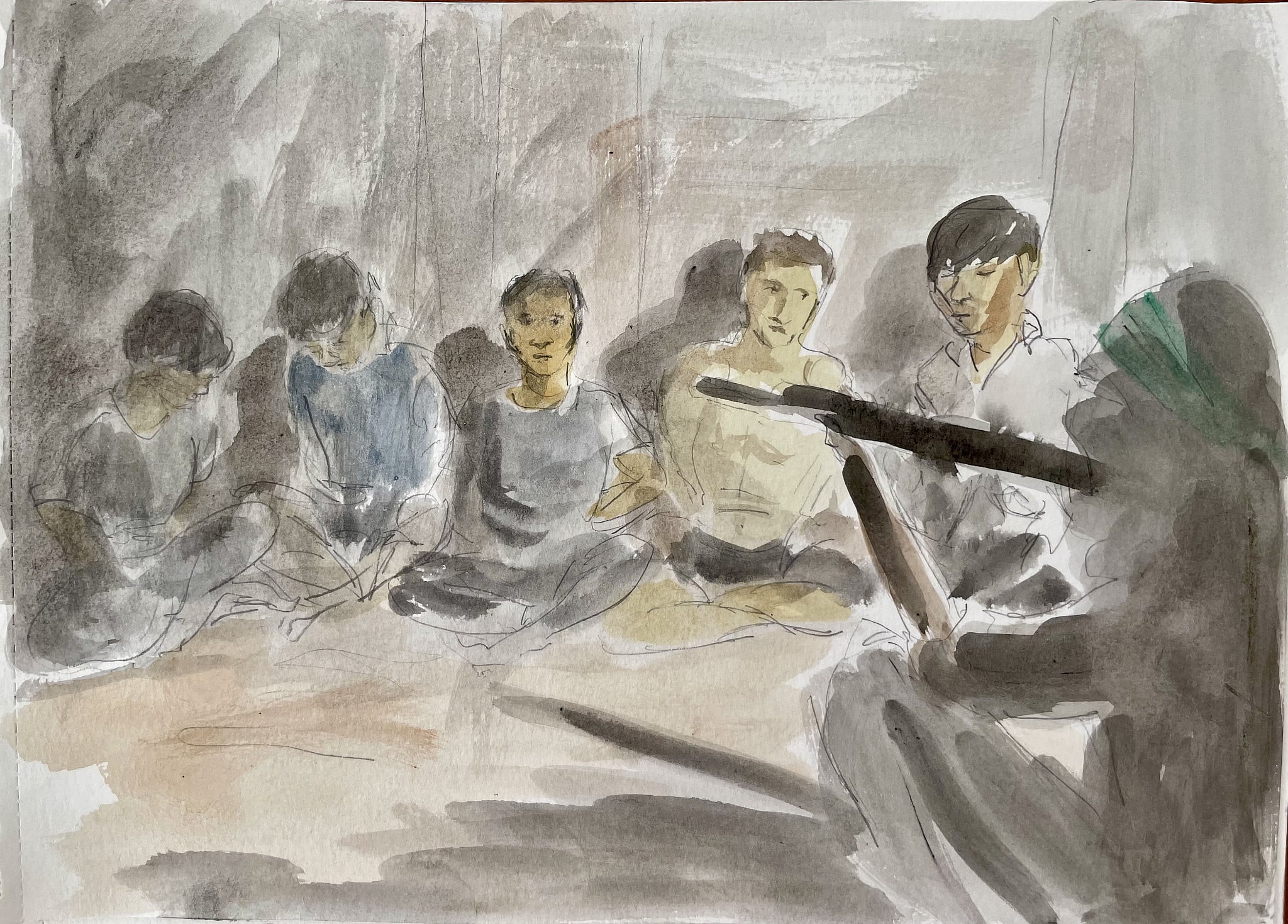
Three years after October 7. Taking the Broken tablets with us.
On Friday, we had our last meal in the soucca.
I loved so much spending time there: the nights with stars like tiny diamonds, the sparkling moon in the black sky, illuminating it like daylight, the pink dawns with shy birds, the midday heat laughingly seek shelter from the sun, the friends lounging on the cushions, the lazy afternoons spent contemplating the slow dance of the trees, the moving shadows of the leaves behind the fabric walls, the fabric gently lifted itself by the quiet breeze, as if they were breathing together, as if we were breathing together, as if the whole world were breathing together.
At this point in the cycle of the Jewish year, everything seems in place for joy.
The Shadow
It was on this very day, three years ago, that darkness engulfed us.
It was at dawn on Simchat Torah. We all remember. That day, the time of our joy was awakened by Hamas rockets raining down on us. They targeted, as always—and as usual, with complete impunity in the eyes of the international press—the most densely populated cities. The rockets fell day and night for several months, until January, when suddenly silence returned to our days and nights. But that was nothing.
That day, we gradually learned through social media what was happening.
And yet it took a day, or several days, before we understood the scale of the disaster. I still remember the moment when Matan told me, in an almost inaudible whisper, sometime in the afternoon: “They’ve taken hostages.”
We thought there were about ten. We thought they were in their homes. We thought it would take a few hours to free them.
We did not think they would be taken to Gaza.
We did not think we would see the body of a young woman, naked, her legs broken, paraded in the back of a pickup truck, amid spitting and cries of victory. A photograph that earned the terrorist who took it the “Photo of the Year” award in an international photography competition, an award that was upheld despite protests and petitions calling for it to be revoked.
If there were an emblem of the post-October 7 world, it would be this prize.
We did not think that the living would be held in tunnels for almost two years. Tunnels without light or water, tunnels with excrement in a hole hastily dug in the ground, tunnels where screams could not be heard and where they were given the bare minimum of food to keep them alive, their skin stretched over their bones. Underground chambers where sometimes they could not even stand upright. Tunnels from which some returned, pale and skeletal, like revenants from the camps, and others did not.
It was the day of our joy that they had chosen to wound, not only those who were tortured that day, the dead and mourners and the survivors and their families, but also our collective memory, forever.
Into this point of light, they placed a point of darkness that still covers us. There is no point in denying it. The blow has been struck. The wound continues to bleed.
And the world post-October 7 only deepens the wound, day after day.
A Date Like an Abyss
The war eventually came to an end.
The tunnels were emptied and filled with concrete. The hostages were returned, including the bodies, including those of people who had been held for ten years.
Returned in exchange for the release of thousands of terrorists imprisoned for life, as Sinwar, the architect of October 7, had himself been released more than a decade earlier, alongside more than a thousand others, in exchange for the recovery of a single person, Gilad Shalit.
In prison, he had not only had time to think about October 7. He had had the opportunity to develop the skills to carry it out. Treated for cancer during his detention, he had also learned Hebrew and pursued his studies, paid for by the taxes of Israeli citizens whom he would once again strive to annihilate upon his release, in accordance with Hamas’s explicit agenda of genocide.
In one of the exchanges after October 7, the man who had raped and murdered Ori Ansbacher, a 19-year-old young woman, in a Jerusalem park, was released.
Today, she is dead, and he is free.
This is the price of bringing our own people home, even in coffins.
Forever, there will be this wound, this abyss, within Simchat Torah. A black hole that still haunts us and marks the festival of the Torah, even if we have carefully chosen to call it by its Gregorian date, “October 7.”
We try not to think about it, but we know.
We know part of what was done, from the condition of the bodies that were recovered or from what was filmed by the body cameras of the masked men, who laughed as they did so, broadcasting live on Telegram and other social media platforms to increase their own pleasure, and that of the global voyeurs.
They had to show it, to humiliate even further, to revel even more in a sadism that had been carefully prepared over a long period of time.
The World of October 8
When Antoine, the editor-in-chief of this publication, called me last Thursday to suggest that I add something “to mark the three years since October 7” to “the tenoua.org”
I had written in 2023 and 2024, he knew I did not want to. And perhaps he also knew that I would not be able to say no.
When the war broke out, I began writing as if my life depended on it. And it did.
Almost every morning, I would find myself awake before dawn, with a dark tea and a sky still black, my hands on a keyboard growing colder and colder as winter unfolded, writing to survive, to keep myself from falling ill.
I needed to tell everything.
That was everything. But it was only the beginning.
A second abyss opened up before us.
What Eva Illouz rightly called “October 8.”
The second wound, inflicted on an open wound. A wound that continues to spread.
We had not expected this one either.
On October 7, the world shifted twice for the Jew.
First, there was what was done to us on our own land.
October 7 marked the end of the illusion of safety for the Jew in the land of Israel. Of course, since its renewed independence, the country had lived under constant attack; of course, wars had followed one another. But we had believed that, at last, the Jew had a place where he could be safe on this earth, on his own land.
On October 7, the Israeli was brutally confronted with his vulnerability.
The residents of the kibbutzim who had dedicated their lives to helping Palestinians found themselves betrayed by those to whom they had unfailingly extended a hand, by those in whom they had believed for decades.
Young and old alike, who had worked for coexistence and fought for it, found themselves murdered, raped, humiliated, devastated.
And then, on October 8, faced with the world’s reactions, the Jew was reminded of his vulnerability on this earth.
Apart from a few timid or courageous expressions of support, there were two reactions that spread across the world like an oil slick: on one side, the icy silence of some, far too many, of those we had believed to be our friends, our colleagues, or enlightened minds; on the other, the sudden disinhibition of a hatred that seemed to have been merely sleeping since 1945—or since the Middle Ages and the accusations of poisoning wells.
What Illouz so rightly called the “genealogy of virtuous hatred” seems less like a “genealogy” than a sudden disinhibition: a collective unleashing of the dark side, emerging from the most unexpected places, from places supposedly devoted to thought and reason. Suddenly, a wave of “collective madness,” disguised as moral virtue, spread across the world and continues to spread. A wave that has only swelled since the day of the attack, on university campuses as well as in parliamentary assemblies, in newspaper offices as well as in art galleries, until it flooded Western culture under a tsunami of hatred: the oldest hatred in the world, a hatred that merely changes its moral clothing from one era to another, the hatred of the Jew, today disguised as “resistance” against Israel, designated as a monster to be destroyed.
I learn today that this madness is no longer confined to the crowds, that it is gradually becoming official. That the Netherlands has just passed a law allowing anyone arriving from Israel to be searched to ensure that they are not carrying “colonialist” products. That the English Green Party has just voted to redefine Zionism as racism.
Yes, for now, the wave continues to swell, and in the meantime, we watch it, stunned, helpless.
The Diary of Tears
It has been more than a year since I stopped writing.
And yet tonight, the day after Simchat Torah in Israel, I am forcing myself to do so.
Because putting things into words is like building a boat on a wave, no matter how small it may be. Perhaps Noah’s Ark was made of words. Mine, in the midst of this flood, certainly is.
I am also writing after lighting a candle for them, for those who can no longer speak. And I am writing to give strength to those who are not yet able to do so.
If I were to write something now, it would be a diary of tears.
A journal of sorrow.
I would make a list of the wounds received every day, as soon as I open social media, as soon as I speak to someone close to me who lives in the Diaspora. And as soon as I learn, too, of another atrocity committed by my own people in Israel and in the territories.
I had always wondered how the most enlightened nations of the early twentieth century could have descended into such madness.
Today, all it takes is a glance at newspaper headlines, political speeches or the confident pronouncements of intellectuals to see the same irrationality at work, at the very heart of institutions that claim to embody reason and justice.
I will not open the list of wounds, of atrocities and injustices committed every day against my people, in every sphere, through boycotts, cancellations, verbal or physical attacks, harassment, and so much more.
I will not open the diary of tears, at least not now.
And I will not open either the diary of my anger against my own people, in politics or on the ground, who behave like our enemies, displaying a supremacist ethno-religious violence of their own, even if on a much smaller scale.
Betrayed by the world, that is nothing new. Betrayed by my own people in my own country, Israel, sometimes hurts almost more.
But listing all these tears would be too much.
For now, for these three years since that dark day, I would simply say this: a page closed on October 7. The world will never be the same again.
The World After
I am not speaking only for Israel, nor only for the Jews.
The world itself has compromised itself, and continues to do so every day, in ways from which I do not know how it will recover.
For us, despite everything, something came to an end on October 7.
The war is, for now, on hold, the tunnels under control, the hostages returned.
And yet, despite everything, there has been this immense, terrible, collective relief. It came in waves, with the agonies of waiting and the unpleasant surprises, with the shock of the grim ceremonies in which the captives were handed over.
But they came out.
The last ones came out on Simchat Torah last year, and since that day, for every resident of Israel, and perhaps for you as well, a stone has been lifted from our hearts. We can breathe a little more freely.
And since then, in Israel, the landscape, both external and internal, will never be the same again.
In the cities and on the roads, at bus and train stations, stickers bearing the smiling faces of those who died on October 7 and since then cover the walls.
In many synagogues, those who come to pray on Simchat Torah arrive with a weight on their hearts that did not exist three years ago. We light a memorial candle before the festival candles.
Many begin with a silent hakafah. Before the dancing, we walk in circles in silence. We mark our mourning.
Here at home, we continue to try to tend to our wounds while caring for the traumatized, while continuing to fight Hezbollah in the north, to contain Hamas as it resurges in Gaza, and to pray that Jewish fundamentalism will not take power.
It is a lot for such a small country.
All around us, we can do nothing but watch, helpless, as hatred swells.
Taking the Broken Tablets with Us
Yes, three years ago, on October 7, something began, an immense wave that carries us along with it, and we are still in the descent.
We are witnessing this wave of hatred swell, an endless surge crashing over our shared humanity, our common humanity.
And what can we possibly do?
Much more than simply “cultivating our wounded garden,” as Voltaire’s Candide concluded.
We are not Candide. We are idealists, in the active, determined sense of the word, and that is our strength. We keep our eyes fixed on the horizon: the ideal of a return that has sustained us for two thousand years, the ideal of a better world that it is our responsibility to help bring into being. For us, this is more than a hope; it is a duty.
We know that exile and redemption, falling and rising again, are at the heart of the human destiny.
The biblical narrative itself, which begins with the chaos of Bereshit and then the fall from Eden, the first murder and then a flood, the descent into Egypt before the redemption that brings us into being as a people, is structured in this way.
And in doing so, it teaches us, between the lines, that everything begins with a breaking.
Now, we know that we carry within us, as the Talmud reminds us (Bava Batra 14a–b), the first Tablets of the Covenant, broken, alongside the new ones, in the Holy Ark.
We do not pretend that the breaking does not exist. We carry it with us.
And so we can do the same in this world after October 7: carry with us those first Tablets, irrevocably broken, of the post-1948 Israel we thought we knew until three years ago.
For with all the wars and upheavals it has known, even the Six-Day War, even the Yom Kippur War, even the intifadas, nothing compares to this abyss. There is now an Israel before October 7, and an Israel after October 7.
But we know how to carry the broken Tablets.
We know, from our mystical tradition, that every “descent is for the sake of ascent” (yeridah l’tsorekh aliyah).
And for millennia, after every Shabbat meal, we have been singing:
“Those who sow in tears, will reap in songs of joy.” (Psalms 126:5)
Our mysticism teaches us that exile anticipates redemption in the same way that night announces the day, and a fall announces a new ascent.
Rising Seven Times
Mishlei, the Book of Proverbs (24:16), teaches us that the wise person is the one who falls seven times and gets back up.
On October 7, we fell thousands of times, as many times as there have been people killed since that day.
But for every death, for every wound, for every breaking, we will rise one more time. And if one day I cannot, someone else will rise for me, with me. This is part of the beauty of the klal, which, despite everything, endures within the community of Israel.
We cannot allow ourselves to fall into utter despair when we have a national anthem called “The Hope,” when we have a tradition that has prayed for two thousand years to return from exile, until we saw that return become reality.
So if a new night fell on October 7, perhaps we can see in it the announcement, still imperceptible, of a new day to come.
It is still night. And it is dark. We are still in the trough of this immense wave that, once again, has ignited human irrationality against the Jew.
But despite all this, with all this, the sun of Sukkot continues to shine upon us. People continue to sing. Flowers continue to grow. Babies continue to be born, and people continue to love one another. It is even said that more babies were born in Israel in 2024 than ever before.
Because here, the best response is to choose life.
We are still waiting for this new day.
But we also know that it is up to us to bring it into being.