A comedic survival guide to a country that breaks you, rebuilds you, and calls it Tuesday.
Featured Post
The year is new. Israel is already double-booked.
The High Holidays promise renewal, but family, romance, travel plans and life in Israel have apparently declined to clear their calendars
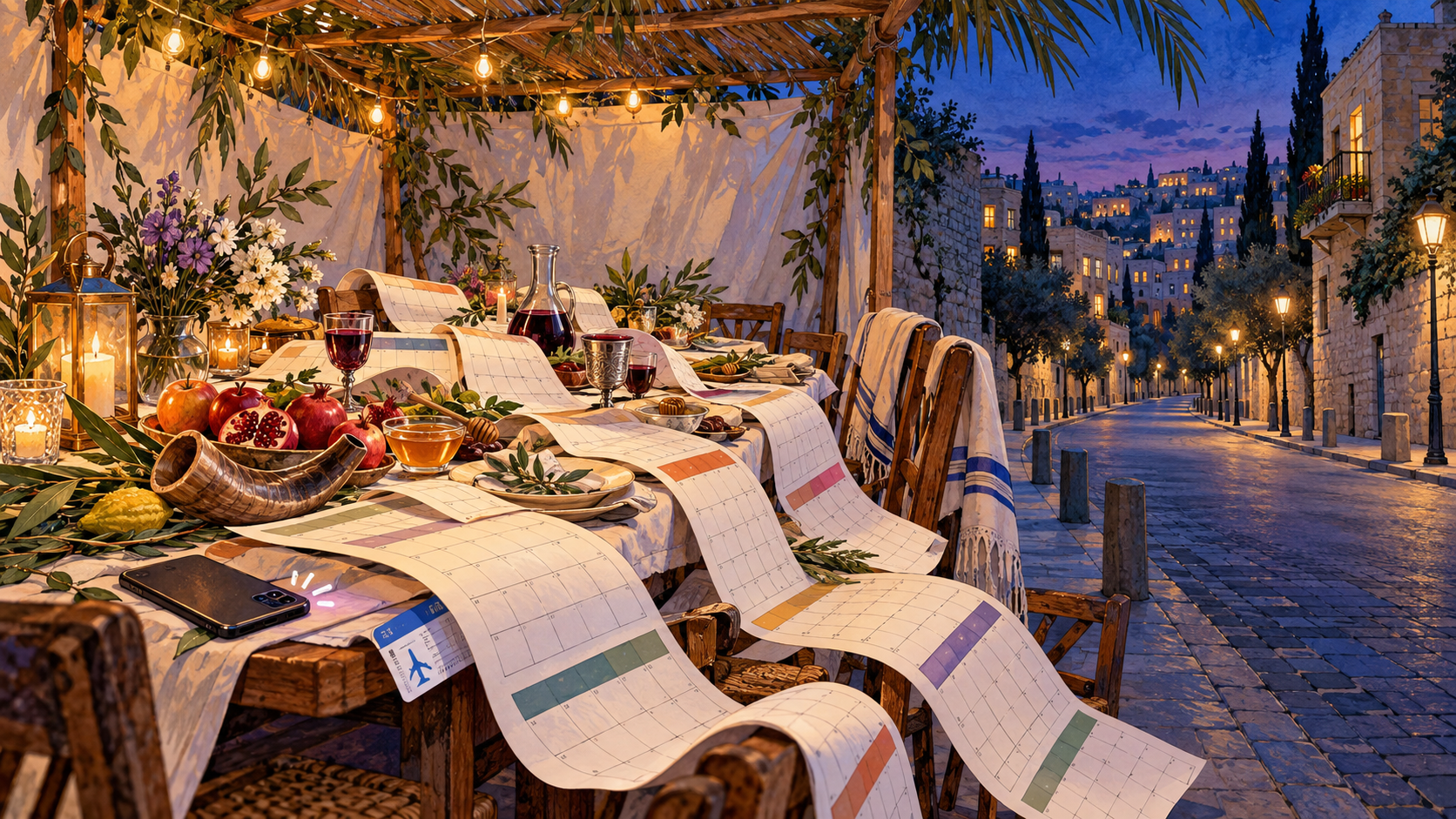
(Image by author)
Israel does not ease you into the new year. It hands you an apple, asks why you have left dress shopping until the last possible minute, blows a shofar at your remaining illusions, and then empties the roads so you can think about what you have done. A few days later, it expects you to eat outdoors beneath foliage secured by optimism and cable ties. This is known, apparently without irony, as the season of our joy.
Rosh Hashanah arrives in a rush of honey, good intentions and the conviction that this year we will be organized. We promise to be more patient, more present and less likely to agree to something without writing it down. I managed to forget an invitation made to me on Shabbat Shuva and accept another one for the same Sukkot meal. My hosts had to remind me of the first. Nothing says spiritual renewal quite like explaining to the people you adore that your calendar exists in several locations, none of which are accessible to your brain.
Yom Kippur is supposed to stop the noise. In Israel, it actually stops the traffic. The roads empty, the airspace closes, and for a brief, astonishing interval the country sounds as though it might let a person finish a thought. Mine did not. At shul I saw my older brother, who has withdrawn from me and much of our family. He was barely civil. His wife sat beside me throughout the day and was loving. It was an impressive piece of emotional choreography: tenderness on one side, estrangement in view, and me reciting prayers for forgiveness while trying not to make a facial expression that would require its own apology.
I would love to tell you that the fast ended in reconciliation, because that is how a decent script would behave. Real families are less respectful of structure. His wife’s kindness was real; so was his distance. Yom Kippur gave me hours in which to feel both. I left with no grand verdict, although I did have a renewed appreciation for the person who chose to sit beside me. Sometimes that is the entire miracle available, and it is rude to send it back for being insufficiently cinematic.
Meanwhile, the other plots refused to wait for an appropriate festival. A lovely gentleman I thought I was dating told me he is not ready to commit. He remains lovely, which rather spoils any hope of casting him as the villain. I appear to have gained a friend, even if the furniture in my head has yet to be rearranged. Someone else used a group WhatsApp for a display of passive aggression. There is a special talent involved in making a private jab before an audience while merely appearing to enquire whether a particular (named… me) person can contact them, as their earlier message to me didn’t go through… which it wouldn’t, because they are blocked!
This is the point at which an ordinary lifestyle column would advise me to breathe, set boundaries and buy a notebook. Israel, however, has its own editorial schedule. On Thursday, Benjamin Netanyahu addressed the UN General Assembly after diplomats walked out. On Friday, the IDF announced it was bolstering forces across its fronts for Sukkot. We debate seating arrangements beneath a new sukkah while soldiers prepare to remain on alert. My ridiculous double booking and the country’s security are not equivalent crises. They do, however, inhabit the same Friday afternoon, the same phone, the same head trying to remember whether there is enough wine.
After the chagim, I am flying to South Africa for a month to help my mother downsize the practice she has built over sixty years. My younger brother and I are sharing inventories: equipment and books to sell, things to donate, others to discard. Mom was among Johannesburg’s outstanding occupational therapists. Her children would argue for a higher ranking, but we are awaiting an independent panel prepared to withstand all of us. A therapy swing can be priced. What Mom knew how to do with it cannot. This, too, is happening while the rest of the country hangs decorations from a roof designed to come down next week.
Perhaps that is why I want to spend the chagim here with my kehilla before I go. The holidays do not put the country or its people into a single mood. Rosh Hashanah did not make me organized. Yom Kippur did not make my family simple. Sukkot will not settle the world, repair my romantic prospects or tell us what to do with six decades of occupational therapy equipment. It will give us somewhere to sit together, even as all those things remain true. That is considerably more useful than another lecture on becoming a new person by Monday.
So I will go to the sukkah carrying gratitude, irritation, a plane ticket, a friendship I did not expect and the mild shame of having double-booked myself with people who were kind enough to invite me. Somewhere, our prime minister has finished addressing the world; somewhere, soldiers will spend the holiday on duty. The year has barely begun, and everybody already has several things to hold at once. I have not run out of words. I am simply living in a country that refuses to let any sentence end before the next one begins.
Related Topics