
Geopolitical strategist pioneering solutions to world's intractable conflicts
There are billions for needy Egypt to take, but it has not
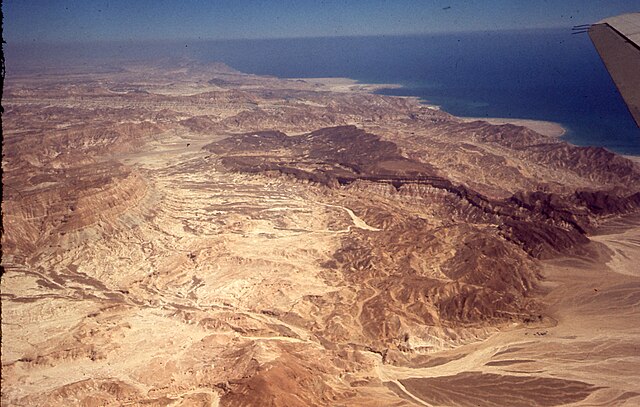
Sinai from the air - National Library of Israel - Courtesy Wikimedia Commons
Egypt is one of the three lynchpins of the PEIS Plan to end the Israeli-Hamas War and resolve the Israeli-Palestinian Conflict once and for all. In the meantime, Egypt is in dire economic straits.
On March 7, 2024, Egypt struck a deal to borrow $8 billion from the IMF, adding to its $70 billion of external debt. Egypt is now one of the most indebted countries in the world. All these loans come with strings attached. Under international pressure, the Egyptian central bank floated the pound, causing it to drop 38% and exacerbating the existing high inflation. The Gaza War already hits Egypt hard. But there is a way out for Egypt: It can stop the war, resolve the conflict, and earn billions. This is the PEIS Plan.
THE PEIS PLAN
The Palestinian-Egyptian-Israeli-Sinai (PEIS) plan proposes that Egypt sells part of the Sinai Peninsula to the Palestinians, the Palestinians sell the West Bank to Israel and use the remittance to pay for its Sinai purchase, which they will combine with the Gaza Strip to form a New Palestinian state. The Israelis buy the West Bank and fulfill their yearning for Judea and Samaria. The PEIS Plan was introduced with this overview article. The Israeli-Palestinian conflict is already intractable with only two namesake parties; adding the Egyptians seems to be a recipe for more deadlock. One way to untangle is to approach each party separately and ask, “What’s in it for you?” A second article asked the Israelis if they wanted to buy the West Bank. Now, the “what’s in it for you” question is posed to the Egyptians: Do you want to sell part of Sinai?
THE PEIS SINAI
The Sinai Peninsula is the tale of two parts. The “good” part is the western and southern Sinai with the Suez Canal and the famous Red Sea Riviera. This part makes money for Egypt: $9 billion in 2023 from the Suez transit fees and billions more from the Riviera tourism. This part is not for sale. The “bad” part is the northern Governorate, with its Sinai desert and the sparsely populated mountainous hinterland. There has been a restive Bedouin uprising since 2011, now taken over by Islamist insurgents, plus the troublesome border crossing with Gaza. Egypt will sell this part to the Palestinians under the PEIS Plan – let’s call it the PEIS Sinai.
This article explores the economic and political ramifications of selling the PEIS Sinai – the PEIS book discusses other factors. How much will Egypt get for its PEIS Sinai? The buyer is the Palestinians, and they don’t have the money. To pay the Egyptians, the Palestinians will sell the West Bank to the Israelis. Although the PEIS Sinai is six times bigger than the West Bank, since Israel will only fund its West Bank purchase, the prices of the two territories will converge into a single number, referred to as the “PEIS number.”
The PEIS number consists of two buckets. The first bucket is the substantial one-time down payment. The Palestinians will remit the Israeli down payment for the West Bank to the Egyptians for the down payment for the PEIS Sinai. The second bucket is the recurring multi-billion mortgage payments for several years. Every year, Israel will get legal ownership of more land in the West Bank, the same for the Palestinians in the PEIS Sinai. Eventually, the West Bank will be fully part of Greater Israel, and the whole PEIS Sinai will belong to the New Palestine state.
By the way, what is Egypt really selling? Egypt will sell to the Palestinians the sovereignty of all the lands in the PEIS Sinai and the ownership of all governmental assets. The owners of private assets will keep their ownership. If New Palestinians want to own these private properties, they have to buy them from the Egyptian owners at market pricing.
Economic benefits
The economic benefits have two columns: expenses and revenues. In the expenses column, there will be cost-savings: no more expenses to assuage the Bedouins, fight the Islamist insurgents, push back the Gazan refugees, or maintain border security with the Israelis – let the New Palestinians deal with those. With a stroke of a pen, President Sisi will cut the Gordian Knot and distribute the millions saved to the 95% of Egyptians living on the mainland.
In the other column, there will be revenues from existing assets and new revenues. Egypt’s top two assets can earn money again and some more. The income from the Suez Canal has plummeted due to the Houthi’s Red Sea attacks in solidarity with Hamas, squeezing the already teetering Egyptian economy. The PEIS Plan for the West Bank will induce a ceasefire in Gaza, removing the Houthi’s rationale and restoring the Suez Canal’s contribution to the Egyptian treasury. Furthermore, once peace takes hold, trade and commerce in the Middle East will make the Suez Canal more busy than ever. Wars and insurgency are also bad for the tourism industry. A permanent peace will bring tourists back to visit the ancient wonders along the Nile River and sample the natural wonders and resorts dotting the Riviera. Cruise itineraries will stop at the Mediterranean and Red Sea ports of all three Egyptian, New Palestinian, and Israeli countries (the EPIc states). On land, the old hajj routes between Cairo to Jerusalem and Mecca will be re-opened for pilgrims to rediscover many forgotten holy sites in the Sinai. The tourism industry employs about 2.5 million Egyptians now and will need more with the peace dividend.
The first new revenue is the Egyptian take on the PEIS number. President Sisi will receive on behalf of the Egyptian people an initial tens of billions down payment and annual multi-billion mortgage payments. Unlike foreign loans that come with strings attached, this money is for him to use in whichever way he likes. He can pay down debts to strengthen the pound, lower inflation, and help the people pull up by themselves. He can spend on subsidies and giveaway measures that make the poor and working class dependent on the government more than ever. He can invest in pharaonic projects, such as the continued development of the $58 billion New Administrative Capital. The best part is that this money will come from Israel, Egypt’s historical nemesis and regional competitor.
The second new revenue comes from the nation-building next door. Six million Palestinian refugees will “return” to their new homeland; many of the three million Palestinians living in the West Bank will emigrate to New Palestine; and the two million Gazans will rebuild after the disastrous war. A clause in the PEIS Plan gives Egyptian (and Israeli) companies preferential treatment in this new market, aiming to create an EPIc economic tie between the three countries.
Political benefits
While the Gaza War has elevated Egypt as the indispensable mediator, demonstrations have erupted in Cairo due to the increased Gazan casualties and the unreciprocated deaths of Egyptian border soldiers. While small, these demonstrations called into question President Sisi’s ability to respond to Israeli belligerence and could grow to include other domestic grievances. A previous article describes how the PEIS Plan can end the Gaza War and make President Sisi a hero.
Will he be accused of selling a piece of matrimony? Egypt has done it before. In 2017, Egypt ceded two strategic Red Sea islands to secure Saudi Arabia’s financial assistance. Due to the worsening cash crunch, Egypt has been selling state assets to private parties – such as a reported $1.9 billion privatization in 2023. In March 2024, Egypt announced a $150 billion land deal with the UAE regarding Ras Al-Hekma, one of the few remaining unscathed havens on the shore of the Mediterranean Sea. The huge tag was based on optimistic valuations and unrealized profits without taking into account the significant expenses of developing this remote area. The proceeds from selling the PEIS Sinai are different: they are “money in the bank” for Egypt.
This unexpected windfall can make President Sisi the father of the “New Egypt.” Egypt gained independence from Britain in 1922 and then got mired in persistent poverty: 40% of Egyptians still earn as little as $2 a day. Egyptians will know about the PEIS number, and the consuming question in their minds will be, “What’s my cut?” President Sisi will ensure that the common people’s pockets will be lined, and his popularity secured for the rest of his six-year term. The arcing story is how their pockets will be lined and what happens to the rest of the money. If the pockets are lined with handouts in perpetual dependence on the government, and the rest of the money goes into the pockets of military men and the inner circle of acolytes, then it will be the familiar story of Egypt. On the other hand, the PEIS money also allows President Sisi to invest in a meritocratic government and private enterprises that create a path for Egyptians to elevate themselves through hard work and entrepreneurship, and transform the old Egypt into a “New Egypt,” democratic and prosperous, as he imagined Egypt would be in his early days of an idealistic military officer.
No matter what future Egyptian history books will say about President Sisi, by letting go of the PEIS Sinai to secure the peace that has stymied generations, he will be in the pantheon of the greatest peacemakers of human history.
The decision
There is an earlier concern that the Israeli-Palestinian conflict is already intractable with two antagonists; adding a third party would create more deadlock. This ain’t so. With only the Israelis and Palestinians facing each other, the only thing they can discuss is the West Bank; both of them want it entirely for themselves, and any two-state solutions that attempted to divide this piece of land among the two peoples that wanted all of it, automatically failed. Adding Egypt means adding a new piece of land – the PEIS Sinai. Now, suddenly everybody can get what they cherish the most, mutually exclusive of the other parties. The Israelis can have the West Bank all for themselves (with exceptions); the Palestinians can have a viable nation they can build without Israeli meddling; the Egyptians can get a windfall to make Egypt great again. The seemingly overlapping point is the PEIS number. Once this number is negotiated and agreed upon, the rest is secondary and will fall into place.
For all this to happen, Egypt must first agree to sell the PEIS Sinai. What will be the Egyptian decision?
Related Topics
Related Posts