
A believer in peace and human dignity
There cannot be a national unity government without the Arab parties
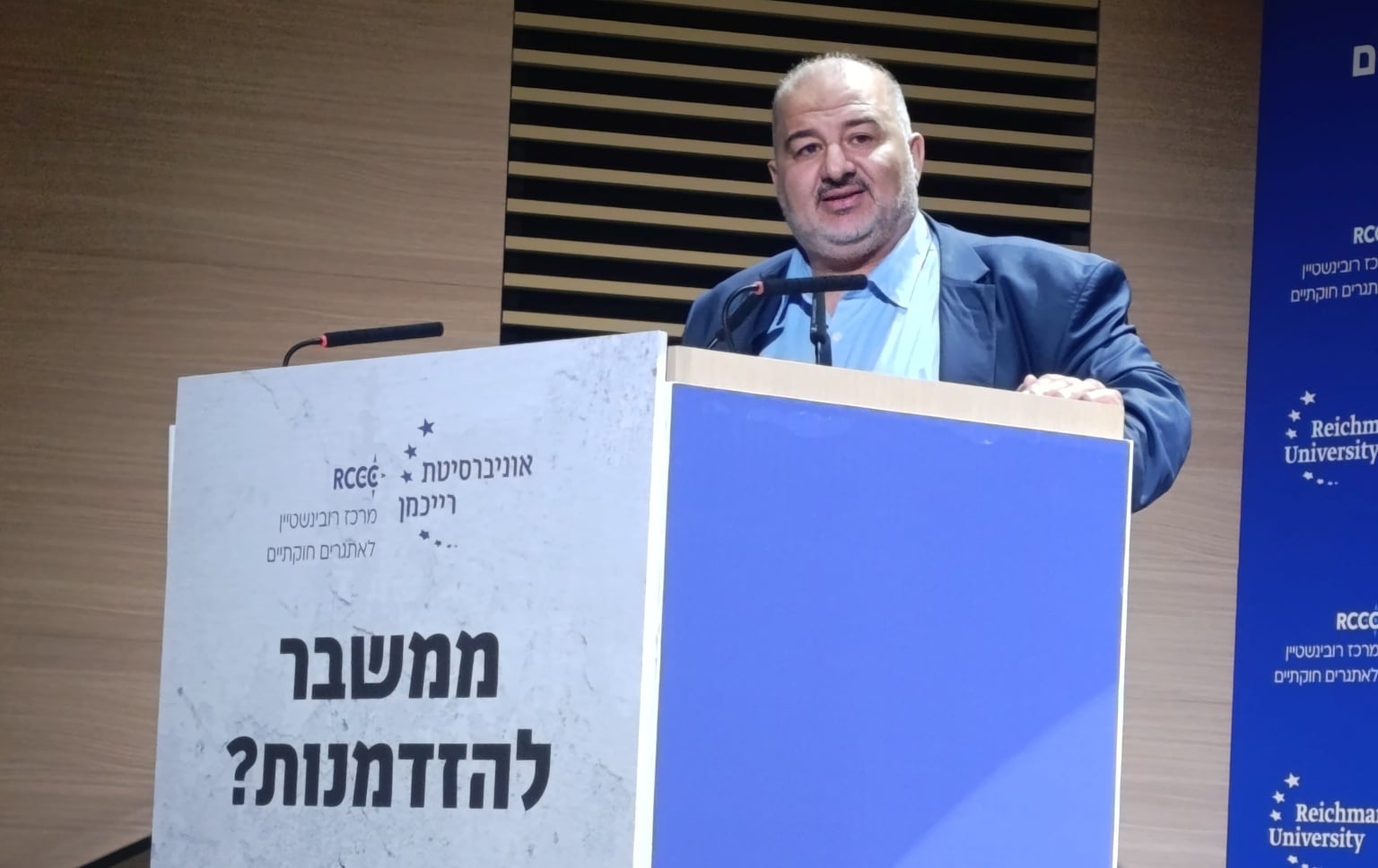
Mansour Abbas, leader of Ra’am, in 2025, at the "From Crisis to Opportunity" conference held by the Rubinstein Institute for Constitutional Challenges at Reichman University in Herzliya, Israel.
In his speech to the Knesset after it was sworn in, prime minister Benjamin Netanyahu aggressively made the case against participation by Arab parties in the Israeli government, and he declared, “We must do one thing: set aside every other consideration and form a national unity government”. I see this as a contradiction.
In the same speech, Netanyahu said, “What do you think will be the real goal of these parties? Merely to improve the social welfare of Israel’s Arab public? We have no problem with that.” He also said, “Arabs vote Likud, vote for all the parties.”
It’s a nice sentiment, but how realistic is it?
Based on the 2022 election, 86% of Israeli Arabs vote for Arab-majority parties while only 14% vote for Jewish-majority parties. Arab presence in non-Arab parties is very sparse as well. According to the Israel Democracy Institute, all Jewish-majority parties combined have only two non-Jewish members in the Knesset. Two happens to also be the number of Jewish members of the Knesset for the Arab parties: one for the Joint List and one for Ra’am. Interestingly, Arab parties have a higher proportion of Jewish members than Jewish parties have a proportion of Arab members.
Even the widest coalition of Jewish parties would represent only 14% of Israeli Arabs, and if that coalition does not include the most moderate Jewish parties, it is likely that the Arab representation would be almost non-existent.
So, it is absurd to talk about a national unity government if not even one Arab party is included.
Blogger and Jewish Israeli Alyssa Eisenstein made an excellent case for inclusion of both Ra’am and the Joint List in the Israeli government. I recommend reading what she wrote. I am not going to try to make the case myself since she has already made it so well, but I will highlight two points.
Eisenstein wrote that including Ra’am and the Joint List in the Israeli government “will likely make many Jewish Israelis deeply uncomfortable. It will require us to confront difficult questions about political power, national identity, Judaism, democracy, and the very nature of the State of Israel. That’s precisely the point. As a Jewish Israeli, I believe this is a conversation — and a national reckoning — we urgently need.”
That’s a fundamental point. Israel is a complex and diverse country where differences are celebrated. Isn’t this what the pro-Israel advocates say? They are mostly right, but there is still work to do. Israel has not yet fully matured as a diverse country that includes a large minority of Arab citizens. It’s time to take that step.
Eisenstein also wrote that, “Bringing Arab parties into a governing coalition does not require endorsing every position they hold, nor does their inclusion mean the inevitable creation of a Palestinian state”.
She is correct, but I would go further. If the Arab parties help with the creation of a Palestinian state, it would be the best service that they could ever make to Israeli Jews. As I explained in my previous blog, the only long-term possibilities for ending the Israel-Palestinian conflict are a two-state solution or a binational state. A two-state solution means that there will still be a Jewish state. A binational state means that there won’t.
This is, among other things, a reality that Israeli Jews must confront, which most Jewish-majority parties have refused to do.
Israel cannot be a true democracy until Arab participation in the government is real rather than symbolic, or even worse, non-existent.
Israelis must get their minds around the fact that Israeli Arabs, or at least the vast majority of them, aren’t Zionists. That should not stop them from being in the government. It didn’t stop Haredi parties from being in the government, so why is it a big problem for Arabs and not for Jews?
Zionism has been realized. Jews have a country. Having some members of the government who aren’t Zionists shouldn’t be a problem. As an Arab who happens to be a Zionist, I find myself a minority of one in most instances where I am among other Arabs, but it doesn’t mean that all those other Arabs are out to destroy Israel.
Five years ago, Mansour Abbas declared that Arabs should move past contesting Israel’s Jewish identity. Isn’t it time for Israeli Jews to accept the Arab identity of 20% of their country’s citizens?
The fact that Gadi Eisenkot, leader of the Yashar party, may not be able to form a government without the Arab parties is a blessing rather than a curse. I hope that Israel will seize this opportunity to build a true national unity government.
Related Topics
Related Posts