


Courtyards and Characters: Wandering Through Jerusalem’s Living Stories
There Is No Such Thing as Israeli Cuisine
What a walk through Jerusalem’s open-air market taught me about the Ingathering of the Exiles
I found myself wandering the halls of Jerusalem’s Museum of Tolerance again this week.
It’s an extraordinary building. It also happens to sit atop part of a 700-year-old Muslim cemetery, earning it the less flattering nickname, the “Museum of Intolerance.”
I wanted to give it another chance. I parked in the underground garage, walked through the front doors, and wandered the empty halls.
There were only a handful of visitors in the entire building. Downstairs, in a side room, there’s a small October 7 exhibit that feels almost like an afterthought. A few photography galleries fill a fraction of the cavernous space, and other than that, mostly crickets.
It is one of the largest and most expensive museums in Israel. It took more than twenty years to complete. Yet somehow it doesn’t really feel like a museum. It feels like a building waiting for someone to figure out what to do with it.

And as I walked through its mostly empty halls, I found myself thinking, I know what story belongs here.
I’ll come back to that.
But first, let me tell you about something that happened last week.
A History Lesson in the Shuk
I was guiding a Christian friend on her first visit to Israel. Like any good tourist, she asked a great question:
“So what’s the typical Israeli cuisine?”
She was probably hoping for a good restaurant recommendation. Instead, she got a history lecture. Sometimes I feel bad for my clients.
“There really isn’t any such thing as Israeli cuisine,” I told her.
She looked confused.
“Let me explain.”
We were standing in Jerusalem’s Machane Yehuda Market, so instead of answering with words, I answered with food.
First we stopped for malawach, that delicious, flaky, pan-fried bread that Yemenite Jews brought here when they arrived, mostly in the 1950s. We spread it with tomato, fiery green schug, and hard-boiled egg, and ate it while standing in the middle of the market.
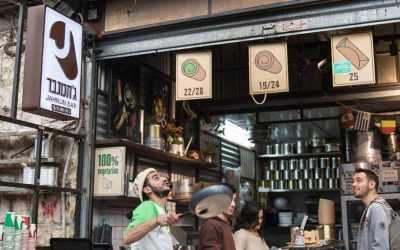
A few stalls later we shared a mufleta, the impossibly thin, buttery pancake that Moroccan Jews traditionally prepare at the end of Passover, covered with butter, honey, chocolate spread, or jam.
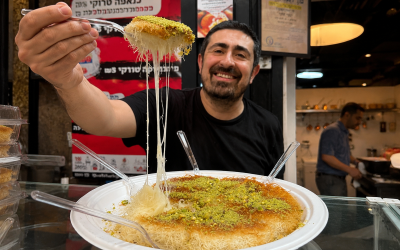
And I couldn’t let her leave without tasting kanafe, that famous dessert claimed by half the Middle East. Ours was made by a Jewish immigrant from Istanbul: shredded kadayif pastry wrapped around sweet cheese, soaked in syrup, sprinkled with pistachios, and served with a scoop of vanilla ice cream.
Somewhere between the malawach and the kanafe, she understood my answer.
There is no such thing as Israeli cuisine because every dish in Israel is an immigration story.
There are more than seven million Jews living in Israel today. They came from well over one hundred countries: Morocco, Iraq, Yemen, Iran, Tunisia, Ethiopia, India, Russia, Argentina, France, America, and many others. Wherever they came from, they brought their language, music, customs and always their recipes.
That is the story Israelis call Kibbutz Galuyot or the Ingathering of the Exiles.
The Impossible Return
To me, it is not simply one remarkable chapter of Jewish history. It has to be the most extraordinary human story ever told.
Since the Romans destroyed the Second Temple in the year 70 CE, the overwhelming majority of the Jewish people lived scattered across the globe, and they remained that way for close to two thousand years.
It’s hard to believe today, especially when you’re stuck in standstill traffic or waiting in an impossibly long line at the bank, but in the late nineteenth century, only about 6,000 Jews lived in the Land of Israel.
Then, in 1881, the modern aliyah or immigration began.
By the time of the Balfour Declaration in 1917, there were already about 60,000 Jews living here.
On the eve of Israel’s independence in 1948, there were 600,000. And, within just two years of statehood, Israel absorbed another 600,000 Jews, doubling its population almost overnight.
That’s like the United States absorbing 330 million new citizens in two years.
Today, more than seven million Jews live in Israel, and researchers estimate that by mid-century, a majority of the world’s Jews will once again live in the Jewish homeland.
In 2025 alone, nearly 22,000 Jews from 105 countries came home to Israel.

Where did all these Jews come from? The answer is quite simple.
They came from the countries in which they had lived during nearly two thousand years of exile.
Of course, for religious Jews, we see this as the fulfillment of the Torah’s ancient promise that God would “gather you from all the nations” and bring you back to the land of your ancestors. But whether one sees prophecy or history, the scale of what happened is astonishing.

But to me, something else is even more remarkable.
Did you ever wonder how exactly did the Jewish people manage to maintain their identity as a nation in exile, eagerly awaiting their return to their homeland, for nearly two thousand years?
A Thought Experiment
Imagine that every Swiss citizen were gathered, loaded onto airplanes, and scattered across the globe. Millions settled throughout Russia, Europe, South America, Asia, and Africa—basically everywhere.
Now send out a team of researchers to interview them and ask one simple question:
“Who are you?”
The first generation would certainly say, “We’re Swiss citizens currently in exile, eagerly awaiting our return home.”
Perhaps even the second generation would feel that way. But after ten generations? How about twenty? And after nineteen hundred years?
How many descendants would still identify themselves as Swiss citizens living in exile, praying daily to return to Switzerland?
The answer is obvious. None.
Yet if you had asked Jews almost anywhere in the Diaspora, at almost any point during those nineteen centuries, “Who are you?” the answer would have been remarkably consistent.
“We are Jews. We are in exile. We pray to return to Zion.”
Think about that for a moment. And then, against every historical precedent, they actually did return.
Just as the biblical prophets foretold, the Ingathering of the Exiles began. Jews who had somehow maintained their identity as members of the nation of Israel while living in exile uprooted themselves from Eastern Europe, Iraq, Ethiopia, Yemen, Morocco, Turkey, and dozens of other countries, bringing with them not only their hopes but also their languages, traditions, recipes, and memories. They brought flaky malawach, paper-thin mufleta, absurdly delicious kanafe, and countless other dishes, each telling the story of a different Jewish community that had finally found its way home.
Is there another story like this anywhere in the annals of human history?
The Story This Building Was Meant to Tell
Which brings me back to the Museum of Tolerance.
If Jerusalem Mayor Moshe Leon ever decides to send me an email asking what I think should become of that building, I’ll have my answer ready.
Don’t build another museum about coexistence. And definitely don’t build another museum about antisemitism.
Build the Museum of the Ingathering.
Imagine walking through galleries devoted to the Jews who returned from Poland, Lithuania, Germany, Spain, Iran, Egypt, Syria, Turkey, Georgia, Bukhara, South Africa, Australia, and dozens of other communities. Each gallery would tell the story of a different exile: what life was like there, why they left, and how they found their way home. Visitors would see prayer books, family photographs, wedding dresses, recipes, children’s toys, battered suitcases, recordings of disappearing languages, and video testimonies of men and women explaining why they left everything behind to begin again in a land many had never seen.
Every room would tell another chapter of the same impossible story. Not just how the Jewish people survived nearly two thousand years in exile, but how, against every historical precedent, they made it home.
Why We Came
To me, this isn’t merely a Jewish story. It is one of the greatest stories humanity has ever witnessed. And if I’m being completely honest, it’s also our story. It is the story that brought my family here five years ago this month.
Why would we leave behind a comfortable life in America to start over in a tiny country halfway around the world?
Because at some point we realized that we didn’t want to just read and hear about this story any longer.
We had an opportunity to become part of it. And was an opportunity too extraordinary to refuse.