
A Mermaid in Jerusalem
Featured Post
There will be war
The Torah pulls no punches about battling enemies, but it also tells us how to make sure we don't lose ourselves in the process (Ki Teitzei)
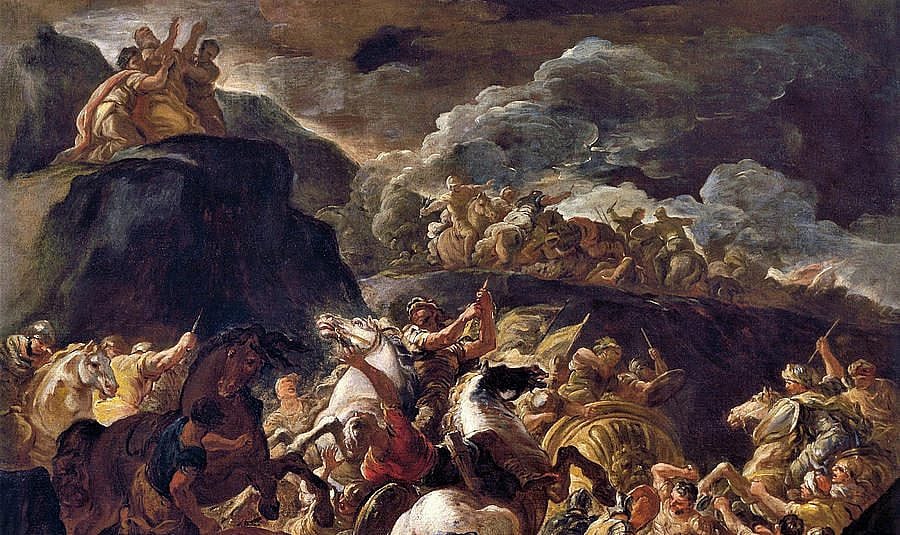
'The Battle of Israel and Amalek,' painted by Luca Giordano in the 17th century, and digitally remastered. (Pexels)
Not long ago, I was walking through the shuk in Jerusalem, weaving between stalls of spices and olives, when I bumped into an old friend. He asked me, “How are you doing?” and I didn’t know how to answer. I thought about the headlines, the war, the hostages, the demonstrations outside synagogues in Europe, Israeli women being jeered at a Coldplay concert… the faces of children on both sides of the border… and all I could manage was, “It’s a lot.”
And he nodded. “It’s always been a lot. But keep going.”
That exchange has stayed with me for many reasons, but a key one is that it leans into this week’s Torah portion, Ki Teitzei, which begins with the words “When you go out to war.” It does not pretend war is an accident. It says straight up: There WILL be war. There will be enemies. There will be fear and rage.
And that has proven to be true.
But instead of telling us how to win, the Torah tells us how not to lose ourselves.
This parashah is a series of laws. Some are discombobulating, some uplifting, some confusing. But together, they teach one thing: in the chaos of violence, we must build fences around our humanity.
We are told: If you see your neighbor’s ox or donkey fallen, don’t hide your eyes. Lo tit’allem. Don’t look away. In war, it is easy to harden your gaze, to see only your own suffering. But Torah says: don’t look away from your brother’s loss or from your neighbor’s burden. Don’t look away from the hostages still in Gaza. Don’t look away from Jewish communities facing antisemitism that has slithered into the mainstream. And also, don’t look away from Palestinian children caught in a nightmare not of their choosing.
We are told: Build a parapet around your roof, ma’akeh, lest someone fall. That’s not about architecture. It’s about community responsibility; and, if you extend this into metaphor, it means guardrails in our speech, in our policies, in our actions, so fewer lives topple into the abyss.
We are told: Don’t let a body hang overnight, don’t strip the poor man of his cloak, don’t humiliate even when punishing. In other words: dignity is non-negotiable, even in the fog of war.
And then comes a passage that complicates the picture: No Ammonite or Moabite may enter, even to the 10th generation, because they denied you bread and water and hired Balaam to curse you. Do not seek their peace. But the children of Edom are your kin, and the Egyptians were your hosts; their descendants may enter after three generations.
On the one hand, the Torah says: Remember betrayal, don’t be naïve, hold boundaries. There are those who cursed you, those who denied you sustenance — you don’t erase that.
On the other hand, the Torah also says: some former enemies can become kin. Even Egypt, where we were enslaved, may be folded back into relationship after time.
What does this mean in terms of our own history? By now, most of us don’t blame the descendants of Nazis for the sins of their grandparents — even if many of us refuse to buy German cars. Most of us harbor no ill will towards Spain for their centuries-old sin of Inquisition — hell, we vacation there! We have peace with Jordan and Egypt — a cold peace, but still, peace.
Does this mean one day we will forgive Gazans, too for the wholesale slaughter of our people on October 7?
Does this mean they will forgive us for our part in their pain?
But then we are also told: Remember what Amalek did to you on the way, attacking the stragglers and faint when you were weary, and not fearing God. When the Eternal your God gives you rest, blot out the memory of Amalek from under heaven. Do not forget.
So Torah gives us a double lens: never forget cruelty — and never erase the possibility of transformation. That’s hard to hold, but it is the only way forward.
This is the razor’s edge we walk now. We know that some families in Gaza actively tortured and held our hostages. And we know many others did not. Torah demands individual accountability, without damning entire peoples… and at the same time, it insists that evil be remembered, named, and opposed.
Finally, we are told: use honest weights and measures. Because nothing corrodes a society more than crooked scales. Antisemitism is the crooked scale of our age — the refusal to weigh Jewish suffering with the same measure as anyone else’s. And Torah calls that an abomination. But Torah also warns: If we adopt crooked measures ourselves, if we dehumanize others, then we become what we hate.
So what does Ki Teitzei ask of us, here and now, in a moment of war, grief, and disorientation?
It asks us to be the people who don’t look away. The people who build guardrails. The people who protect dignity, even under fire. The people who remember Amalek, but refuse to become Amalek. The people who carry memory of betrayal, but still leave the door open for reconciliation after generations. The people who hold honest scales in a crooked world.
That is how we “go out to war” without losing the war for our own souls.
I will try to hold on to that.
—
Thank you Rabbi Evan Schultz and Rabbi Chuck Davidson for your insights on this.
Related Topics
Related Posts