


NEVER AGAIN IS NOW!
There’s a land that I heard of once in a lullaby…
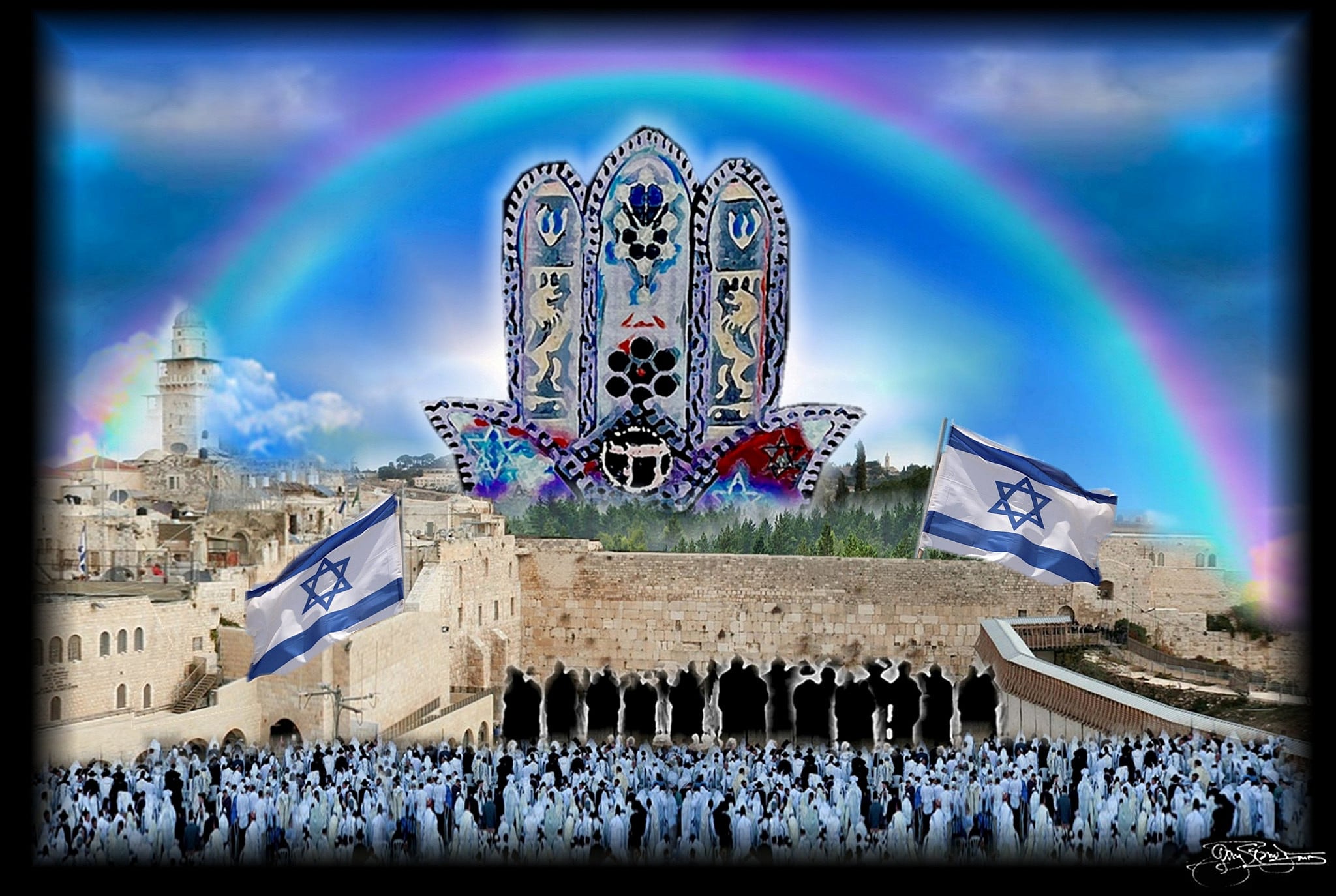
Original artwork and photo-montage by Gary S. Branfman.
This week, in 1939 cinema history, The Wizard of Oz was released to rave reviews and critical acclaim. Italy’s University of Turin studied and surveyed 47,000 international films. The Wizard of Oz was named “most influential film of all time”.
Inspired by Lyman Frank Baum’s 1900 children’s classic, “The Wonderful Wizard of Oz”, which unapologetically sprouted Populist, adult-oriented allegories and metaphors spotlighting the political, economic, and social controversies of the time.
In the narrative, the Scarecrow portrays the American farmer and their troubles in the late 19th century. The Tin Man represents the American factory worker and the steel industry’s failure to combat increased international competition. The Cowardly Lion represents a blustery politician and orator, with no leadership qualities. The winged monkeys are the militaristic terroristic pawns of a ruthless dictator.
The Emerald City itself represents the complexities of the American dream and the challenges of achieving it in a landscape marked by inequality and illusion. Baum’s book as well as the MGM film embrace feminism by placing only women in positions of power, strength and bravery.
The leading men are flawed, heartless, brainless, fraudulent and lack courage.
More thorough, detailed and thought-provoking interpretations of Baum’s original story are as voluminous as they are varied.
https://medium.com/illumination/behind-the-curtain-the-wizard-of-ozs-political-allegory-decoded-2df3c7bd2a74
https://lawliberty.org/the-wizard-of-oz-as-an-allegory-for-the-1896-presidential-election/
https://study.com/academy/lesson/the-wonderful-wizard-of-oz-by-l-frank-baum-symbolism-analysis.html
With all these complexities in mind, screenwriter Noel Langley presented a script to Metro-Goldwyn-Mayer Corporation. Unsatisfied with his adaptation, MGM hired a team of Jewish screenwriters including Herman Mankiewicz, Irving Beecher, Edgar Woolf, and Herbert Fields whose rewrites included a constant undeniable flow of Yiddishkeit. The final script was completed on 8 October 1938, one month before Kristallnacht.
While Baum’s story centers around the fantastical adventures of an 8-year-old girl with no mention of a dream, fantasy, or rainbow, the film differs in that it centers around the fantasy-strewn dreams of a teenage “coming of age” girl on the edge of adulthood, and the proverbial rainbow becomes a central theme.
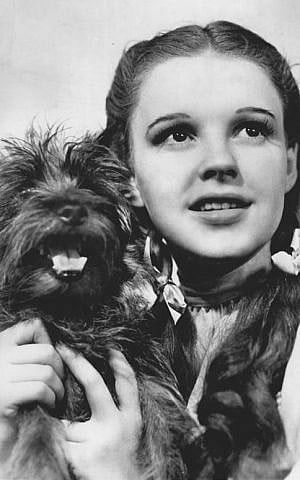
Public domain in the United States, published between 1930 and 1977, without a copyright notice
An angelic figure in the guise of Glinda, the Good Witch, suggests that Dorothy, “follow the Yellow Brick Road.” The “Yellow Brick Road” parallels the “Golden Path” in Buddhism and the Kabbala’s Sephiroth.
These metaphors are spiritual journeys of divine energy and the ascent of human consciousness which, as Dorothy discovers, lead to self-discovery and spiritual awakening.
In an overwhelmingly confusing and complex world, Dorothy yearns to find a lovely, peaceful worry-free world, “Somewhere Over the Rainbow.”
The rainbow serves as a central figure in Jewish scripture and tradition, representing the beauty of the divine presence.
In the Book of Ezekiel, a rainbow appears in Ezekiel’s vision of God’s glory. In the Zohar (the central text of Kabbala), we learn that before the arrival of Mashiach, a brilliantly bright and colorful rainbow will appear. In Genesis 9:12-17 God decrees, “I have set my rainbow in the clouds, and it will be the sign of the covenant between Myself and the world”.
In “Somewhere Over the Rainbow”, Dorothy’s optimistically resonating voice proclaims,
“When all the clouds darken up the skyway,
there’s a rainbow highway to be found,
Leading from your windowpane.”
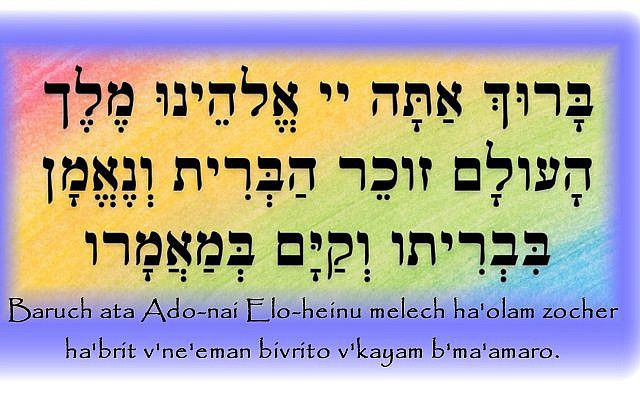
When we witness a rainbow, God commands us to say,
“Blessed are You, Lord our God, King of the universe, who remembers the covenant, and is faithful to His covenant, and keeps His promise.”
Composing the mesmerizing masterpiece highlighting Dorothy’s rainbow obsession was an arduous assignment. It provided a golden opportunity for lyricist Yip Harburg (born Isidore Hochberg, the Yiddish-speaking son of Russian-Jewish immigrants), and Jewish composer Harold Arlen (born Hyman Arluck, the son of a cantor) to honor Zionism.
Hochberg and Arlen’s “Somewhere Over the Rainbow” never mentions or makes any reference to Wizards, Witches, Kansas, or the Land of Oz. Their emotional plea was an homage not to Oz, but to their dreams of a Jewish State in our ancestral Homeland.
On a backdrop of demonic pogroms, Hitler’s reign of terror, the precipice of the Holocaust, and Kristallnacht looming in their rearview mirrors,
Harburg and Arlen penned the optimistic prophetic thoughts in the song’s narrated introduction:
“When all the world is a hopeless jumble
And the raindrops tumble all around,
Heaven opens a magic lane”.
They then refer to, “The land that they heard of once in a lullaby”, and “Where troubles melt like lemon drops”, sounds to me like the land of milk and honey.
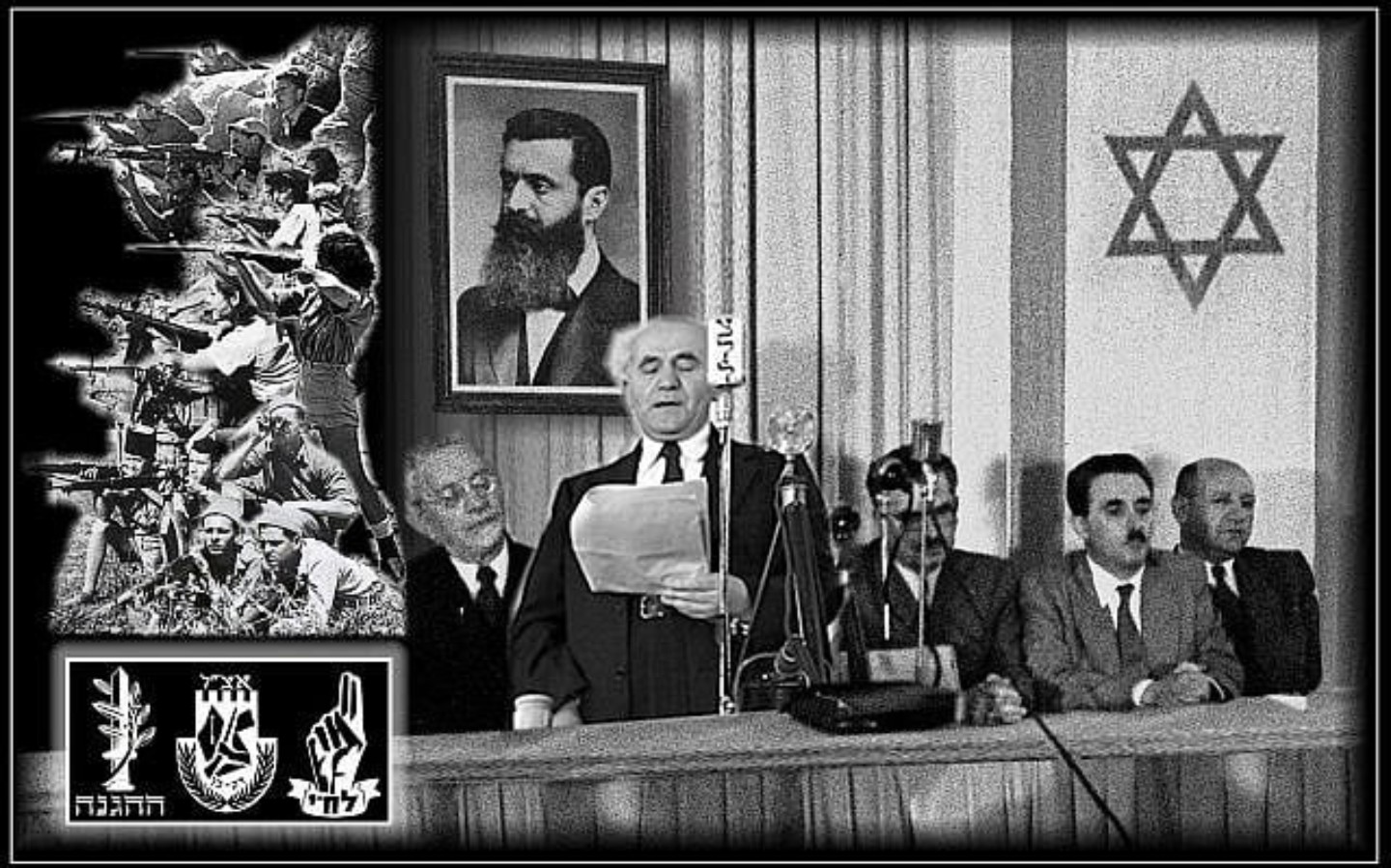
Less than a decade later, from the still-smoldering ashes of Auschwitz, the Modern State of Israel was born.
“Somewhere Over the Rainbow,” received the Academy Award for Best original song. It was voted, “The 20th Century’s No. 1 Song” by the Recording Industry Association of America and by the National Endowment of the Arts. The Library of Congress lists it among, “culturally, historically, or aesthetically significant works”. The American Film Institute placed it on the top of their, “100 Years, One Hundred Songs” list and it received the “Towering Song Award” by the Songwriters Hall of Fame.
In 1998, “Somewhere Over the Rainbow” was played on the first US Space Shuttle to the International Space Station as a wake-up call for our astronauts. It has been covered by at least 1,350 artists, competing masterfully for the most covered song in music history.
In 2014 the Oscars celebrated the song’s 75th anniversary and selected Jewish Performer Pink to perform it.
From the Academy of Arts stage, Pink declared,
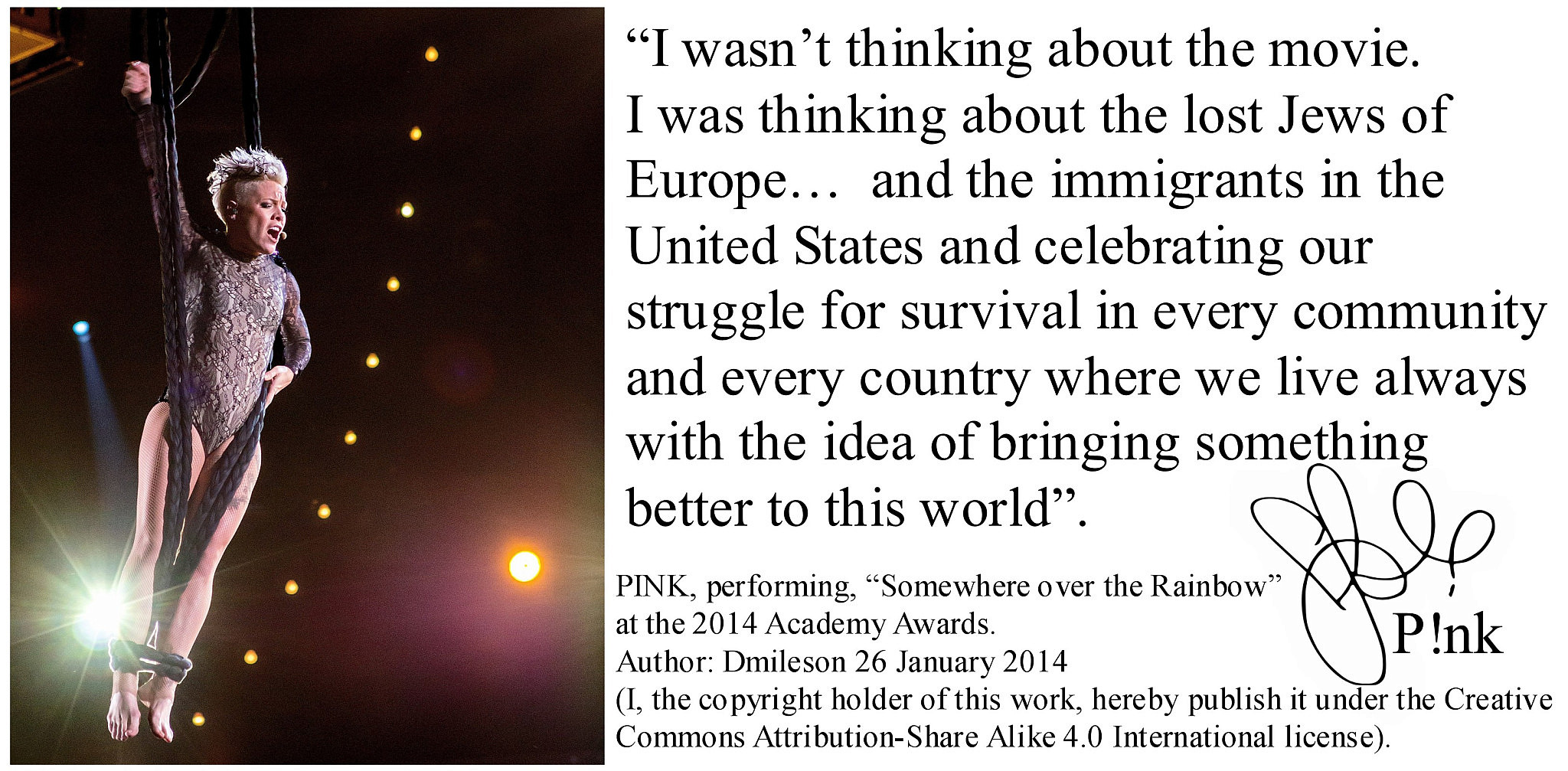 The Wizard of Oz was produced by MGM, founded by Jews Louis Burt Mayer (born Lazar Meir) and Samuel Goldwyn (born Szmuel Gelbfisz), and released by Loew’s Incorporated (founded by Marcus Loew). Today, “The Wizard of Oz” is owned by Warner Brothers (created by those clever Jewish brothers Harry, Albert, Sam, and Jack).
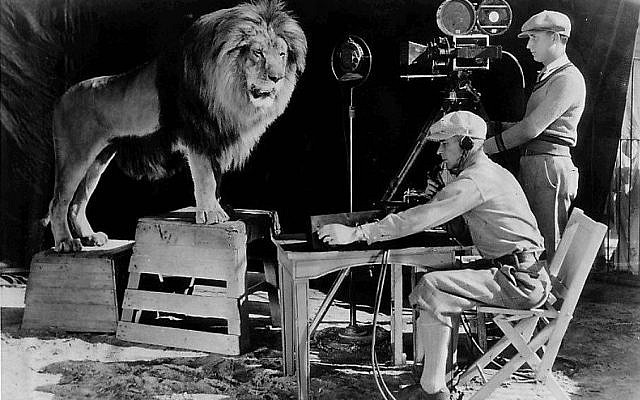
From the Collection of Fred A. Parrish, 28 December 1928
This work is in the public domain in the United States because it was published in the United States between 1930 and 1977, inclusive, without a copyright notice (Wikipedia).
The screenwriters and lyricist took full advantage of the oxymoronic Cowardly Lion. A pitiful example of a lion, yearning to be the Lion of Judah as King, played by Jewish vaudevillian comedian and actor Bert Lahr (born Irving Lahrheim).
Among the Jewish munchkins, Meinhardt Raabe played the Coroner of Munchkin Land. At a towering 3’ 6” tall, he joined the Civil Air Patrol during WWII and served as a pilot and instructor. He later received his MBA from Drexler University. Other Jewish munchkins included Lollipop Guild members Jakob “Jackie” Gerlich and the oldest surviving munchkin, Jerry Maren who passed away in 2018 at the age of 99.
In Baum’s “The Wonderful Wizard of Oz,” Dorothy’s slippers were a somewhat boring silver compared to the sparklingly celebrated “Ruby Red Slippers” of the film, designed by Jewish American costume designer Adrian Greenburg.
Rubies are more valuable than sapphires and emeralds and exceptional rubies can be valued higher than diamonds. In the context of our proverbs, King Solomon reminds us that the value of rubies is surpassed by the values of both wisdom and virtue.
Perhaps the Wise King underestimated their value? Dorothy’s Ruby Red Slippers brought in a whopping $32.5 Million at Auction last year, making them the most valuable movie memorabilia in history.
As Dorothy’s travels on her imagination-propelled slippers, while clicking their heels three times, she reminds us that, There’s No Place Like Home!
NEXT YEAR IN JERUSALEM.
AM YISRAEL CHAI!