

They are not Baishonim nor Rachmonim bnei Rachmonim
*”As IDF plans crackdown on draft dodgers, Haredim roar defiance and prepare for evasion
After army issues over 50,000 new conscription orders, UTJ spiritual leader Rabbi Dov Lando promises to ‘make the world tremble’ if evaders arrested”*
The Gemara in Yevamos 79a offers a remarkable definition of Jewish identity:
“שלשה סימנים יש באומה זו: הרחמנים, והביישנים, וגומלי חסדים.”
“There are three distinguishing signs of this nation: they are merciful, they are modest, and they perform acts of kindness.”
And then comes a startling comment from Rav:
“כל מי שאין בו רחמים — אין בו זרעו של אברהם אבינו.”
“Anyone who lacks mercy — it is certain that he is not of the seed of Avraham Avinu.”
This is not an isolated line; it is an axiom repeated across Shas, Midrashim, and codified in the words of the Rishonim. The implication is radical: if a Jew ceases to reflect the defining traits of the Jewish people — rachmanus, busha, and chesed — it is not merely a behavioral failure, but a question of identity.
This trio of traits is not an ethical ideal; it is a halachic marker. Rashi (Yevamos 79a) comments:
“כיון דאכזרי הוא — בידוע שאינו מזרעו של אברהם.”
Cruelty is not a personality quirk; it is an indictment of spiritual yichus. Rashi understands the Gemara literally: the lack of mercy is a sign of alienness from Avraham’s legacy.
Similarly, the Midrash Tanchuma (Noach 5) says:
“שלשה סימנים יש לישראל… וכל מי שאין בו — יש לחשוש לייחוסו.”
“If one lacks these traits, one must suspect his lineage.”
The Rambam, in Hilchos Issurei Biah 19:17, while discussing issues of forbidden marriages and family purity, references the concept that improper character may reflect a deeper corruption of yichus. This is not about legal status per se, but about spiritual continuity. The Jewish people are not merely a halachic construct — we are a spiritual family, defined by our middos.
The Maharal (in Netiv HaBusha and Netiv HaRachamim) explains that busha and rachamim are not accidental traits — they are expressions of the Tzelem Elokim. Shame is the awareness of standing in front of G-d. Mercy is the application of G-dliness to the world. To be a Jew is to live these truths reflexively.
If someone consistently lacks these traits, the Maharal argues, they are living in spiritual exile — cut off from their root in Avraham, Yitzchak, and Yaakov.
Thus, when a Torah Jew shows no shame in sin, no mercy toward the suffering, and no drive to help others — the question is no longer “what did he do?”The question becomes: who is he?
In our generation, the Jewish heart is under attack.
In some communities, shame is dismissed as weakness — replaced by arrogance. Mercy is replaced by ideological coldness — “we must protect ourselves,” becomes an excuse for silence in the face of injustice. And kindness is replaced by bureaucracy, tribalism, and power.
There are Torah Jews today — leaders — who dismiss the suffering of others as irrelevant, without the slightest busha, who show no compassion for fellow Jews outside their circle.
If these three markers disappear, the Gemara says we must raise the alarm. Not to declare people “not Jewish,” chas v’shalom — but to declare that something is deeply off. This is not about halachah — it’s about neshama.
The Navi Yeshayahu (1:3) laments:
“ידע שור קונהו… ישראל לא ידע, עמי לא התבונן.”
The ox knows its master. But My nation — no longer recognizes who they are.
A Jew who no longer shows rachamim, no longer knows shame, and no longer practices kindness, is not only sinning — he is forgetting who he is. And worse — forgetting whose child he is.
We are the children of Avraham — father of mercy. We are the students of Moshe — the humblest man.
We are the people of Torah — a Torah whose ways are darchei noam.
If we cannot see mercy, shame, and kindness in ourselves — what Torah are we studying? May we merit to feel again. To care again. And may Hashem, Who is merciful, modest, and kind — look upon His people and say: Yes. These are My children. PM
*
TIMES OF ISRAEL:
As IDF plans crackdown on draft dodgers, Haredim roar defiance and prepare for evasion After army issues over 50,000 new conscription orders, UTJ spiritual leader Rabbi Dov Lando promises to ‘make the world tremble’ if evaders arrested*
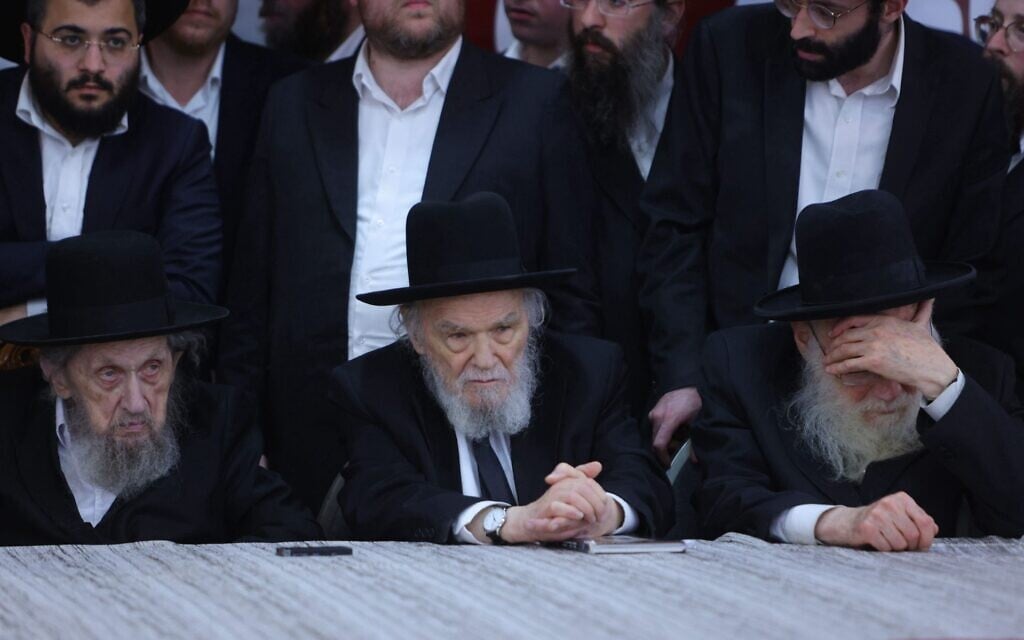
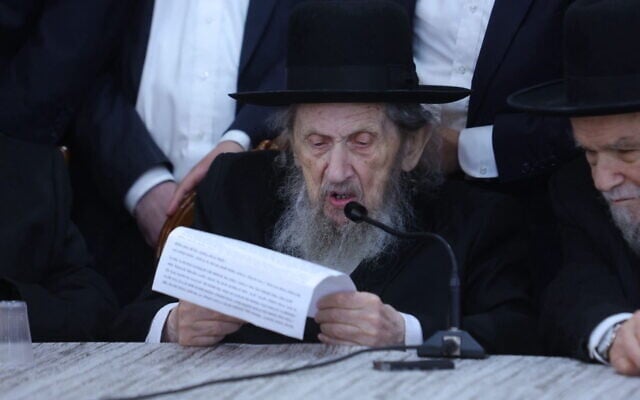
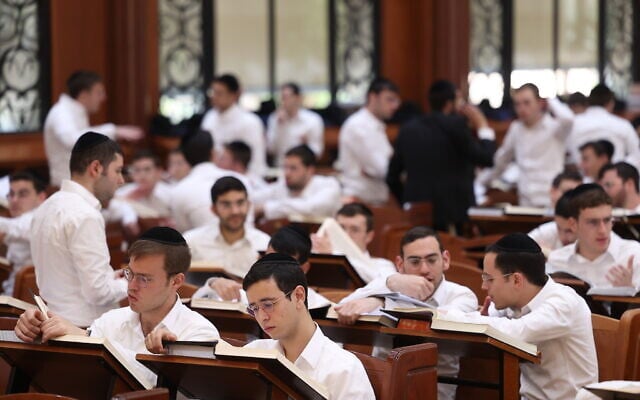
If Israeli authorities begin to arrest yeshiva students for draft evasion, the Haredi community will “make the world tremble, with all our strength and heart,” Rabbi Dov Lando, the spiritual leader of the United Torah Judaism party, warned on Thursday evening.
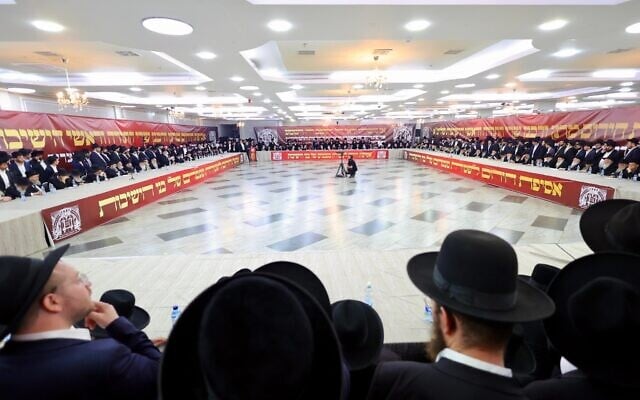
Addressing a rabbinical conference in the central city of Bnei Brak, Lando told the leaders of Israel’s largest yeshivas that unless the government halts its enlistment efforts, it will find itself facing “a united, global Haredi Jewry that is fighting for its very soul.”
Many ultra-Orthodox Jews believe that military service is incompatible with their way of life and fear that those who enlist will be secularized.
Organized by the so-called Yeshiva Committee, on whose board Lando sits, the meeting was part of a wave of conferences and initiatives aimed at stymying increased enforcement measures against Haredi draft dodgers implemented by the IDF, which in recent days have led to the arrests of several yeshiva students.
Only a day earlier, the top rabbinic leadership of the ultra-Orthodox community announced at another conference in the central kibbutz of Ma’ale Hahamisha that it was absolutely forbidden to enlist in “any military framework.”
Like at that earlier meeting, on Thursday evening, the Yeshiva Committee issued orders prohibiting yeshiva students from making separate accommodations with the IDF, insisting that all members of the community, “without exception,” were required to act solely according to its instructions, which would be conveyed by a dedicated staff member at every yeshiva.
And while it did not specifically detail what those instructions entailed, the implications were clear.
‘Don’t show up, don’t answer, don’t respond’
While it previously served as the Haredi community’s primary vehicle for coordination between ultra-Orthodox yeshivas and the Defense Ministry in matters of service deferments, the Yeshiva Committee recently began transitioning from coordinating legal deferments to endorsing draft dodging via its telephone hotline, a Times of Israel investigation found earlier this year.
“I asked them what to do and they said that according to the instructions of the [rabbis] I shouldn’t do anything,” one yeshiva student who received a call-up order recalled in March. “Don’t show up, don’t answer, don’t respond.”
This was also the message in a document circulated among yeshiva students by the group last week, in which it advised them not to travel abroad or even to go out in public without good reason.
Noting that the Haredi community’s rabbinic leadership had ordered yeshiva students to ignore call-up orders, the document instructed readers to call the hotline in response to any inquiries or problems.
Similar instructions have previously been issued by former Sephardic chief rabbi and Shas spiritual leader Yitzhak Yosef, who has said young men should tear up and flush conscription orders down the toilet. In one case, a building in the Haredi settlement of Modi’in Illit reportedly experienced plumbing problems after his instructions were followed.
Under Israeli law, a person inciting others to evade service during wartime is liable to a prison term of 15 years.
Mass conscription orders
Wednesday and Thursday’s meetings came on the heels of an announcement by the IDF that it had completed sending out an additional 54,000 draft orders to ultra-Orthodox men who are eligible for military service and have not yet enlisted.
The orders constitute the first stage in the screening and evaluation process that the army conducts for recruits a year ahead of their enlistment in the military.
The army has stated that it is facing a manpower shortage and currently needs some 12,000 new soldiers, 7,000 of whom would be combat troops. Approximately 80,000 Haredi men between the ages of 18 and 24 are currently eligible for service and have not enlisted, generating significant resentment among secular and national-religious Israelis who have been doing repeated rounds of reserve service amid the ongoing conflicts in Gaza and elsewhere.
Both the Ashkenazi United Torah Judaism and Sephardic Shas parties have been pushing hard for the passage of legislation enabling most ultra-Orthodox males to continue to avoid military conscription or other national service, in the wake of last year’s High Court of Justice ruling that such exemptions were currently illegal on equality grounds.
The government’s failure to advance such legislation led to UTJ quitting the coalition last month. It was quickly followed by Shas, which, while quitting the government, has remained part of the coalition.
In the absence of an exemption law, the IDF and the Attorney General’s Office recently announced a new plan for increased enforcement against draft evaders, under which the timeline for declaring a candidate for military service an evader would be shortened and checkpoints to capture dodgers would be set up throughout the country.
Effectively implementing the plan without a law containing strong financial sanctions will be difficult.
Due to a lack of jail space to hold those arrested for draft dodging, new solutions are currently being examined, the Attorney General’s Office admitted in early July, noting that the “tools available to the army under existing law are not enough to carry out effective enforcement.”
Since then, a number of Haredi draft dodgers have been arrested, sparking protests throughout the country in which demonstrators blocked traffic and caused property damage.
During protests last Wednesday, Haredi demonstrators blocked the entrance to Jerusalem and caused disruptions on Route 4 near Bnei Brak, at the Shilat Junction near Modi’in and in Beit Shemesh and Petah Tikva.

Under Jerusalem’s Chords Bridge, the protesters, the vast majority of them Haredi males, chanted the popular slogan “We will die rather than enlist” and held up signs against military conscription.
Several days later, Haredim belonging to the extreme Jerusalem Faction demonstrated outside a Petah Tikva police station after being summoned to the scene by a dedicated hotline established by the Jerusalem Faction to mobilize protesters in the wake of arrests.
An extremist ultra-Orthodox group numbering some 60,000 members, the Jerusalem Faction is considered among the most conservative of Haredi factions and regularly demonstrates raucously against the enlistment of yeshiva students.
Flyers distributed by the group’s anti-enlistment “Am Kadosh” (Holy Nation) hotline have urged members of the public to sign up to receive updates when yeshiva students are arrested for draft evasion.
Am Kadosh is just one of a growing ecosystem of hotlines set up by the Haredi community in response to the so-called “enlistment crisis,” including one linked to former Jerusalem Affairs Minister Meir Porush.
New initiatives aimed at encouraging Haredim to remain in yeshiva are springing up all the time, including an English-language hotline run by a group calling itself “Notnim Gav” (Got Your Back), a spokesman for which said that “service in the Israeli army is strictly prohibited for any Torah and mitzvah-observant man.”
Another, called “Ezram U’maginam” (Their Salvation and Protector), has put up posters in Haredi neighborhoods appealing to those who have received orders to call for advice, while one Jerusalem-based group has been handing out flyers to yeshiva students instructing them not to answer the door if the police show up.
Aside from protesting and holding conferences, members of the ultra-Orthodox public have supported yeshiva students seeking to avoid military service financially as well, from fundraising abroad to subsidize yeshiva budgets and offer discounts to draft dodgers.
According to the Walla news site, stores in Modi’in Illit have begun offering price reductions to yeshiva students who have received draft orders and have not enlisted.
Overcoming this level of opposition without a conscription law containing strong financial sanctions will be difficult.
Due to a lack of jail space to hold those arrested for draft dodging, new solutions are currently being examined, the Attorney General’s Office admitted in early July, noting that the “tools available to the army under existing law are not enough to carry out effective enforcement.”
COURTESY THE TIMES OF ISRAEL:
