
Professional Indian author and strategic affairs writer.
They Asked Their Names First
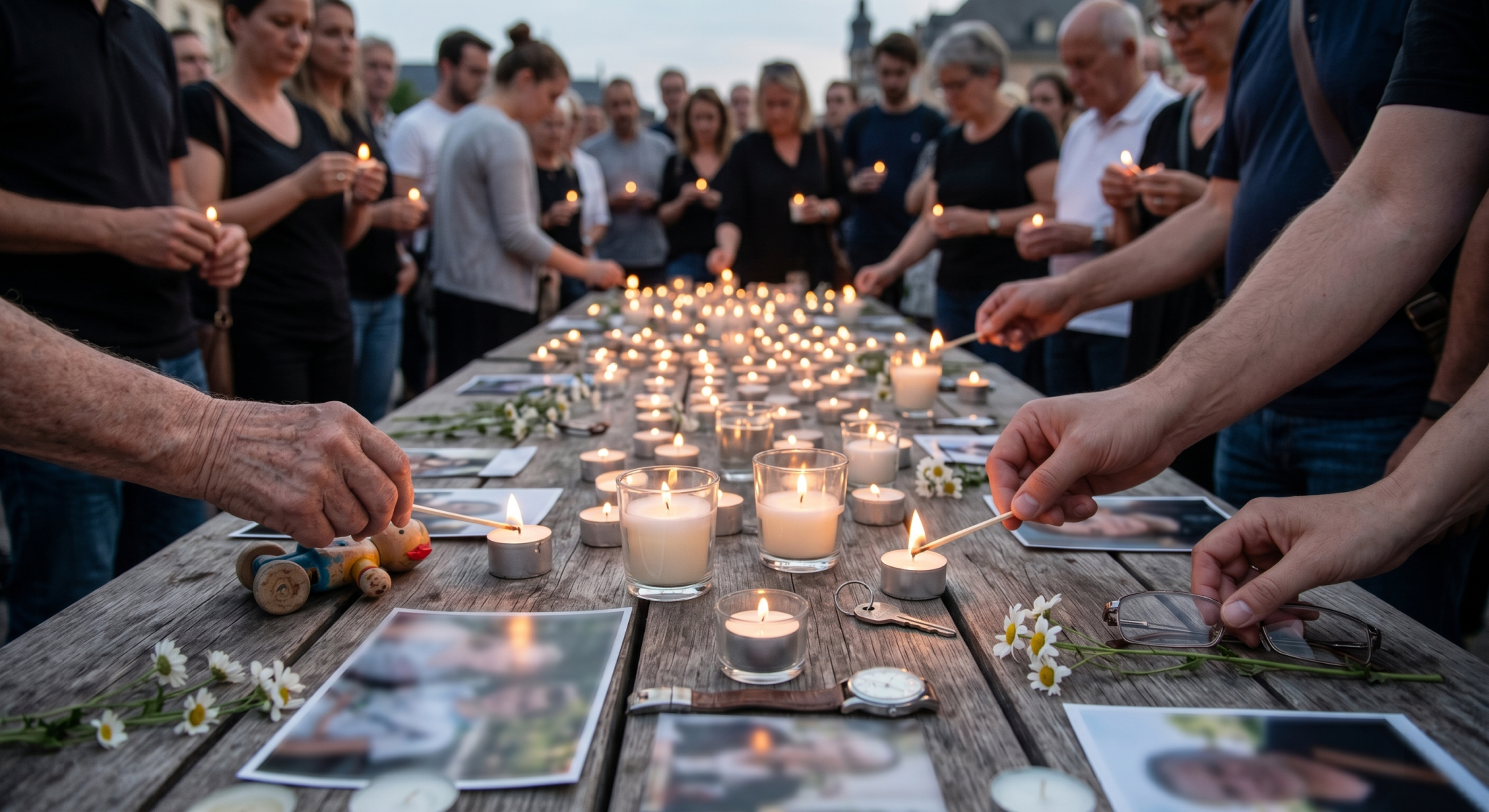
A conceptual illustration representing a community mourning the victims of terror.
One year ago on 22 April 2025, 26 people were killed in the Baisaran Valley near Pahalgam in Jammu and Kashmir. They were tourists, honeymooners, families, and young men on holiday, sitting in a meadow so beautiful that locals call it the mini-Switzerland of India. They had no warning. They had no defense. The terrorists who entered that valley on the afternoon of April 22, 2025 were armed with M4 carbines and AK-47s. Before they fired a single shot, they did something that has stayed with me since I first read about it.
They asked their victims their names.
Not because they wanted to know them. Because they wanted to sort them. Those who could recite the Islamic Kalima were identified as Muslim and spared. Those who could not were killed. Some Hindu men were made to remove their trousers to be checked for circumcision before being shot at close range. Shubham Dwivedi from Kanpur was the first to fall. A terrorist walked up to him and his wife and asked directly, “Hindu hai, Muslim hai?” Shubham said, “We are Hindus.” He was shot in the head. Indian Navy Lieutenant Vinay Narwal from Haryana was killed six days after his wedding. A daughter of a victim from Pune later recounted that when her father failed to recite the verse he was asked to repeat, “They pumped three bullets into him: one in the head, one behind the ear, and one in the back.”
The terrorists also told the Hindu widows, before walking away, that they had been spared so they could go and narrate the horrors of their husbands’ killing to Prime Minister Modi.
I want to stay with that detail for a moment, because it is important. This was not random violence. It was not the spray of bullets in a panicked ambush. It was organized, deliberate, identity-based murder. It was the targeting of people not for what they had done but for who they were.
Eighteen months before Pahalgam, on October 7, 2023, something broadly similar unfolded in southern Israel.
The Parallel That Should Not Have to Be Made
At approximately 6:30 in the morning on October 7, 2023, Hamas launched a coordinated attack on Israel from the Gaza Strip. In total, 1,195 people were killed that day, including at least 828 civilians. At the Nova music festival near Kibbutz Re’im, where young Israelis had gathered to dance through the night of the Jewish holiday of Shemini Atzeret, 364 people were murdered. Families in the kibbutzim of Be’eri, Kfar Aza, Nir Oz, and Nir Yitzhak were massacred in their homes. 251 people were taken hostage into Gaza, including children and elderly grandparents. It was the deadliest day for Jews since the Holocaust.
The victims at the Nova festival were not soldiers. They were young people celebrating a holiday on a dance floor. The people in the kibbutzim were farmers, teachers, and artists. They were killed because they were Jews, living in Israel. Their identity was their crime in the eyes of those who came for them.
The method was different from Pahalgam. The geography was different. The organizations responsible were different. But the logic was identical: sort the people by faith, and kill those who belong to the wrong one.
Israeli Ambassador to India Reuven Azar, in a video message released on the anniversary of the Pahalgam attack yesterday, said it plainly: “For us, in Israel, this pain is deeply familiar. On October 7, we witnessed similar brutality against our own people. This tragedy reminds us that terrorism has no borders. India and Israel stand united in our fight against terrorism.”
Israeli Foreign Minister Gideon Sa’ar added: “Israel remains resolute and unwavering in its fight against terrorism in all its forms. Together with India, we will continue to strengthen our cooperation to confront this threat with determination and to advance peace, security, and stability.”
These are not diplomatic formalities. When an Israeli official says “this pain is deeply familiar,” they mean something specific. They mean that the experience of civilians being selected for death by identity is not abstract to them. They have lived it.
The Thread Nobody Has Connected Clearly Enough
There is a detail that almost never appears in the coverage of the Pahalgam attack, and I think it matters enormously.
The organization behind the Pahalgam massacre was The Resistance Front, a proxy of Lashkar-e-Taiba. Lashkar-e-Taiba is the same Pakistan-based group that carried out the 2008 Mumbai attacks, which killed 166 people across the city over three days and nights. Among the targets that night was the Nariman Chabad House in Colaba, a Jewish cultural center run by Rabbi Gavriel Holtzberg and his wife Rivka, both of whom were killed. Four other Israelis and Jewish visitors were also murdered there. Wiretap recordings later obtained by Indian intelligence revealed that the terrorists had specifically planned to target the Chabad House because they knew it was Jewish. “They knew targeting Jews was going to make more headlines,” an Israeli filmmaker researching the Mumbai community later said, citing Indian government sources.
In 2008, Lashkar-e-Taiba killed Israelis and Jews on Indian soil. In 2025, Lashkar-e-Taiba’s proxy killed Hindu tourists on Indian soil. The targets were different. The organization was the same.
India and Israel do not merely face terrorism that is metaphorically connected. They face terrorism that is literally, organizationally connected. It is rooted in the same networks, drawing on the same ideology, expressing the same fundamental belief that civilians of a particular faith deserve to die.
This is something that cannot be argued away, and it is something that both countries have understood for a long time, even when political circumstances made it uncomfortable to say out loud.
What Operation Sindoor Meant
India’s response to Pahalgam was not immediate, and it was not impulsive. It came fifteen days later, on the night of May 7, 2025, and it was precise.
Operation Sindoor, named after the red vermilion powder worn by Hindu married women as a deliberate honoring of the wives who were widowed in Baisaran Valley, launched between 1:05 and 1:30 in the morning. In under 23 minutes, Indian forces struck nine targets across Pakistan and Pakistan-occupied Kashmir. For the first time since 1971, India crossed into Pakistan’s Punjab province, striking Lashkar-e-Taiba’s headquarters in Muridke near Lahore and Jaish-e-Mohammed’s base in Bahawalpur. Hizbul Mujahideen infrastructure in Pakistan-occupied Kashmir was also struck. The weapons used included Rafale jets, SCALP cruise missiles, HAMMER precision bombs, and BrahMos missiles, a combination of imported and indigenously developed systems.
The Indian Ministry of Defense described the strikes as “focused, measured, and non-escalatory.” No Pakistani military facilities were targeted. India’s stated objective was to destroy terrorist infrastructure, not to fight the Pakistani state. This was a distinction that mattered strategically, even as the two countries came dangerously close to full-scale conflict.
Pakistan struck back. Over the following days, Pakistani drones and missiles targeted Indian military installations. Cross-border shelling hit civilian areas in Jammu and Kashmir, killing sixteen civilians including women and children. In a detail that did not receive enough attention, Pakistan deliberately targeted religious sites on the Indian side: the Shambhu Temple in Jammu, a Gurdwara in Poonch, and Christian convents. This was not collateral damage. These were chosen targets, a counter-message to India’s own narrative of unity.
India’s air defense systems intercepted the Pakistani drones. Indigenous platforms, including the Akash missile system and the Akashteer command system, performed effectively. Pakistan’s Chinese-supplied air defense network proved unable to counter India’s precision strikes. A 114-aircraft aerial battle (72 Indian, 42 Pakistani) unfolded along the border in what analysts described as the largest beyond-visual-range air engagement in the India-Pakistan border’s history.
On May 10, Pakistan’s Director General of Military Operations called his Indian counterpart. The ceasefire was agreed at 5 PM that day.
Operation Sindoor was not just a military event. It established what analysts now call India’s “new red line”: state-backed terrorism directed at Indian civilians will be met with military force against the infrastructure that enables it, regardless of where that infrastructure is located.
Benjamin Netanyahu, within hours of the Pahalgam attack on April 22, 2025, had written to Modi: “I am deeply saddened by the barbaric terrorist attack in Pahalgam, Jammu and Kashmir, that killed and injured dozens of innocents. Israel stands with India in its fight against terrorism.” After Operation Sindoor launched, Israel’s Ambassador Azar followed up: “Israel supports India’s right to self-defense. Terrorists should know there’s no place to hide from their heinous crimes against the innocent.”
Israel did not hedge. It did not call for “restraint on all sides.” It named the thing for what it was.
The Man Who Did Not Ask Anyone’s Religion
There is one more person in this story who deserves to be named.
Syed Adil Hussain Shah was a pony-ride operator from Pahalgam. He was Muslim. He was 31 years old, earning roughly 300 rupees a day ferrying tourists up the trail to Baisaran, saving to pay for his sisters’ weddings. When the shooting began on April 22, he did not flee. He tried to wrestle the rifle from one of the attackers. He was shot and killed.
He was the only local civilian who died that day. The only non-tourist.
His father, Syed Haider Shah, said afterwards, “He sacrificed his life for humanity. He did not think about religion or who the tourists were. He just tried to save them.”
His brother Naushad said, “He was soft-hearted but could never tolerate injustice. When he saw innocent people being attacked, he stood up against it. That is when they killed him.”
His widow Gulnaz Akhtar says she takes pride in what he did, even as she navigates a life guttered by grief. She has since lost their infant daughter. She returned to her parents’ home after his death.
I think about Adil Hussain Shah when I think about what terrorism actually is and what it is actually trying to destroy. It is not trying to destroy a government or a military. It is trying to destroy the ordinary decency of ordinary people, the impulse that makes a man on a horseback trail put his body between a gun and a stranger. The terrorists at Baisaran asked their victims’ names before shooting. Adil Hussain Shah asked nobody’s name. He just moved.
What India and Israel Share That Cannot Be Borrowed
I am an Indian writer. I have no personal experience of either the October 7 attacks or the Pahalgam massacre. But I have spent enough time studying the history between India and Israel to understand that the solidarity these two countries feel is not merely diplomatic.
Most of the world, when confronted with attacks like these, responds with condolences. The language is kind, and the intent is genuine, but it comes from the outside, from people who have not experienced the specific horror of civilians being sorted by identity before being killed. There is a difference between condemning an act of terrorism and understanding what it feels like to be on the receiving end of that particular method: the deliberate use of faith as a criterion for murder.
India knows that feeling. Israel knows that feeling. It is knowing, specific, and impossible to fully convey to those who have not lived through it.
The Israeli ambassador’s words on the anniversary of Pahalgam were not protocol. “This pain is deeply familiar” is not a line from a diplomatic brief. It is the statement of a country that watched Hamas go through its own version of a list, on its own territory, eighteen months before a similar list was made on the slopes of a Kashmiri mountain.
Two democracies. Two peoples with ancient civilizations and long memories. Two countries that have been told by their enemies, in different languages and different geographies, that their citizens’ lives are forfeit by virtue of who they are.
What they have chosen to do with that knowledge, to build something real, to share intelligence, to stand beside each other in international forums when it is politically costly to do so, is perhaps the most honest thing about the relationship between India and Israel. It was not built on convenience. It was built, in part, on a shared understanding of what it means to be targeted not for what you have done, but simply for who you are.
On the one-year anniversary of Pahalgam, that understanding has not faded. If anything, it has deepened.
Related Topics