They Chose Light in Edinburgh
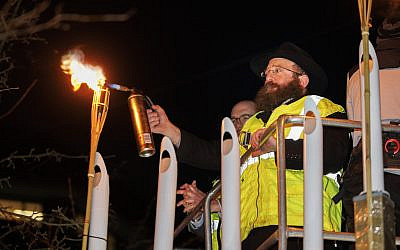
credit Toby Long photographer.
In the Wake of Terror, Scotland’s Jewish Community Choose Light
Just a week ago, in the quiet of our kitchen, I told my husband I wanted to go into Edinburgh to witness my first Chanukah menorah lighting in my new home country, Scotland. It felt like a small, hopeful step toward connecting with a community I was only beginning to know. But my husband, a native Scot and not Jewish, looked at me with worry. He had seen the rising tide of antisemitic attacks around the world and understood what it meant to gather publicly as a Jew in these times. Between our chronic illnesses and a fresh NHS warning about a severe flu sweeping the country, the risks felt real on multiple levels. I wondered if fear was keeping me from something that mattered deeply.
On the day when the Edinburgh event was to take place, I woke to horrifying news: a terror attack on Jews at a Chanukah celebration at Bondi Beach in Sydney. My heart broke for the victims and their families. Suddenly, my unease about going into Edinburgh no longer felt imagined.
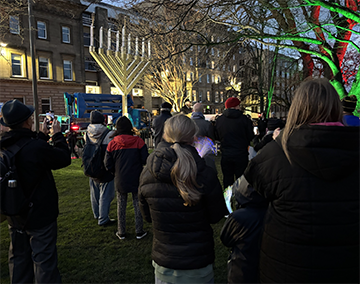
Scotland’s Jewish community is small, only a few thousand people. Every gathering carries weight and meaning. It is a world apart from New York City, where I grew up surrounded by a vast Jewish population compared to most parts of the world. That evening, I saw photos posted on a Jewish community page—images of people standing together in St Andrew Square, watching the menorah being lit. In the depth of the Scottish winter, where darkness arrives early and lingers long, the light felt symbolic in a way that went beyond ritual. It gave me a profound sense of hope. Chanukah is about light in the darkness, miracles, resilience—and the decision to gather anyway felt like resilience made visible.
Ben Macpherson, MSP for Edinburgh Northern and Leith and Minister for Higher and Further Education, attended the event and shared a message of solidarity with Scotland’s Jewish community. He then ascended with the Rabbi in a cherry picker to light the shamash—the lead candle—of Scotland’s Tallest Menorah, an iconic candelabra standing as a public symbol of hope.
Rabbi Pinny Weinman of Chabad of Edinburgh, along with members of the local Jewish community, reflected on the themes of the holiday and their relevance to the moment. After the lighting, attendees gathered in a large marquee beside the menorah to share traditional Chanukah foods—latkes and sufganiyot. (traditional donuts)
Wanting to understand what had compelled people to attend despite the risks, I reached out to several members of the community.
Ethel, who lives in Edinburgh, told me the event was “very powerful and joyful,” despite the grief many are carrying. She noted that the turnout was high. “Rather than being deterred,” she said, “events like this seem to bring the Jewish community in Scotland closer together—something I’ve noticed especially since October 7.”
Dov, whose family lives in the Highlands, travelled with his entire family, driving roughly 90 minutes to be there. “We took a family vote,” he told me. “All of us said yes. Basically, we can no longer hide behind the parapet. It is way past time to stand up and say, ‘I’m Jewish. Am Yisrael Chai.’” He admitted they were nervous and spent more time than usual scanning the crowd, but said everything went well. “There was only a small Police Scotland presence, and we were very glad we went.”
Karolina, visiting from London with her family, said they had been looking forward to the lighting for weeks. “Being here reminded us how safe and welcome Jewish life can feel in Scotland, in a way that’s become harder back home,” she shared. “The gathering was open, relaxed, and full of kindness. With everything happening in the world—including the events in Australia, where our cousin was, thankfully safe—it felt important to stand together, show up with courage, and be visible.”
Rabbi Pinny Weinman, later reflected on the meaning of the evening: “Hanukkah is a celebration of light, faith, and perseverance — a time when we remember that even a small flame can dispel great darkness. In light of the tragic events in Sydney that have shaken the Jewish community and so many others around the world, this message feels especially powerful. Here in Scotland, the Scottish National Hanukkah Celebration brings together people from all walks of life to stand united, to reject hatred, and to reaffirm our shared values of dignity, compassion, and peace. Especially in challenging times, the Menorah’s light reminds us that goodness, kindness, and community spirit will always prevail. We are proud to celebrate this beautiful festival in the heart of Edinburgh, together with the entire community.”
As I watched the images from Sydney and reflected on the words shared in Edinburgh, I found myself thinking of Mila, an elderly woman I met in 2014 while visiting my father’s assisted living facility. Mila had survived the camps. She once told me how the female guards taunted her daily, telling her she would die. Mila decided she would prove them wrong. She did more than survive—she outlived her tormentors, refusing to be diminished or extinguished.
At my father’s funeral in 2015, Mila was there. I was shaking with grief when she embraced me. It was a tight, grounding hug—strong, steady, and full of life—at a moment when my own world had collapsed.
Those memories intertwine now with the images from Sydney and the sight of people gathering in St Andrew Square to light candles in the cold. After the last few years of rising antisemitism, of hatred spilling across social feeds and into daily life, Scotland’s Jewish community chose to show up.
They stood together and said, quietly and unmistakably: we are here. And it is this—community, visibility, and the refusal to give fear the final word….that will carry us forward.