


Thiago Ávila Provokes the Jewish Community, Again
On Sunday, September 20, on the eve of Yom Kippur, activist and congressional candidate for São Paulo Thiago Ávila took yet another provocative step involving the Jewish community. A few months earlier, Ávila had already established his campaign headquarters in Higienópolis, a neighborhood with a long-established Jewish presence. At the time, he said he had chosen the location because of its “good location, transportation and rent.”
This time, Ávila went to Rua Estado de Israel (State of Israel Street) in São Paulo and covered the street’s official sign with a sticker reading “Free Palestine, from the river to the sea,” reproducing the visual style of public street signage. The action was recorded on video and began circulating on social media and in media outlets in Brazil and abroad.
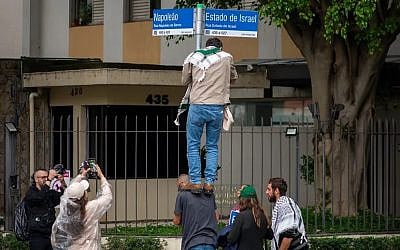
The episode gained even greater significance because it took place precisely at the beginning of Yom Kippur, the holiest day of the Jewish calendar.
The image crossed borders, but perhaps it did not generate the shock that a scene like this should have. A congressional candidate covered the words “State of Israel” on an official public street sign and replaced them with a political slogan that, for a significant part of the Jewish community, is understood as a message calling for Israel’s elimination.
The meaning of “from the river to the sea” remains contested. Supporters describe it as a call for Palestinian freedom, while Jewish organizations and others interpret it as a rejection of Israel’s existence.
The incident has already prompted political reactions and led representatives in São Paulo to file reports and request an investigation by the Public Prosecutor’s Office, including over possible damage to public property and potential discrimination against the Jewish community.
What should cause outrage is not only the political message. It is the fact that it was placed over the name of Israel, on a street officially bearing that name, precisely as Jews were entering the holiest day of their year.
And perhaps the most concerning part is how easily a scene like this can be reduced to yet another episode in the political dispute between Israel and Palestine — when, for many Jews, it touches something much deeper: the right of Israel to exist and the right of Jewish identity to be recognized without being erased.