Carrie Bradshaw of the Middle East
Things Not to Say on Dates or On Television
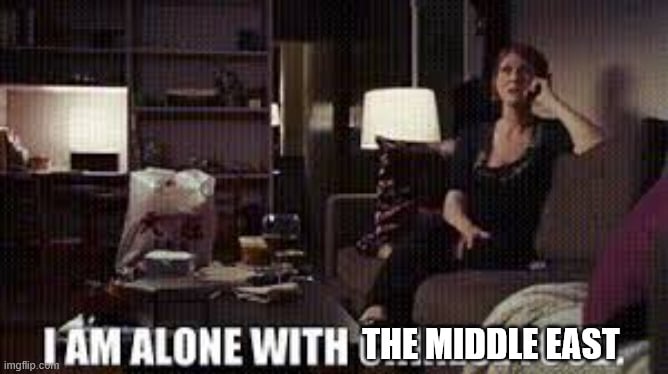
Adapted meme based on a scene from Sex and the City (HBO), included here for cultural commentary.
I was running late, which is unlike me, but work had thrown me into a week of community engagements and television interviews I was unprepared—and unprepped—for. At the time, I was working with October 7th survivors and hostage families. Sometimes that meant speaking beside them, a role I was honored to rise to and unsure how to play. I threw my purse across the hotel room searching for my mascara and found a yellow Post-it with smudged writing and a child-like heart drawn on it.
German Tech Guy and I met in Los Angeles. He was in town before heading to a tech conference in Las Vegas. He was sweet and mildly autistic. Drinks led to a one-night stand that led to him spending the entire week with me. Smiling down at the yellow Post-it in my hand, I was reminded of a version of myself I hadn’t seen in a while. I texted him as I rushed myself to the hotel lobby.
There was a lot I couldn’t say on television. The constraints weren’t malevolent and were mostly self-imposed. The Professional Me was concise, measured, and empathetic in exactly the right quantities. The dating version was lighter, less political (if you can believe it), and vaguely mysterious. Neither version was entirely fake, and neither version was entirely me.
The hostage crisis needed to remain friendly across the political spectrum, though there are people I won’t be naming who tried to use it for their own political purposes. When a journalist occasionally asked me about Netanyahu or human rights violations, I knew my goal—especially as an unaffected party—was to make sure the mostly non-Jewish viewers remembered at least one of the 251 men, women, and children taken on October 7th. They were the ones I was trying to help.
I checked my phone between interviews for WhatsApp messages and news updates. I never knew when a development from across the world would inform my next interview. The news always came through, but Tech Guy, who occasionally texted me over the years to compliment my WhatsApp picture and ask about the next time I’d be in Europe, wasn’t receiving my message. The emotional whiplash was normal back then. One minute I was explaining Hamas in Spanish to daytime television audiences; the next I was pretending to be engaged in witty banter with whatever guy I met in town.
I knew very little about Tech Guy, and he knew very little about me. When we said goodbye before he drove off to his Vegas conference, he hugged me tightly and whispered, “The world is small.” I didn’t know how to respond. Most love stories don’t last forever. Sometimes they last a night, or a week. Tech Guy wanted our story to last longer. I thought we both deserved more than that but didn’t let myself say it.
During my time advocating for the hostages, I never felt like it was me doing it. There was definite imposter syndrome. Far more prepared and directly impacted individuals were dedicating their lives to this work, but it also needed to be done in Spanish, and I guess that’s where I came in.
There were about one hundred Latino victims of October 7th, nineteen of which were taken hostage. Amongst them were the Bibas children: a red-headed baby and a toddler whose pictures reached even those most removed from the region. Some were first generation Israelis, and many had immigrated to the region seeking economic stability, safety, or fleeing persecution. What was said, and in what language it was said, mattered.
Press tours and event days were a whirlwind, and I tried to distract myself any way I could. I sent Tech Guy another message as an intern escorted me to the news studio and switched on Professional Mode.
I have never been good at not saying things. It used to get me into trouble a lot as a kid. Growing up you learn to be more strategic about what to say and when. That was the side that came out with Tech Guy. It’s not that I felt nothing. I’m not the kind of person who can do that. It’s that I wanted to keep our time together intact and untouched by the complications of communication. He either didn’t care or didn’t see them. I liked hearing from him over the years, and I didn’t feel I could tell him that.
The journalist interviewing me flirted off camera. Nothing makes a man flirt with you faster than explaining terrorism confidently under studio lighting. Freud would have had a field day with cable news. I thought about all the things I couldn’t say: that some activists were opportunists, that Netanyahu was forgetting about the hostages, that grief becomes competitive, and that media training sometimes feels indistinguishable from emotional repression.
Professional Me started showing up everywhere. I became media trained in my personal life. I answered emotional questions the way politicians answer questions about conflicts they’ll never personally live through: adjacent to the truth, technically accurate, carefully unrevealing. The last time Tech Guy and I spoke, he had invited me to visit him. I smiled but hated myself for it. Desire and intimacy are easy in short bursts. Nobody becomes real. Reality introduces logistics, politics, exhaustion, and need.
The problem with learning how to communicate strategically is that eventually you stop knowing when honesty is allowed again, and who gets to see every side of you. Sometimes, you end up hiding you from yourself. After an exhausting week of professional head-nodding, I was desperate to be the dating version of me, one that slowed down, smiled, giggled, and got invited to foreign countries by handsome strangers.
The messages never went through. WhatsApp eventually notified me that the number appeared to be no longer in service. I felt a slight panic as the day wrapped up and I found myself alone at the hotel bar… again. I sipped on my tequila on the rocks, wondering what version of myself I was left with. Not the professional, not the dating one. Just a girl in a bar. It was easier to explain Middle Eastern politics on live television than to admit I didn’t know what that looked like.
Advocacy taught me how to compress complicated truths into digestible sentences. Dating taught me the opposite problem: how to stretch silence long enough for someone to project what they wanted onto you. Leaving yourself out of the equation guarantees control over the narrative.
The ice knocked against my teeth, letting me know I either needed to commit to another drink or commit to another night in a hotel room with my own thoughts. I checked my phone one more time. A notification from a different guy, one that had seen me on television performing my Professional Me routine, popped up. I told you terrorism gets a man going. I ordered another drink at the bar and hit reply.
Related Topics