


"Violence can be justifiable, but it will never be legitimate." — Hannah Arendt
Thirty-One Years Since Rabin Was Killed, Netanyahu Is Still Testing Israel
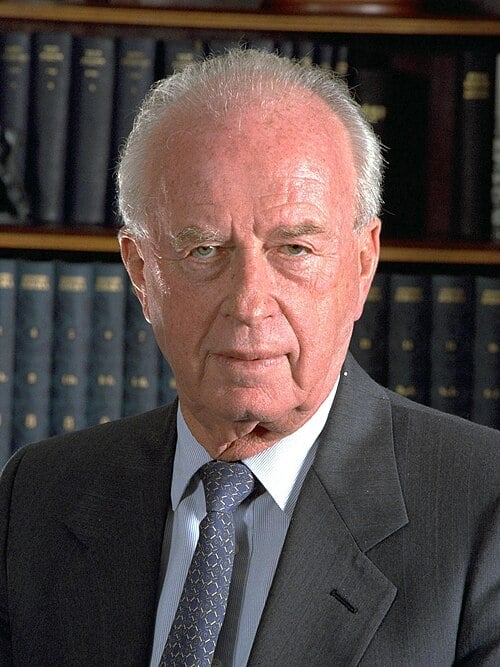
Only the names and faces have changed, but Netanyahu’s formula is the same, and it still consists of delegitimizing political rivals, weaponizing fear against Arabs, and intimidating those who threaten his political survival.
On October 5, 1995, the day the Knesset was debating the Oslo II agreement, Benjamin Netanyahu, then forty-five and the leader of the opposition, spoke from a hotel balcony above Jerusalem’s Zion Square. Beneath him, a crowd of tens of thousands chanted that the Prime Minister, Yitzhak Rabin, was a traitor and a murderer and called for his death, while posters with doctored pictures of Rabin in an SS uniform and in a keffiyeh passed from hand to hand. That same week, Netanyahu argued that the government lacked “a Zionist majority,” a reference to the votes of the Arab members of the Knesset on which Rabin depended.
Netanyahu maintains that he neither saw the posters nor heard the violent chants, though accounts from the time say he raised his hand to try to quiet the chanting he says he did not hear. A month later, on the night of November 4th, Rabin walked down the steps of Tel Aviv’s City Hall toward his car and was shot in the back by the extremist Yigal Amir, and ever since, Netanyahu has denied that the balcony had anything to do with the steps. Years later, while he still led the opposition, Isaac Herzog, now Israel’s President, told the Knesset at its annual memorial session for Rabin that we were gathered there because of what had happened in 1995 “on that accursed balcony.” In 2019, after Yair Netanyahu wrote that Rabin had murdered Holocaust survivors on the Altalena, Rabin’s son, Yuval, replied that the accusation carried on the work of the 1995 poster that had dressed his father in an SS uniform, and he closed with the words “Don’t say you didn’t see it.”
On Sunday night, five days after the election in which Netanyahu’s bloc lost its majority, about two dozen people planted themselves outside the home of Gadi Eisenkot, the former chief of staff who is now the likeliest man to replace Netanyahu, and called him a traitor. A man with a megaphone, whom the Israeli press identified as Yossi Cohen, shouted that Eisenkot had murdered his own son, Gal, who fell in Gaza in December 2023, and told Eisenkot’s wife, Hannah, that she would join her son. To call a father who has buried his son a murderer, and to promise the soldier’s mother a place beside him, is a death threat. The protest ended at about nine, with no arrests, and afterward, according to Channel 12, an unidentified woman walked into the building and spent several minutes searching for the Eisenkots’ apartment until neighbors noticed her and walked her out.
On that same Sunday, Justice Noam Sohlberg, who chairs the Central Elections Committee, said that the election had been conducted properly and that its outcome reflected the will of the voters; Likud replied that, until the investigation was completed, a dark cloud hung over the results, asked on Monday to postpone certification, and was turned down. Also on Monday, Netanyahu ruled out a coalition with the Arab lists, accusing them of being parties that “support terrorism and deny the existence of the Jewish state.” On Tuesday, i24NEWS reported that the Shin Bet chief, David Zini, had asked for approval to question Mansour Abbas, Ahmad Tibi, and Sami Abu Shehadeh under caution, along with a fourth Arab politician whose name cannot be published, although he had supplied evidence only against the last of the four. The request is part of the investigation into suspected foreign funding and vote buying that the Shin Bet opened at the request of the Central Elections Committee. Netanyahu chose Zini last year to run the agency, and the man he chose had to ask more than once, according to Ynet, what Abbas was called before he could name the lawmaker he wanted questioned. The attorney general, Gali Baharav-Miara, replied that elected officials, like other citizens, are not questioned without evidence, and that the Shin Bet had been withholding the investigation’s materials for two days.
As of Monday, Netanyahu had not condemned the man with the megaphone, and since I cannot get inside his head, I offer the two reasons my own head comes up with for that silence. The first is that the accusation of treachery shouted on that sidewalk came out of the statement in which Likud warned, after the election, that Zionist parties willing to cooperate with the Arab bloc would be “dangerous to Israel,” so that condemning the chant would mean disowning his own party. The second is the art of the alibi, which he learned on a Jerusalem balcony. In 1995 the alibi required a raised hand; in 2026 it takes only silence, which leaves no picture to be used against him.
By the same logic, I imagine that Netanyahu has nothing to lose when Zini goes after three Arab party leaders without evidence, on the eve of the day the President begins hearing the recommendations that could hand his rival the mandate, because the maneuver gives him two words, under caution, printed beside the names of the men whose parties hold the nineteen seats that could decide whether he keeps his chair. If the attorney general resists, so much the better for him, and on Tuesday Likud showed how her resistance can be sold as a cover-up.
In 1995 the traitor was the Prime Minister, a former chief of staff who needed the votes of Arab members of the Knesset to pass an agreement, and Netanyahu said that Rabin’s government had no Zionist majority. In 2026 the traitor is a former chief of staff who may need the recommendations of Arab members of the Knesset to receive the mandate, and Netanyahu, together with his party, suggests that an alliance with those lawmakers would be treason.
Today the question of what Netanyahu saw from that balcony also cuts the other way, and it becomes what the man with the megaphone sees when he looks at Netanyahu. He sees a party that had no comment, a circle around the Prime Minister in which no one condemned a word, a police force that made no arrests, and a Shin Bet that decided to give Eisenkot bodyguards of its own only after that Sunday. He also sees what happened to Yair Golan, who leads the Democrats and who, according to the petition his party filed with the High Court in September, was the only party leader named in a death threat attached to a brick thrown at Channel 12’s studios in July. The police rated the threat against him at four on a scale of six, the same rating Eisenkot received, and still Golan had to go to court to hear its president, Isaac Amit, say that the Shin Bet was instructing the police on his protection and that the petition had better be withdrawn. On October 22nd, at a state ceremony on Mount Herzl that the Prime Minister has not attended since 2019, President Herzog warned that words kill, and in Rabin Square Golan accused the Prime Minister who had incited against Rabin in 1995 of now creating the conditions for the next Yigal Amir. Five days later, on election day, a man with a large knife under his coat was arrested near Golan at a campaign event in Tel Aviv’s HaMesila Park; the party says he moved toward Golan threateningly, and the police, who were escorting Golan, deny that there was any attempted stabbing. A limit that yields a little each week shows the next Yigal Amir where to wait.
Some of the names have not changed, and the owner of one of them will be among the first through the President’s door today, when Religious Zionism-Zehut opens the consultations. That name belongs to Moshe Feiglin, who founded Zo Artzeinu with Shmuel Sackett, led the movement when it blocked eighty intersections across the country in August 1995 to protest Rabin’s government, and was convicted of sedition in 1997. His partner on the list is Bezalel Smotrich, who was fifteen in 1995 and who in 2021 told the lawmakers of the Joint List that they were in the Knesset by mistake, because Ben-Gurion had failed to finish the job and throw them out in 1948. It is a sentence of the kind one scrapes off the sole of a shoe, and it did not stop him, the following year, from becoming the finance minister in charge of every Arab taxpayer’s money. Tomorrow the President receives Otzma Yehudit, which announced this week that it would vote against certifying the results and is the party of another unchanged name, Itamar Ben-Gvir, the minister to whom our police now answer. In October 1995, at nineteen, Ben-Gvir was an activist in Kach, the Kahanist movement outlawed the year before, and he held up for the television cameras the emblem stolen from Rabin’s Cadillac and warned that, having reached the car, they would reach Rabin too. The man who reached Rabin a month later, Yigal Amir, had loose ties to Eyal, a tiny far-right group founded by a former Kach activist.
If I were Gadi Eisenkot, I would thank the neighbors before I thanked the Shin Bet. Thirty-one years ago tonight, it took three shots at the foot of the steps of Tel Aviv’s City Hall for us to learn where Israel’s limit lay; on Sunday, the Eisenkots’ neighbors drew that limit without waiting to find out what the stranger wanted. In the country Netanyahu is still testing, the limit has come to depend on whoever is willing to see, and so I ask you, the reader, to look at Rabin in this photograph, in a suit and tie, facing us Israelis, without the SS uniform or the keffiyeh that Zion Square put on him, and not to say you didn’t see it.