This Is How Hatred Is Normalised in Australia
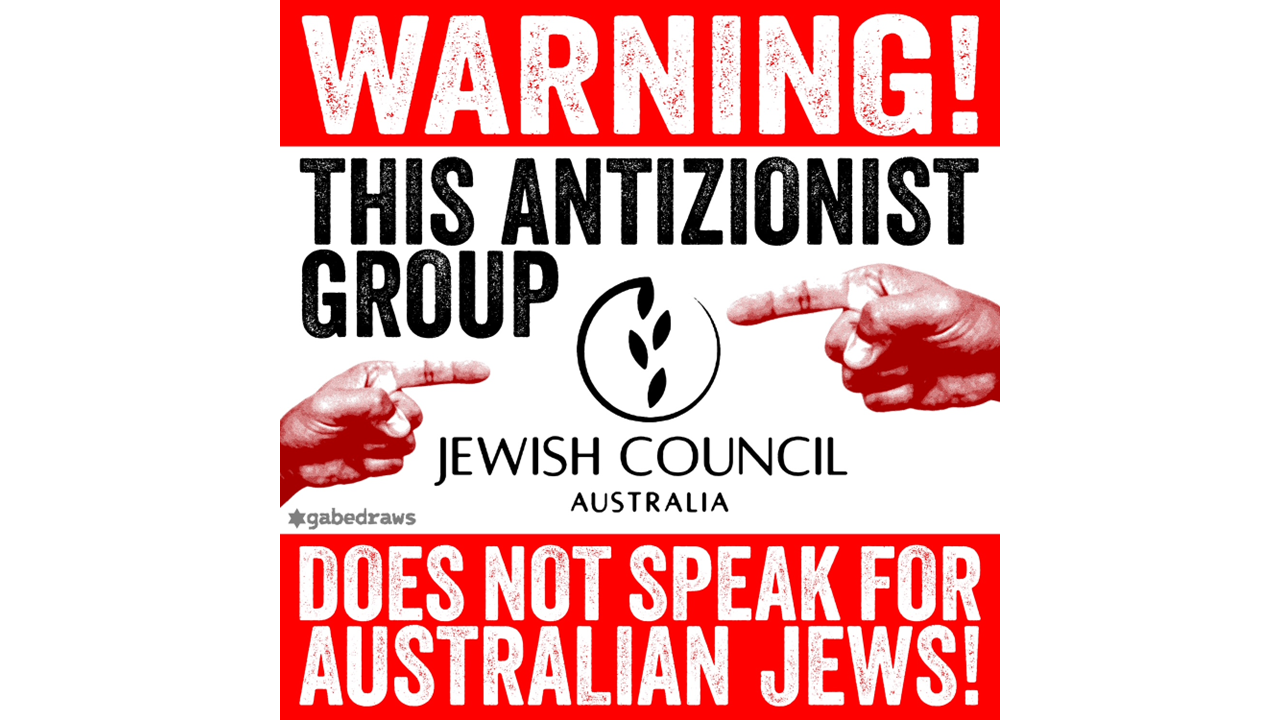
On Sunday night, I attended a vigil organised by the Jewish Council of Australia at Grattan Street Gardens in Prahran, Melbourne. I did not attend as a participant. I attended as a silent protest.
I went because the Jewish Council is an openly antizionist organisation that has played a role in normalising contemporary Jew hatred in Australia. Antizionism is neither new nor benign. It is a modern mutation of antisemitism, using different language and moral frameworks to achieve the same outcome: the delegitimisation, isolation and, ultimately, the targeting of Jews.
The way this vigil was framed felt deeply disrespectful to the victims of the Bondi massacre. I did not feel I could stay away and say nothing.
I am a Jewish, Zionist Australian who has spent the past two years actively campaigning against Jew hatred, particularly within healthcare. I was not shocked by Bondi. Given the scale of antizionist rhetoric that has been allowed to fester across universities, online spaces and public demonstrations, under state and federal Labor governments that have too often chosen silence, equivocation or appeasement, an act of mass violence was inevitable.
That does not make it any less devastating. Fifteen innocent Australians were murdered in Bondi. But this violence did not come out of nowhere.
What I did not expect was that my first personal experience of open Jew hatred would come from people who identify themselves as Jewish.
The event was advertised as a community vigil. One of the speakers was Sarah Schwartz, Executive Officer of the Jewish Council of Australia. Since its inception, this organisation has sought to present itself publicly as a representative Jewish voice, despite being rejected by the overwhelming majority of Jewish Australians.
Over the past two years, the Jewish Council has played a profoundly destructive role in Australian public life. Through sustained antizionist advocacy, it has helped legitimise narratives that demonise Jews while cloaking that hostility in the language of ethics, justice and compassion. The cumulative effect has been the normalisation of contemporary Jew hatred and the fracturing of the Jewish community at a moment when clarity and solidarity were essential.
Since the Bondi massacre, the Council has pivoted to calls for “unity”, while simultaneously urging Jews to join its ranks, despite having minimal Jewish membership, and continuing to present itself publicly as a representative Jewish voice. This is not unity. This is deception.
There is a historical warning here that Australians should understand. In the Soviet Union, the Yevsektsiya, the Jewish sections of the Communist Party, were used to suppress Jewish religion, culture and Zionism from within the Jewish community while presenting a Jewish face to openly anti-Jewish policies. Their role was not to reflect diversity, but to provide cover, allowing harmful policies to be justified by pointing to Jewish involvement. The lesson is not that history repeats itself in identical form, but that it often rhymes. Movements hostile to Jews have repeatedly elevated a small number of “approved Jews” to provide moral cover: we cannot be antisemitic, look who agrees with us.
On Sunday night, our group stood quietly at the edge of the gathering. We did not chant, shout or interrupt. At that stage, we were not holding signs. They lay face down in a box at our feet. We had no intention of displaying them unless confronted.
That changed when Max Kaiser, Executive Officer of the Council, walked approximately one hundred metres towards us to demand an explanation for our presence and to inspect our signs. I asked him to move away and not to touch our belongings. He then summoned others connected to the event, who positioned themselves directly in front of us, moving side to side to block us from view.
The posture was unmistakably threatening. Arms folded, bodies closing in, they appeared intent on provocation. We tried to remain silent. The image it evoked in me, viscerally and immediately, was one of authoritarian intimidation.
Only then did we lift our signs. I was so distressed that I held mine upside down.
The signs bore the names of the fifteen Australians murdered in Bondi, asking that they be remembered. Others referenced historical and contemporary episodes in which antizionist Jew hatred preceded or justified violence against Jews: Poland in 1968, the Munich Olympics, Argentina in 1994, October 7, 2023, and Washington, Manchester and Bondi in 2025.
The police who were in attendance were called over. Despite our silence and lack of aggression, we were told we were “disturbing the peace”. Members of our group were physically moved on. I was grabbed by the arms and shoulders and pushed away. Those actively blocking and intimidating us were not.
This raises serious questions. What briefing were police given before the event? Who framed the situation for them? Why were silent Jewish protesters removed while those engaging in intimidation were left alone? And why does an organisation that does not represent the vast majority of Jewish Australians appear to wield such influence with authorities?
Legacy Jewish organisations are now confronting a harsh reality. Calling all of this simply “antisemitism” has not stopped Jews from being attacked. Language matters. Precision matters. Antizionism must be named for what it is. Organisations that have helped normalise it should have been challenged far more forcefully, before Australians were misled into believing they speak for us.
Antisemitism is the hatred my grandparents experienced in Poland. My paternal grandmother was twelve years old when she lost every living relative. My paternal grandparents were Bielski partisans during the Holocaust. I honour their memory by refusing to shrink in the face of today’s Jew hatred.
There is another factor in the Bondi attack that our political leaders continue to avoid naming: Islamic extremism. A Prime Minister unwilling to name a problem cannot hope to confront it.
Australia is on a dangerous trajectory. Courage begins with honesty. Naming the problem is not divisive. It is liberating, just as naming domestic violence is the first step to surviving it.
Australia should not overlook two years of damage and accept, without scrutiny, a self appointed group as authoritative at a moment of national grief and confusion.
The victims of Bondi deserve more than symbolism.
They deserve moral clarity, courage and truth.