
CFO | Empower Society for Good I Author
This Is the Blessing? וזאת הברכה after October 7
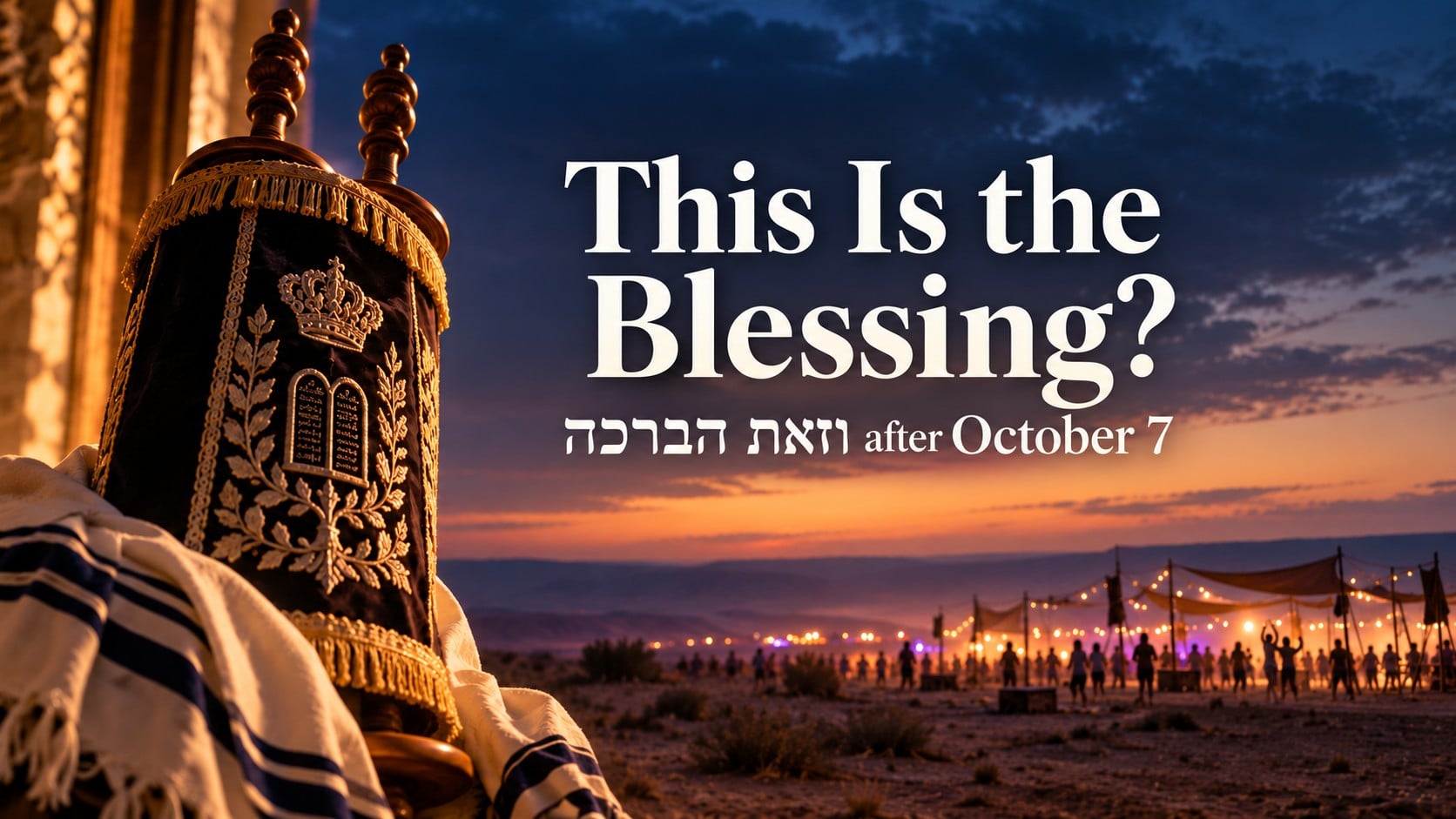
As Simchat Torah approaches, I feel a trepidation I never felt before.
Once, this was the day of dancing. The day Jews completed the Torah and immediately began again. The day we held the Torah close, circled the bimah, lifted children onto shoulders and sang until the words became something deeper than words.
For many Jews, it still is that day. And perhaps it should be. Jews must dance. Children must be lifted. Torah must not become a museum piece for grief.
But for me, I cannot simply go through the motions.
Now the day has another name.
October 7.
And the question sits heavily: What does it mean to dance with the Torah on the anniversary of a massacre? What does it mean to read וזאת הברכה — “And this is the blessing” — after Jewish families were slaughtered, hostages were dragged into Gaza, and the people of Israel woke up to the terrible knowledge that the emperor had no clothes?
I do not pretend to know why God allowed that day to happen. Anyone who explains it too neatly should be treated with caution. It is too raw and too terrible for easy theology.
But I do know this: October 7 exposed illusions.
It exposed the illusion that Hamas had been contained. It exposed the illusion that fences, cameras, intelligence systems and strategic concepts could replace vigilance. It exposed the illusion that warnings from soldiers on the border could be heard and still not truly listened to.
It also exposed something deeper.
October 7 was not only an attack on Israel’s border. It was an attack on three visions of Jewish life.
In synagogues, Jews were preparing to dance with the Torah: the ancient dance of covenant, memory, holiness and obligation.
At Nova, young Israelis were dancing under the desert sky: the modern dance of youth, freedom, music, openness and life.
And in the kibbutzim and border communities, many Israelis were living a third vision: the hope of peaceful coexistence. Many of the victims were peace activists, people who had spent years driving Gazans to Israeli hospitals, employing Palestinians, believing in neighborliness, dialogue and shared humanity.
Hamas attacked all three.
It attacked the Jew with the Torah, the Jew at the music festival and the Jew who still believed that coexistence was possible. The religious and the secular. The ancient covenant, the modern Israeli dream and the moral hope that Jews and Arabs could one day live beside each other in dignity.
The attack on Nova was barbarism in its rawest form: young people hunted while they danced, women violated, bodies burned and mutilated, families shattered, hostages dragged into Gaza.
What followed after October 7 was a different kind of assault, dressed in the language of civilization.
It came in marches, statements, slogans, university encampments, U.N. speeches, legal accusations, boycotts and the sudden moral amnesia of people who could not bring themselves to stand with Jews even after a massacre.
One used guns, knives and fire.
The other used words: genocide, apartheid, occupation, resistance.
One tried to destroy Jewish bodies.
The other tried to destroy Jewish legitimacy.
October 7 was not followed by moral clarity. It was followed by a second assault.
And that is part of the trepidation I feel this year.
The fear is not only that we remember October 7. It is that the world has learned the wrong lesson from October 7.
Since that day, too many governments and institutions have blurred the line between Jew, Israeli and “settler” until all three become suspect. Britain, Norway , Netherlands and others now speak the language of sanctions, boycotts and restrictions as if they are drawing careful moral distinctions. But in practice, the old pattern is returning: the Jew is being singled out again.
Israeli farmers, Israeli businesses, Israeli travelers, Israeli academics, Israeli products, Israeli normal life — all are being treated as morally contaminated.
This does not bring peace closer. It rewards the strategy of October 7. It teaches the enemies of Israel that massacre works: kill Jews, drag hostages into tunnels, provoke war, wait for the world to tire of Israeli self-defense, and then watch sanctions and boycotts fall not on the murderers, but on the Jewish state.
The world has found a new way to do an old thing: boycott the Jew and call it justice.
That is not moral clarity. It is moral collapse.
Nova should have united the world. Every music festival, every artist, every young person who has ever danced beneath lights and open sky should have understood immediately what was violated there.
The rapes and sexual violence should have united every women’s organization. The burning and mutilation of bodies should have united every human-rights organization. The kidnapping of children, grandparents and wounded civilians should have united every civilized nation.
Instead, many looked away. Some questioned. Some denied. Some explained. Some inverted the crime and placed Israel in the dock.
That was the moment the battle lines were drawn.
The question is not whether the world is worthy of Israel. Israel does not need the world’s applause in order to exist.
The question is whether the world still has moral clarity.
A world worthy of blessing is a world with moral clarity. Not perfect politics. Not universal agreement. Not automatic support for every Israeli decision. Moral clarity.
The ability to distinguish between murderer and murdered. Between rape and “resistance.” Between hostages and bargaining chips. Between a democracy defending itself and an ideology that sanctifies death. Between Palestinian suffering and the Palestinian leadership that has repeatedly chosen rejection, terror and historical revisionism over coexistence.
That leadership issue matters. I do not mean Palestinians as human beings do not suffer. They do. Their lives matter. Their future matters. But the tragedy is that Palestinian leadership, again and again, has chosen the destruction of Jewish sovereignty over the building of its own society.
From 1948 to 1967, when Egypt controlled Gaza and Jordan controlled Judea and Samaria, no Palestinian state was created. The cause became sacred only when it could be aimed at the Jewish state. Too often, “Palestine” has not meant a state beside Israel. It has meant a cause against Israel. Not self-determination, but Jewish non-determination.
This is why the world’s language is so dishonest. It speaks of peace while rewarding terror. It speaks of occupation while erasing Jewish history. It speaks of Palestinian statehood while ignoring the repeated refusal to accept Jewish sovereignty in any borders.
A world worthy of blessing tells the truth. It does not hide behind slogans. It does not rewrite history. It does not pretend that Jews are foreign occupiers in Jerusalem. It does not turn “human rights” into a costume for old hatred.
If the world can still recognize truth, then perhaps it can still be worthy of blessing.
But on the present trajectory, I am not sure.
What the world lacks is not information. It lacks leadership.
It lacks leaders with moral courage, leaders who can see clearly, speak plainly and resist the fashionable lie. We have seen the difference leadership makes. Canada under Stephen Harper was a strong friend of Israel, morally clear and unembarrassed by that clarity. Canada today is something very different. Britain under one government is not Britain under another. Nations do not simply drift by accident; they are led, or they are misled.
Sometimes the clearest voices come from unexpected places. Mosab Hassan Yousef, the son of a Hamas founder, speaks with an authority many Western leaders lack because he knows the ideology from within. He does not romanticize terror. He does not dress barbarism in academic language. He names it.
That is what leadership does. It names reality.
And this brings וזאת הברכה back to us.
The words mean: “And this is the blessing.” Not an abstract blessing. Not a vague wish that everything should be fine. This blessing. This people. This land. This covenant. This responsibility. This impossible, wounded, stubborn, holy national project.
The blessing is not automatic. It must be carried.
Moshe gives his final blessing while standing outside the Land he will never enter. The Torah ends with loss. The greatest leader in Jewish history dies before reaching the destination of his life.
And yet the final word is not despair.
It is blessing.
But the Torah does not end only with Moshe’s death. It ends with succession:
וִיהוֹשֻׁעַ בִּן נוּן מָלֵא רוּחַ חָכְמָה כִּי סָמַךְ מֹשֶׁה אֶת יָדָיו עָלָיו
“Joshua son of Nun was filled with the spirit of wisdom, because Moses had laid his hands upon him.”
The Torah does not end with charisma. It ends with succession. It does not end with slogans. It ends with wisdom passed to the next leader.
That is painfully relevant now.
I am not a politician. I am not writing as a party activist. But after October 7, leadership change is not a slogan. It is a national necessity. In any serious organization, the CEO of a system that suffered such a catastrophic failure would accept responsibility and go.
Yes, Benjamin Netanyahu has had real achievements, especially on the international stage. But October 7 happened on his watch. The system failed on his watch. A leader cannot claim credit for success and escape responsibility for catastrophe.
And yet the harder truth is that Israel has not produced an obvious Joshua.
Where is our Joshua? Where is our Caleb? Where is our Nachshon ben Aminadav? Who is prepared to step out of the old political trenches and say: we need a new path?
A path beyond “only Bibi” and beyond “anything but Bibi.” A path beyond personality politics, exhausted slogans, managed decline and the endless habit of allowing others to define our future.
We need leadership with wisdom, courage and spiritual seriousness. Leadership that can tell the truth about Hamas, Palestinian rejectionism, Western cowardice and Israel’s own failures without collapsing into hatred or despair.
But truth-telling is not enough. We need leadership that can write our agenda again.
Leadership that can tell our story without apology. Leadership that can explain what Jewish sovereignty means, what security requires, what coexistence can and cannot mean after October 7, and what future we intend to build in this land.
For too long, Israel has lived inside arguments written by others. We answer accusations. We explain slogans. We defend ourselves against histories that erase us.
That must end.
A worthy leadership does not merely respond to the world’s agenda. It writes its own: rooted in Torah, history, security, justice, moral clarity and the stubborn blessing of Jewish return.
Perhaps that is what וזאת הברכה means after October 7.
Not that we are automatically blessed. Not that Jewish suffering is good. Not that October 7 was necessary. God forbid.
The blessing is that even after loss, Israel continues.
Moses dies, but the people enter the Land. The Torah ends, but we begin again with בראשית. The leader is gone, but the covenant remains. The people are afraid, but they are still commanded to move forward.
On Simchat Torah after October 7, we do not dance because everything is fine. We dance because Jewish history has never waited for everything to be fine.
We dance with tears. We dance with memory. We dance with rage disciplined into responsibility. We dance for the murdered. We dance for the hostages. We dance for the soldiers. We dance for the children who must still know joy. We dance because Hamas wanted Jewish joy to end.
But if we dance, we must also listen.
וזאת הברכה asks whether we are worthy of the blessing we have been given.
It asks whether the world still has the moral clarity to recognize truth.
And it asks whether we can produce leaders filled not only with ambition, but with wisdom.
The emperor has no clothes. The illusions have fallen.
Now the Jewish people must clothe itself again in memory, courage, sovereignty, moral clarity, responsibility and blessing.
Related Topics
Related Posts