
Author of 'Juggernaut: a Paradigm Shift on Antisemitism'
Where Was God in the Holocaust? My Answer
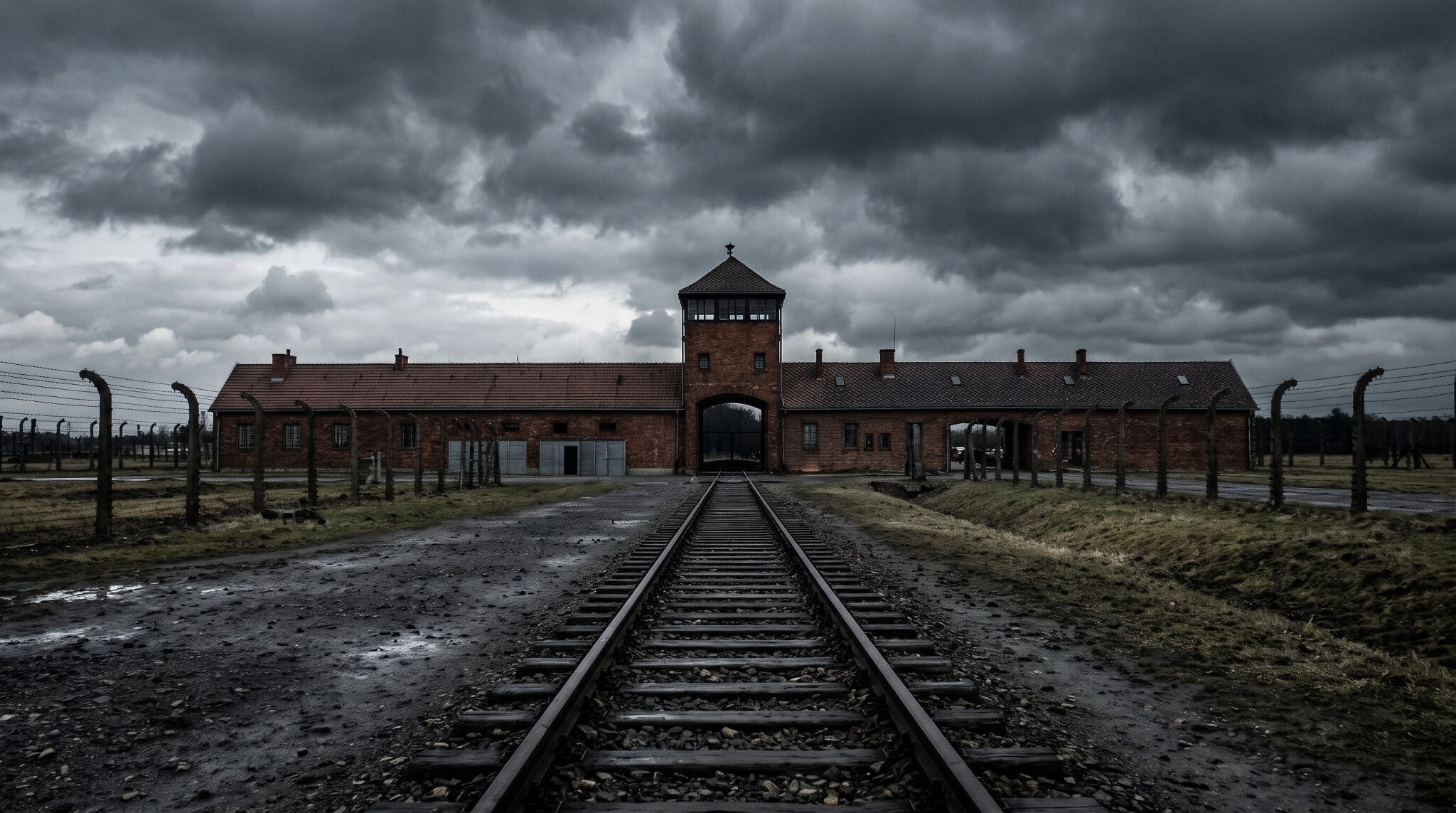
Where was God in the Holocaust?
A flood hits a small town. A deeply religious man climbs onto his roof as the water rises and prays: “God, save me. I have faith in you.” A man in a rowboat paddles by and shouts, “Jump in!” The religious man waves him off: “God will save me.” The water reaches his waist. A rescue motorboat pulls up. “No, go save others. God will save me.” The water reaches his neck. A helicopter drops a rope ladder. “I’m staying right here. God will save me.” The helicopter leaves, and the man drowns.
At the gates of Heaven, he stands before God, furious. “I had complete faith in you. Why did you let me drown?”
God sighs. “What do you mean? I sent you two boats and a helicopter.”
Every November, around the anniversary of Kristallnacht, someone looks into a camera and asks the question the Diaspora has been asking for eighty years: where was God in the Holocaust? Why was He silent?
I’ll answer it the way a Sabra answers, straight. God was not silent. He spoke for 60 years before the first train left for Auschwitz. He sent the boats, one after another, and He opened the door. The Jews of Europe heard Him and decided to stay on the roof. The question assumes a silent God. The real question is a different one: where were the Jews when God was calling?
First, let me clear away the worst answer, because some Jews give it. The Satmar Rebbe, Joel Teitelbaum, taught that the Holocaust was God’s punishment for Zionism, for “forcing God’s hand” by building a state. He had it backwards. Forcing God’s hand is the reason there is a Jewish people at all. Sarah forced it when she told Abraham that the son of the maidservant would not inherit with Isaac, and God answered: “Whatever Sarah says to you, listen to her voice” (Genesis 21:12). If Sarah hadn’t forced God’s hand, we would all be Ishmaelites today. God’s wrath is kept for the enemies of Israel, not for His people. The Holocaust was not a punishment. God sent the exit. The Gentiles did what Gentiles do to the Jews who stayed in their house.
The exit always led to the same address. Zionism is not a 19th-century European idea. It is at least 3,000 years old; it just wasn’t called that. It is the right to Mount Zion, to Jerusalem, the city whose name Jews carried into every exile and every Seder: “Next year in Jerusalem.” Herzl gave the movement an office in Basel. He didn’t invent it.
So the question was never whether we had an address. The question was whether we would go when the door opened. And the hard truth is that we failed almost every time. When Israel left Egypt, Rashi, following the sages, says only one in five went out; the rest died in the plague of darkness, because they did not want to leave. The one in five who did leave reached the border of the land, heard the spies’ report, and cried that it would be better to go back to Egypt than to “fall by the sword” (Numbers 14:3). The same refusal every time, and the same fear behind it: the fear of having to fight for the land.
That fear was born again after Rome. After the savage Diaspora revolt of 115–117 CE, the Kitos War, and the fall of Bar Kokhba in 135, the Jewish people split in two. One part remembered the sword and, 18 centuries later, became the Zionists. The other swore never to raise a sword again, even at the cost of their lives, and waited for God to come down from heaven and do the fighting for them. That is where the exile mindset was born. And then, in the nineteenth century, God started sending boats.
The first was the rowboat, in 1881. Pogroms swept Russia, and a handful of young Biluim got up and went home to drain swamps and die of malaria in the Land of Israel. That is where our war of independence really began, in 1881, not 1948. The road to Zion opened in the same year the villages of Russia burned. A child could have read that sign.
The second came in 1897, when Herzl convened the First Zionist Congress. He wanted it in Munich. The Jews of Munich, terrified that the Germans would see Jews meeting as a nation, forced him out to Basel. Remember the city. A generation later it was the cradle of Nazism.
The third was the motorboat, and it was the loudest of all. In 1917 the Balfour Declaration promised a national home for the Jewish people. In 1920, the San Remo Resolution wrote that promise into international law. In 1922, the League of Nations gave Britain the Mandate and recognized “the historical connection of the Jewish people with Palestine.” For the first time since Bar Kokhba, the nations of the world said to the Jews: the deed is yours, go home. Britain was never the landlord of this land. It was the custodian, handed the keys with one job: build the national home and hand it to its owner.
And the Jews of Europe looked at the open gate and stayed where they were. They were like a prisoner who prays for freedom for twenty years and then, when the gate finally opens, refuses to leave because he’s afraid of paying rent.
They didn’t refuse quietly. In 1885, the Reform rabbis of America met in Pittsburgh and declared: “We consider ourselves no longer a nation, but a religious community, and therefore expect neither a return to Palestine…” Their leader, Isaac Mayer Wise, put it plainly: “We are Englishmen in England, Frenchmen in France, and Americans in America.” In Eastern Europe, the Bund preached Doykeit, “here-ness”: stay in Poland, fix the Gentile world, and the Gentiles will stop hating you. In Germany, Max Naumann, an Iron Cross veteran, led Jews who declared they were “Germans of Mosaic faith.” Every one of them believed that if they made themselves less Jewish, the hatred would stop.
Then, in 1939, the custodian shut the door. The British White Paper capped Jewish immigration at 75,000 over five years, and after that the Arabs would decide. The door had been open for 58 years. It closed just as the crematoria of Europe were being fired up, when it was already too late for most. If the Jews of Europe had done what they were supposed to do between 1881 and 1917, there would have been no Holocaust. There would have been millions of Jews in the Land of Israel before Hitler ever opened his mouth in a beer hall.
And the ones who said “here”? The Gestapo didn’t care about Naumann’s Iron Cross. The gas chambers didn’t care about the Bundists’ socialism. The Reform German, the Bundist, and the Zionist who didn’t make it out in time went into the same chambers. “Here” is a death trap when you are a guest in someone else’s house. The six million were not killed because God was silent. They were killed in the house they refused to leave.
Now look at today. On November 8, on the eve of the Kristallnacht anniversary, a group in Philadelphia organized a “Boycott Ride” past six Jewish-owned businesses near Rittenhouse Square. Their flyer called them “Zionist establishments” and said they must go. One owner, Yehuda Sichel, a grandson of Holocaust survivors, answered: “We’re not going anywhere.”
I understand him. I’m glad he stood in his doorway, and I would never tell a Jew to bow his head to a mob. But as a brother who cares about you and your children: it doesn’t matter if you built that restaurant. It doesn’t matter if you built the whole town. It is not your home. Wise said Americans in America. Naumann said Germans of Mosaic faith. A man in Philadelphia says we’re not going anywhere. It’s the same sentence in three accents.
And that ride didn’t come out of nowhere. Look at who has been marching through Western cities since October 2023. “Queers for Palestine,” marching for a cause that would execute them first. A climate march in Amsterdam chanting “No climate justice on occupied land.” Google engineers staging sit-ins in their own offices against a contract with Israel until twenty-eight of them were fired. A Cornell professor calling the massacre “exhilarating” eight days after it happened. Young Americans reading Osama bin Laden’s “Letter to America” into their phones and nodding. These people agree on nothing: not God, not gender, not capitalism. They agree on one face. They don’t love Palestine; they love the enemy of the Jew. And when the march ends, it walks past a Jewish shop. Every Jew of 1938 would recognize that sign.
People ask the same question about October 7: where was God on Simchat Torah of 2023? I won’t answer like a prophet. I’ll answer from the record. God was where He was when Amalek came for us the first time, at Rephidim, right after Egypt. The Torah says Amalek attacked “all that were feeble behind thee” (Deuteronomy 25:18), the weak at the back of the camp. That is exactly what happened in the kibbutzim and at the Nova festival. And God didn’t stop Amalek from attacking, or come down from the sky to fight instead of us. Joshua went out with men and defeated Amalek “with the edge of the sword” (Exodus 17:13). The Mishnah asks whether Moses’s raised hands won the battle, and answers that Israel prevailed when it looked upward and fought. God was not watching from the sky. He was with the men holding the swords. On October 7 He was with the grandfathers in Sderot who grabbed their pistols and ran toward the fire, and with the reservists who drove south before the orders came. He has been with the army of Israel every day since. The difference between 1942 and 2023 is not where God was. It is where the Jews were. In 1942 they were in someone else’s house with no army. In 2023 they were in their own house with a sword in their hand, and the house is still standing.
That is the whole point, and it runs through our entire history: God stands with those who carry the sword, not with those who sit and wait for Him to do the fighting for them. At the Red Sea, with Pharaoh’s chariots behind them, Moses cried out to God, and God answered: “Wherefore criest thou unto me? speak unto the children of Israel, that they go forward” (Exodus 14:15). The Talmud says the sea did not split until Nachshon ben Aminadav walked into the water first. While Moses was still praying, God said to him: “My beloved ones are drowning in the sea, and you prolong your prayer?” (Sotah 37a). Gideon’s three hundred didn’t stand on a hill and pray. They went down into the enemy camp shouting, “The sword of the LORD, and of Gideon” (Judges 7:20): the LORD’s and Gideon’s, together. When Nehemiah rebuilt the walls of Jerusalem, every builder worked with one hand and held a weapon in the other (Nehemiah 4:17). The Maccabees didn’t wait in caves for a miracle. They took up arms first, and only then came the miracle we light candles for every Hanukkah. Every time, the order is the same: first the Jew stands up, then God stands with him. The man on the roof had faith, and he drowned. Faith that refuses the boat is not faith. It is fear dressed up as piety. The Jews who waited in Europe for God to save them were waiting for something He never promised. The Jews who drained the swamps and picked up rifles were doing exactly what He had always asked.
And that is what makes today’s refusal even harder to forgive. In 1939, a custodian shut the gate. Today there is no custodian and no gate. Israel exists. Every Jew on earth could come home tomorrow morning. And look at the world he is choosing to stay in: Jews pushed out of one social structure after another, antisemitism rising everywhere, Nazis raising their heads again, Islamists and Jew haters in every street, and the violence rising. These are the signs of 1881 again, only louder.
So if you are sitting on the roof waiting for the Messiah, look at what has already come. In 1881 God sent the rowboat. In 1917, He sent the motorboat. In 1948 He sent the helicopter: a Jewish state with a Jewish army, standing at the gate with the ladder down. Today it lands at Ben Gurion Airport every single day. Don’t stand at the gates of Heaven and ask God why He let you drown. You already know His answer.
I don’t want someone, 50 years from now, to sit in front of a camera and ask: where was God in the second Holocaust? I’m answering now, before it happens. God is in Jerusalem, calling the Jews home. They just have to listen.
–
Sources:
Genesis 21:12; Exodus 14:15, 17:13; Numbers 14:3; Deuteronomy 25:18; Judges 7:20; Nehemiah 4:17
Talmud Bavli, Sotah 37a, https://www.sefaria.org/Sotah.37a
Rashi on Exodus 13:18 and 10:22, https://www.sefaria.org/Rashi_on_Exodus.13.18
Mishnah Rosh Hashanah 3:8, https://www.sefaria.org/Mishnah_Rosh_Hashanah.3.8
The Pittsburgh Platform, Central Conference of American Rabbis, 1885
The Mandate for Palestine, League of Nations, July 24, 1922, https://avalon.law.yale.edu/20th_century/palmanda.asp
San Remo Conference, April 1920, Jewish Virtual Library, https://www.jewishvirtuallibrary.org/the-san-remo-conference
British White Paper of 1939, Encyclopaedia Britannica, https://britannica.com/topic/White-Paper-United-Kingdom-1939
Philadelphia “Boycott Ride,” Fox 29, https://www.fox29.com/news/philadelphia-bike-rally-targeting-jewish-owned-businesses-sparks-state-local-outrage; The Philadelphia Inquirer, https://www.inquirer.com/opinion/commentary/bike-boycott-targets-jewish-israeli-owned-businesses-kristallnacht-eve-20261106.html
Cornell Daily Sun (October 2023); Euronews (November 13, 2023); NBC News (April 2024); NPR (November 17, 2023)
Related Topics
Related Posts