


Rabbi and editor of 'No Time for Neutrality'
This Tisha B’Av, Israel Needs a Stronger Love
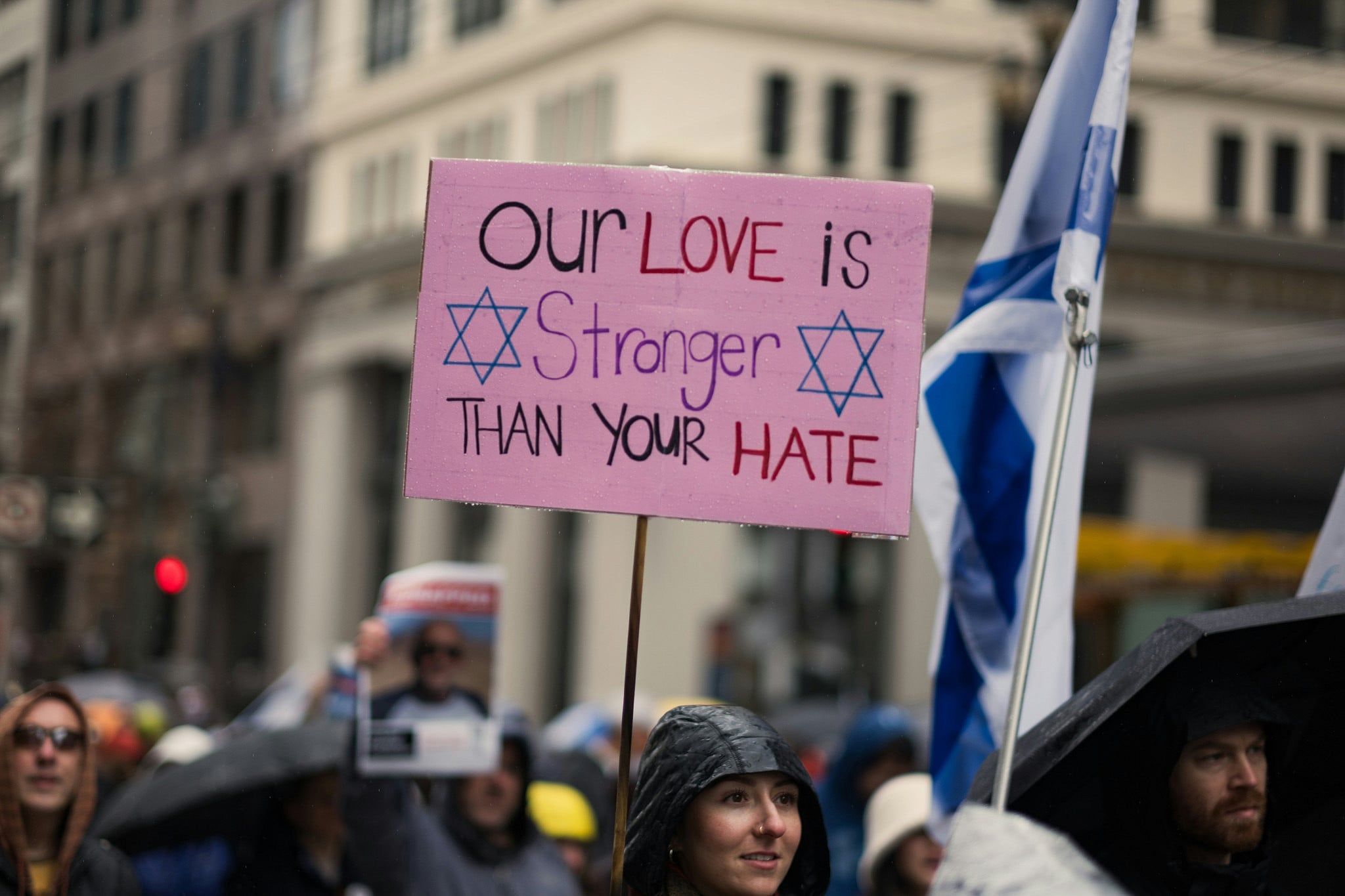
Image: An activist holds up a sign stating "OUR LOVE IS STRONGER THAN YOUR HATE", at a recent march against antisemitism in San Francisco. Source: Levi Meir Clancy / Upsplash. Free to use under the Unsplash License.
As Jews prepare to observe Tisha B’Av tonight — the annual fast day mourning the ancient destruction of Jerusalem and other catastrophes in Jewish history — American support for Israel appears to be entering a new and unsettling era. Last week, 103 House Democrats, nearly half the caucus, joined one Republican in voting to eliminate the $3.3 billion in annual American security assistance to Israel. The amendment failed, 314–104, but a vote like that would have been nearly inconceivable only a few years ago. Days later, New York City’s mayor urged the federal government to arrest Israel’s prime minister under an International Criminal Court warrant. Taken together, these developments make something increasingly difficult to deny: support for Israel that once seemed nearly axiomatic in American political life is becoming more contested, more conditional, and more fragile.
Many Jews will look at these developments and conclude that this is a moment for in-group solidarity and circling the wagons, not critical self-reflection. After October 7 and amid a resurgence of antisemitism, that instinct is understandable. Israel faces real enemies, Jewish vulnerability is not imaginary, and some of the people condemning Israel have shown themselves strikingly indifferent to Jewish wellbeing.
But Tisha B’Av preserves a more demanding understanding of solidarity. The day calls us to remember the violence inflicted upon the Jewish people by enemies from without, yet the prophets whose warnings echo through this season also ask what happened within Jewish society: how power was used, whose suffering was ignored, and which warnings were dismissed until catastrophe could no longer be prevented. Jewish memory does not require us to choose between mourning what has been done to us and examining what we have done — or failed to do. It insists that we remain capable of both.
Rabbi David Ingber, founder of Romemu in New York City, recently raised a related challenge in Tablet, arguing that liberal rabbis are quick to invoke the biblical prophets when criticizing Israel, Jewish institutions, or Jewish power, yet less willing to summon the same moral clarity when confronting Hamas, Iran, Hezbollah, antisemitism, or progressive movements that excuse it.
I admire Rabbi Ingber’s teaching and leadership, and I agree with him about the stakes. Since October 7, many Jews have learned, painfully, that people fluent in the language of justice can be evasive, callous, or even cruel when Jews are targeted. Jewish safety is a justice issue, and any moral vision that extends compassion to everyone except Jews is badly broken.
Still, his diagnosis does not match the American Jewish world I know. Blind spots exist across the spectrum: some Jews are quick to detect antisemitism when it appears in anti-Zionist language on the left, as we should be, but far less clear when it appears in nationalist, Christian-supremacist, or conspiratorial language on the right, especially when the speaker also claims to stand with Israel. Antisemitism does not stop being antisemitism when it comes wrapped in an Israeli flag.
From where I sit, the larger American Jewish imbalance has not generally been excessive scrutiny of Jewish power. More often, it has been defensiveness about Israel, suspicion of Israel’s critics, avoidance of Palestinian suffering, and reluctance to ask what is being done with Jewish power and in the Jewish people’s name. Liberal Jewish spaces have their own blind spots, and we should reject any version of prophetic Judaism that has compassion for everyone except Jews. I simply do not believe that the dominant problem in American Jewish life is that Jews have been too willing to call our own side to account.
Rabbi Ingber also challenges liberal rabbis’ use of the prophetic tradition. It is true that the biblical prophets rebuked non-Israelite nations, but their central burden was Israel and Judah: the ways their own societies abused power, betrayed the vulnerable, mistook religious observance for righteousness, and imagined themselves immune from moral judgment.
That is not cherry-picking. It is reading for center of gravity.
The prophet Isaiah, whose words accompany us in the days leading up to Tisha B’Av, does not reassure the people of Judah by comparing them to their enemies. He denounces leaders who accept bribes, a society in which the orphan and widow cannot secure justice, and worshippers who raise hands in prayer while those hands remain stained with blood. His message is not that Israel alone is evil, or that the nations surrounding it are innocent, but rather that Israel remains responsible for what Israel does. The fact that one’s enemies also act immorally is not an alibi for refusing self-examination.
True, some criticism of Israel is shallow, contemptuous, historically illiterate, or functionally indifferent to Jewish life. Similarly, some critics treat Jewish peoplehood as embarrassing, Jewish sovereignty as inherently illegitimate, and Jewish fear as a manipulative distraction. I have no interest in dressing that up as prophetic.
Yet criticism can also emerge from attachment, covenant, and love — from the conviction that Jewish power must remain accountable to Jewish responsibility. That kind of criticism is not a repudiation of Jewish tradition; it is embedded within it. The Torah commands: “You shall surely rebuke your fellow, and incur no guilt because of them.”
The same is true in Jewish education. American Jewish life has not broadly neglected Israel or Zionism, as Rabbi Ingber contends; in many institutions, Israel has been among the dominant educational emphases for decades. What we have often neglected is not attachment, but the capacity to sustain attachment through complexity.
We taught pride without sufficient room for argument, defense without discernment, and love without enough light. We offered young Jews an Israel they were expected to embrace, but not always the intellectual and spiritual resources to remain connected when they encountered occupation, religious extremism, Palestinian narratives, or Israeli policies that conflicted with values we had also taught them to cherish.
That kind of love is too brittle. If one critical article, one Palestinian story, or one honest conversation can threaten a young Jew’s entire relationship with Israel, then we should ask what kind of relationship we have built. A love that cannot hear a hard truth is a weak kind.
We need a stronger love: one that can affirm Israel’s centrality to Jewish life while recognizing that Palestinians, too, are created in the image of God; oppose antisemitism without using it as a shield against moral scrutiny; defend Jewish sovereignty while insisting that sovereignty remain answerable to Jewish ethics; and grieve Jewish suffering without becoming indifferent to the suffering of others.
The House vote and the mayor’s statement do not prove that every criticism of Israel is justified, that ending American assistance would be wise, or that Netanyahu is beyond defense. They do, however, show that the old political consensus is fracturing, and that reflexively denouncing Israel’s critics will not restore it. Nor will abandoning Israel.
The question is whether American Jews can articulate a form of solidarity capacious enough to defend Israel against those who seek its destruction, honest enough to confront the ways Israel may be contributing to its own isolation, and rooted deeply enough in Jewish tradition to refuse both contempt and flattery.
Tisha B’Av asks us to mourn Jerusalem’s destruction, but mourning in the Jewish tradition is not merely an exercise in grievance. It is also an invitation to clarity, responsibility, and return. The prophets whose voices accompany us into the fast loved Jerusalem enough to warn it, and remained bound to their people even when their people did not want to hear what they had to say.
If Israel is ours enough to defend and support, then it must also be ours enough to challenge. We can name antisemitism without silencing every critic, defend Israel without denying Palestinian suffering, and challenge Israel without abandoning it.
We need a stronger love.
Related Topics
Related Posts

