Three Funerals and a Wedding
To say that I don’t like roller coasters would be an understatement—along the lines of describing the Grand Canyon as having “a nice view.” I probably haven’t been on one in 45 years, and the odds are high that my streak will likely continue for the next 45 years.
There’s even a word for the fear of roller coasters: veloxrotaphobia. Actually, there are two words: it’s also called coasterphobia, but the latter is a clumsy, inelegant compound that makes me think some lazy intern was on his phone the day the boss tasked him with inventing a new word. There’s no question that while coasterphobia excels for memorability and pronounceability, it totally lacks the hip factor of veloxrotaphobia.
—
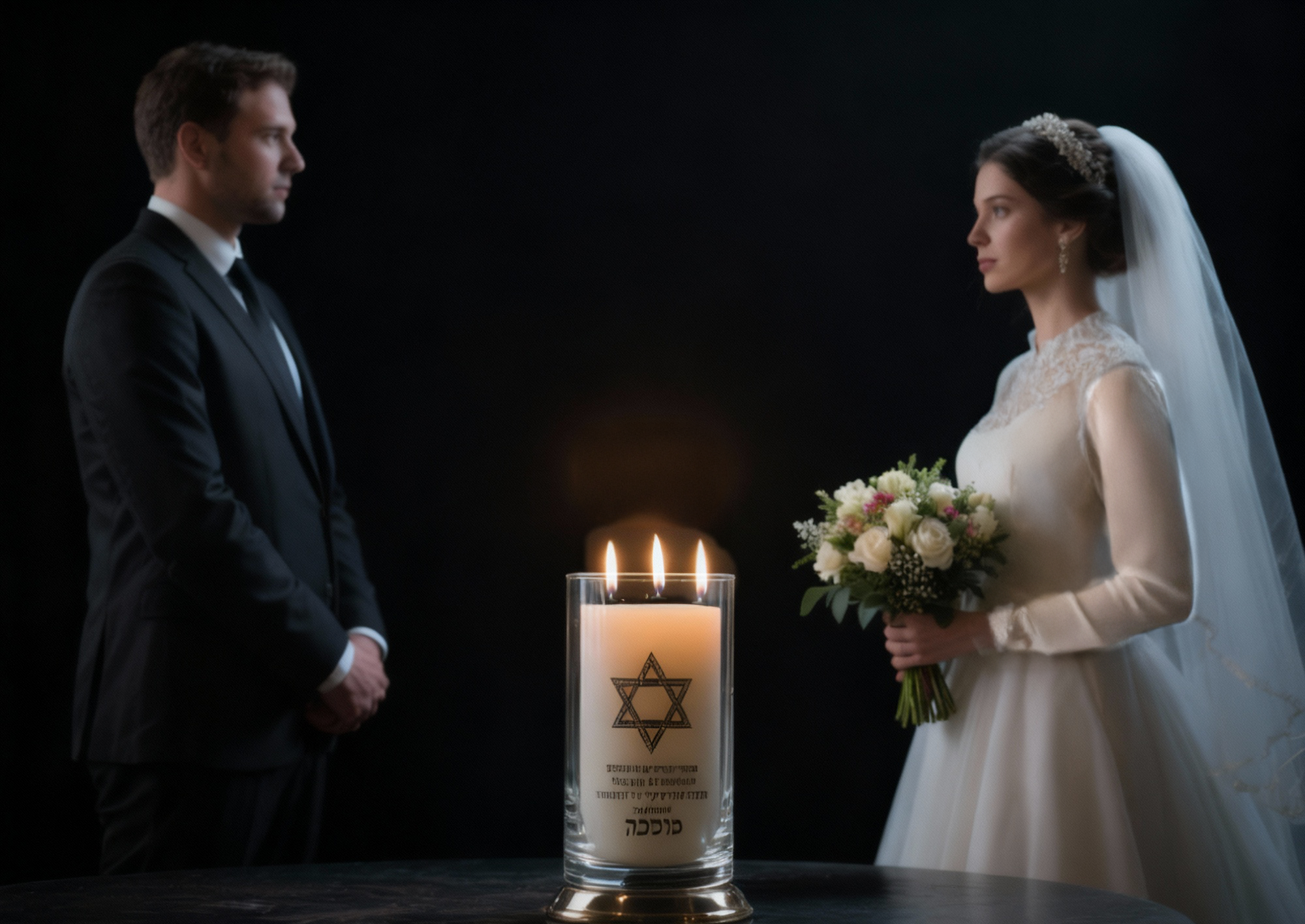
There’s one roller coaster unavoidable for all of us, and that’s the one known as life. I remember a rabbi once describing the storming duel of emotions when officiating at a funeral by day and a wedding that same night. It seemed to me that this realm was mostly relegated to clergy, who, by the nature of their positions, must scurry between lifecycle events.
Joyous. Tragic. Celebratory. Somber. All part of the job.
Once we made aliyah to Israel, I quickly learned that this emotional roller coaster was not merely the purview of religious officials—it was an all-too-common, profound bond shared by every Israeli. The catastrophes touch everyone; the celebrations reach us all.
Not long after we arrived, our son was on a hike ambushed by nearby Arabs, who hurled large rocks at the group, the mob pursuing the hikers up and down the wadis of Gush Etzion for nearly an hour. Miraculously, the physical injuries were minor, and a couple of months later, we scheduled a special meal for family and friends. The Sunday dinner doubled as a Seudat Hoda’ah—a meal of thanksgiving for his escape from potential harm—and a Mesibat Giyus, a pre-Army sendoff in anticipation of his entry to the Paratroops.
On the Friday night before our planned event, terrorists snuck into the settlement of Itamar, slaughtering five members of the Fogel family in their beds, including three young children. Unbeknownst to me at the time, the Fogels were relatives of our cousins in Jerusalem.
So, in the small world that is Israel, a number of those scheduled to be at our party spent the afternoon attending the heartrending funerals. Those who could join us afterward transitioned from the horrific scene of the afternoon into dancing and singing with us in the evening.
It was a day on the national roller coaster, where the aftereffects are far more painful and long-lasting than the nausea felt after a ride at Six Flags. These treacherous journeys affect everyone here, not just rabbis.
—
The riders are strapped in, fully aware that the ride will have twists and turns, soaring ascents, and precipitous drops. For the moment, as the cars head upward with a signature clackety-clack-clackety-clack along the wooden tracks, the crowd smiles, and their upstretched arms almost seem to touch the endless, bright blue sky.
—
What could have possibly added to the boundless Simcha at the end of Sukkot, with the euphoric return of the live hostages? Glued to our screens on Hoshana Rabba, we watched the unimaginable become reality. So many of our people came home, delivered from their prisons, freed from their sadistic captors.
Who could ever have imagined the redemption we felt as we danced on Simchat Torah in the very halls where we first heard the news of the massacres exactly two years earlier?
—
As the cars pass the crest, the blue sky vanishes in an instant, and the riders suddenly plummet—down, down, down. The clackety-clack-clackety-clack is subsumed by the thunderous sound of rushing air smacking them straight in the faces. Their cheers from a moment ago are forgotten in their screams at the seemingly bottomless descent.
—
Funeral One
The close of Simchat Torah in the USA brought the unthinkable news of the death of Rabbi Moshe Hauer, zt”l. For those of us from Baltimore, the shock took on another dimension.
I don’t claim to have been very close to him, though we were certainly friendly. Many of our friends were themselves dear friends of his. We lived just two blocks apart. Our son Avi’s bar mitzvah took place in his shul. We served on a board together.
Rabbi Hauer was a soft-spoken man of quiet wisdom, modesty, and intense care for others. There is little I can add to the oceans of ink which have and will be written in tribute to him, other than one small facet.
Many have spoken about the fact that he was an incredible listener, always hearing people out before gently weighing in. He not only welcomed opinions with an open ear, he did so with an open heart. He taught others to do so as well.
As a mentor of younger rabbis, one of these protégés approached Rabbi Hauer for advice before assuming his first pulpit, in Binghamton, NY, where I grew up.
To introduce his response, I’ll give a little background.
On some of my father’s visits to Baltimore in the ‘90s, he spoke to Rabbi Hauer (then a fairly new rabbi) after Shul. My father would share feedback on the rabbi’s drasha or anything else he noticed could be improved. These were not complaints but constructive suggestions.
Rabbi Hauer listened, of course, but he also took my father’s suggestions to heart, implementing them as he saw appropriate. It was clear to him that my father’s only interest was in helping him improve his skills and better tend to his flock.
So when—years later—the young Binghamton-bound rabbi asked Rabbi Hauer for his guidance in his first rabbinic position, Rabbi Hauer instructed him to find a confidant in the Shul whom he could trust to give him the straight scoop on what he was doing right and what could be improved.
(Full disclosure: he told him that Mr. Staiman was the man he could trust.)
Chana and I attended the funeral of the great listener, Rabbi Moshe Hauer. Because the flight from America bearing the casket only arrived in time for a Friday afternoon burial in Jerusalem, the eulogies were short and few. For many attendees, words were almost unnecessary, given the pervasive devastation at his loss and the reverence already on display.
—
What seemed to be a safe and secure journey a moment ago is now riddled with confusion and chaos. Will the passengers find comfort as they level off from the first drop? What awaits around the next bend? Both literally and figuratively, everything is up in the air.
—
Funeral Two
As if Baltimore had not already been left reeling, several days later, a young student at the Mir Yeshiva in Jerusalem was found lifeless in his room. It was Shlomo Aryeh Ribakow, the son of someone I have known since our Israel-yeshiva days some 45 years ago.
He was named after his grandfather, Rabbi Shlomo Aryeh (Ervin) Preis, who had been the rabbi of our Shul in Baltimore and the head of the local rabbinical council. The new child’s naming at his bris two decades ago took place in that same Shul on Yom Kippur. There was not a dry eye in the crowd back then as the infant assumed a name laden with a tradition of humble dedication.
Nor was there a dry eye in the crowd today, as his family, heaving with pain, fearlessly accepted G-d’s judgment as they bade him farewell. Since this funeral took place on the first day of Rosh Chodesh, the eulogies were, again, short and few.
As a family of Kohanim, they stood on the road above the open grave, watching as loved ones and yeshiva mates filled the earth and helped return Shlomo Aryeh’s body to the dust from whence it came.
His resting place is but a few a few steps from his namesake and grandfather.
—
It’s too late to get off, but many wonder what they are doing here. What were they thinking to get on this insane ride in the first place? When will this end?
—
Funeral Three
The following day we received word that Aryeh’s father had passed. Aryeh is the reliable Ba’al Koreh and a Gabbai in our Shul. He is clearly someone who was raised right. And the nonagenarian who had raised him right had gone on to the next world.
It was the second day of Rosh Chodesh, so the eulogies were, yet once more, short and few. For many of us — despite arriving on time — who could not even enter the packed hall, it was clear that this was a very special man, whose devotion to his G-d and his family had borne the most beautiful fruits.
Another family of Kohanim, his widow and five children were just a little further down the road from the funeral held the day prior, as other non-Kohanic members of the tribe acted as their agents to fill the grave of their loved one with earth of the Holy Land.
A couple of days later, Chana and I followed up with a Shiva visit in Jerusalem. While every death is a tragedy to a family, there was clearly a feeling in the air that this Shiva was a loving tribute to a patriarch who had lived a long, productive, and exemplary life. Smiles and anecdotes were abundant. Warm stories were shared with relatives and friends.
I suspect that most of us hope that Shivas held for us, after 120 years, will be like that: a celebration of a life well-led. I know that I do.
—
Things slow down, and the cars jerk to a sudden stop. The silence is deafening, and the air is thick with anticipation. After a dramatic pause, slowly, they begin to rise again.
—
And A Wedding
Of the wife and five children who filled the apartment for Shiva, one son was absent during our visit. His daughter — one of the deceased’s granddaughters — was getting married that evening, and he had rightfully left the house of mourning to prepare for his daughter’s nuptials.
The free-flowing conversation in the Shiva house continued until the door opened and the room fell still.
Without notice, the bride entered, regally flanked by her sisters and sister-in-law, who wore coordinated ocean-blue bridesmaids’ dresses. The bride’s lovely white gown radiated with the same intensity as her big smile, together projecting a light which dispelled — and expelled — any darkness of grief from the room. Her wedding would not be complete if she did not include her grandmother, even if that meant traveling to the place where she sat, grieving her husband. The group of young ladies neared the chair in which their grandmother sat. They all embraced, sharing loving words.
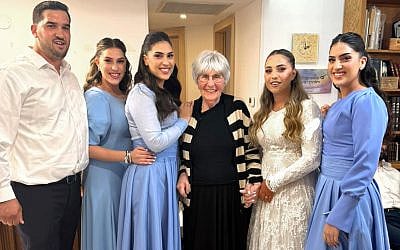
The eyes in the room were suddenly brimming with a different mix this time. The salty tears of grief merged with tears of joy, as the beautiful spectacle unfolded.
One generation was saying goodbye. But at the very same moment, the next generation was sprouting anew, with the vibrant promise of life and love and fulfillment. Of being the next link in one family’s chain of forging lives well lived.
—
It’s been a wild ride. Some will return to try it again, but perhaps not just yet. Most are glad it’s over. But everyone agrees that they are now a bit different than when they started.
—
The drive home from the shiva house was fairly uneventful. Until the final 10 minutes, that is. Little did we expect yet another unforgettable experience awaited us.
As we turned onto the roadway to our neighborhood, we saw that a busload of high school students had gotten off at one of the traffic circles. Dressed in blue and white, they also carried Israeli flags, seemingly for some sort of rally.
At the next circle, the scene repeated itself, and then we noticed cars parking along the shoulders, with people streaming to line the sides of the road. The further we got, the denser the crowds. Some carried homemade signs:
“Welcome Home, Eitan!”
Eitan Mor, former hostage, had been released from the hospital, and was making his way via Beit Shemesh, through Gush Etzion, and then on to his home in Kiryat Arba. For the first time in two years, he would walk tall through his front door, where he would no longer dwell in a twisted world of torture, deprivation, and darkness. He would no longer just survive. He was going home to live.
It would not be a short trek to his destination. But all along it, he would be greeted by cheering, singing Israelis of all sizes, shapes, and colors. My wife hopped out to join the throngs of well-wishers. The roller coaster which began on October 7, 2023, had taken us to war and prayer and longing and desperation and hope and every stop on the emotional spectrum. This was one of those transcendent moments on this journey of life in Israel that you must grasp with all your might and treasure with all your soul.
Minutes later, the van carrying Eitan approached. The well-wishers flooded the road, surrounding the vehicle, singing, dancing, and cheering. Eitan smiled broadly, waving and giving high-fives through his open window. He was back with his People.
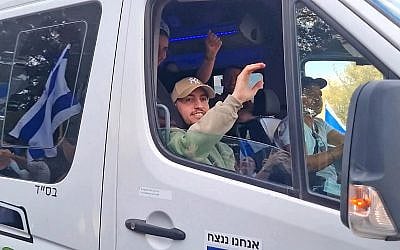
In time, the sea of love enveloping Eitan’s vehicle parted, and the van continued on its way to greet the next group on his trek. His trek home.
Home.
Home.
—
The ride in the amusement park may be over, but the roller coaster of life rolls on—surprising us, testing us, and transforming us. We hold fast and listen for the clackety-clack, praying for the strength to weather the lows, and grateful for the gift of every exhilarating rise.