


Founder | Children’s Book Author | Empowering Women & Supporter of Global Peace Initiatives | Mom | Yemma
Three Jewish Generations in the Doorway of Lecce
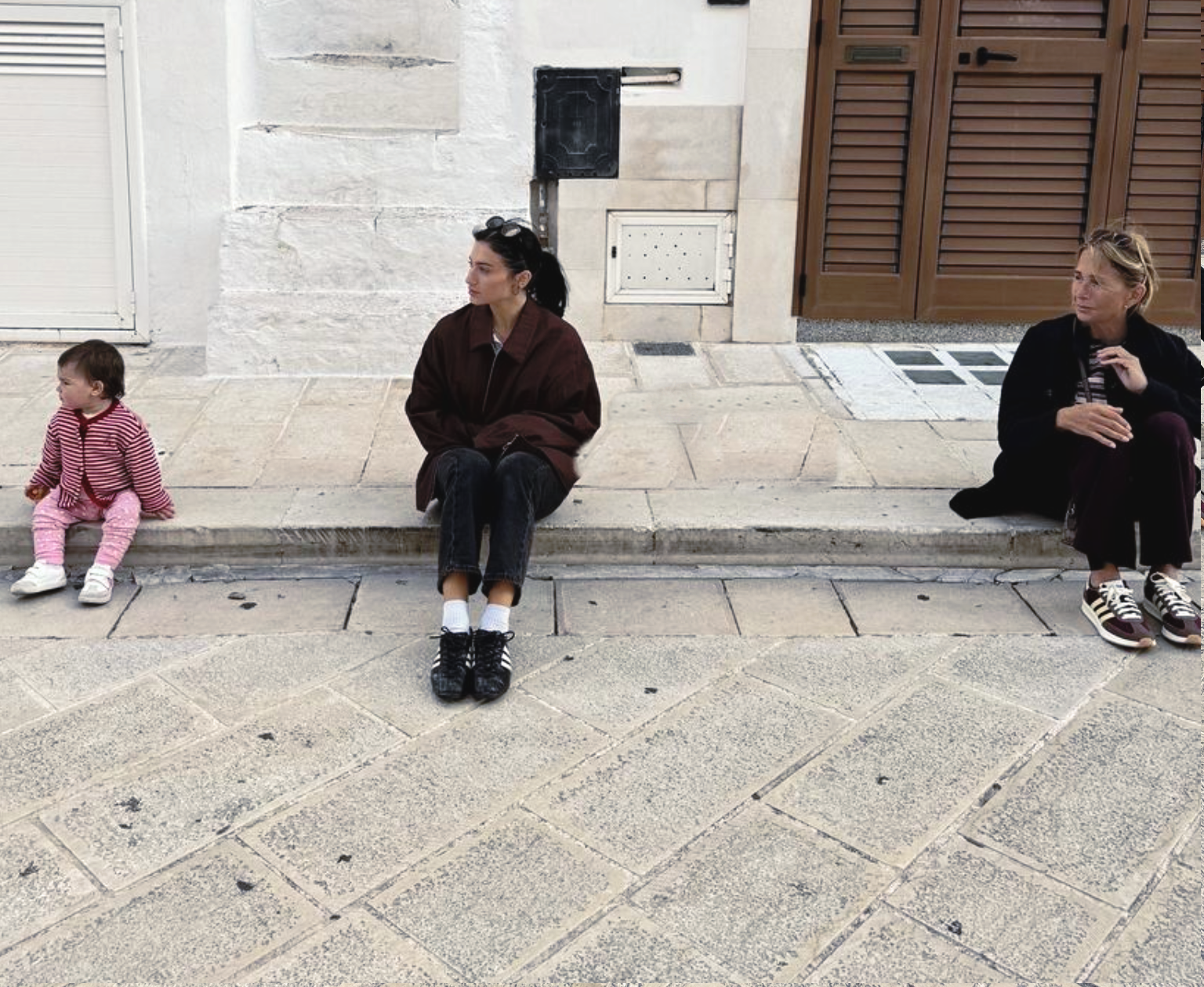
The author with her daughter and granddaughter in Puglia, Italy, October 2026
Why Puglia
Years ago, when my children were young, I began inventing fantasy adventures for them at bedtime. The stories revolved around Papimento, a character who lives in Brooklyn, New York, and whose adventures take him to exciting places around the world. The first, Papimento and the Chocolate Mountains, was set in Switzerland and was finally published in March 2026. The next adventure takes place in Italy.
When my milestone birthday approached, I decided I wanted to do something more than celebrate. I wanted to bring the world I had imagined for Papimento to life and share an adventure with the people I love most: my children and their families. I wanted them to step into the story with me.
I chose Puglia, in the heel of the Italian boot. Its ancient towns, some dating back 3,000 years, its layered histories, extraordinary beauty, and food seemed made for a fantasy adventure. Greeks, Romans, Arabs, and peoples from across the Balkans had all left their mark on the region. I imagined its whitewashed villages, winding streets, and turquoise waters as the perfect setting for Papimento’s next story.
I had no idea that Puglia would take me somewhere quite different: into another dark chapter of Jewish history.
Whitewashed Villages, Trulli, and Focaccia
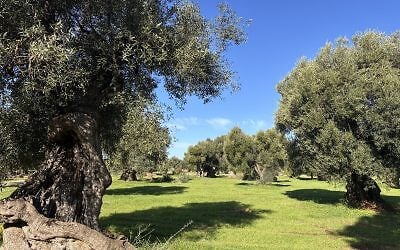 We rented a villa on a masseria, a traditional olive farm near Fasano. One morning, walking among the ancient olive trees, I noticed their enormous trunks, twisted and split, scarred with notches and hollows carved by centuries. Suddenly, I was a child in Israel again. I hadn’t expected to feel so at home so far from home.
We wandered the whitewashed lanes of Ostuni, explored the harbor of Monopoli, and discovered the cone-roofed trulli of Alberobello, which looked as if they had come straight out of a children’s book. We soaked up some sun at Polignano a Mare, next to cliffs the color of honey.
And then there was the food. One of my favorite dishes was fave e cicoria, a creamy fava bean purée with bitter chicory. I could also have lived on focaccia barese, the undisputed queen of Apulian street food, with its crisp bottom and soft, olive-studded top.
It was everything I had imagined for a birthday celebration, and a place where a writer could let her mind wander.
Where Are the Jews?
I never expected this birthday to awaken my sense of being Jewish so profoundly. Perhaps the milestone had made me more reflective. Or perhaps it was the world we are living in. Whatever the reason, I found myself thinking more deeply about my Jewish identity, my family, and the generations that will come after me.
My birthday fell on Shabbat. In Jewish tradition, we believe that on our birthday we are given a special power to bless others. I wanted to bless everyone close to my heart, and anyone in need of a blessing. So I looked for a Chabad house, as I always do to find a synagogue when traveling. But there was no Chabad. The nearest synagogue, in Trani, held no regular Shabbat services. The towns we planned to visit had none at all. All those thousands of years of history, and almost no Jews?
Few peoples have been persecuted as often as the Jews, and my family knows this history all too well. When Spain expelled its Jews, my ancestors fled to Morocco. Other relatives escaped Spain for Portugal, only to be driven out again. Generations later, as hostility toward Jews grew in Morocco, my family was forced to flee once more, this time to Israel.
I began researching the Jews of Puglia and discovered that the region had once been home to a thriving community, one that had existed for centuries. Beginning in 1495, those Jews faced the same impossible choice: convert, leave, or die.
One of the community’s most important centers was Lecce, about an hour south of our masseria. Today, a Jewish museum stands over the remains of its old synagogue. I knew we had to go.
Beneath the Golden Stone of Lecce
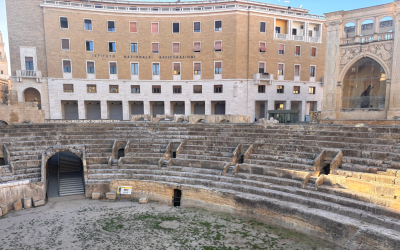 Of all the places we visited, Lecce held the most wonders. Known as the “Florence of the South,” it is filled with Baroque churches and palazzi carved from soft, honey-colored stone. But I hadn’t come for what stood above ground. I had come for what lay beneath it.
In the old Jewish quarter, the street names still remember: Via della Sinagoga; Via Abramo Balmes, named for a Jewish physician and Hebrew scholar born here in the 1400s; and Vico della Saponea, the lane of the soap makers, a trade the Jews of Lecce were known for.
Jews had lived in this corner of Italy for well over a thousand years. Lecce was one of the region’s important centers of Jewish life and learning. Puglia’s scholars were so respected that a medieval sage wrote, “For out of Bari shall go forth the Law, and the word of the Lord from Otranto.”
But that history was shattered by violence. In 1495, a mob attacked Lecce’s Jewish quarter and set it ablaze. Those who survived were scattered. Under Spanish rule, an order of expulsion followed in 1510, and by 1541, Jewish life in southern Italy had come to an end.
The story of the museum began in 2009, when a local tour operator named Michelangelo Mazzotta bought a house on Via della Sinagoga and wondered about the street’s name. Together with his partner, Francesco De Giorgi, and Professor Fabrizio Lelli, a scholar of Hebrew who became the museum’s director, he began investigating. Beneath a Baroque palazzo, in cellars that had once been a restaurant, they uncovered the remains of a fifteenth-century synagogue and its mikveh, a ritual bath. None of these men was Jewish. They did it anyway.
The Gate of Heaven
 We descended the stairs and stood over the mikveh, its dark, still water in a pool cut from the rock. Beneath a glass floor lay more stone pools, whose original purposes remain uncertain. I loved that our guide didn’t pretend to know everything. She showed us what remained and let it speak.
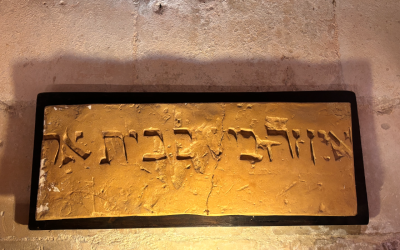
On one wall hung a stone slab carved with Hebrew letters, broken off mid-word: Ein zeh ki im beit Elo…, “This is none other than the house of G-d.” They are the words Jacob spoke when he awoke from his dream of the ladder. We were told that after the Jews were driven out, the stone was set into the ceiling of a latrine, with the holy words facing down. It wasn’t enough to expel the Jews. Their words had to be humiliated too.
Yet above that broken stone, someone had hung a calligraphy of the complete verse: How awesome is this place! This is none other than the house of G-d, and this is the gate of heaven. The words had been put back where they belong.
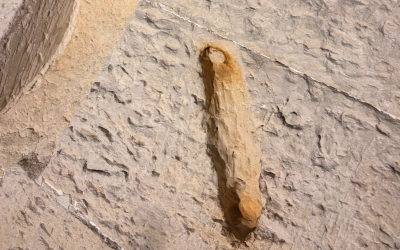 Then I saw the doorframe. Carved into the stone was a narrow slot, the place where a mezuzah once hung. A rush of emotion came over me. The slot had been empty for more than five hundred years. I reached out and ran my fingers along the groove, as if to say, I am here. I closed my eyes and whispered my blessings. There was no mezuzah, yet somehow the doorway felt full of spirit. Life is a journey: when one door closes, another opens. Wherever I go, I know my Jewish traditions will remain a comforting constant.
The Faces on the Wall
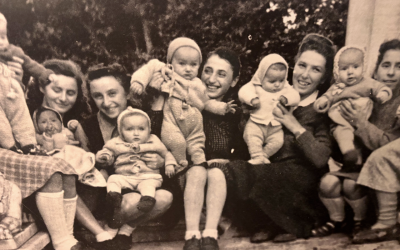 I expected the museum to end with yet another European story of Jewish persecution, displacement, and exile. Instead, the last room held black-and-white photographs. Teenagers dressed for Purim grinned at the camera. Women pushed baby carriages along a seaside promenade. Young mothers laughed as they held up babies in knitted bonnets.
They were Holocaust survivors. After the war, thousands waited in camps along this coast for a way to reach the Land of Israel. Here, on these beaches, they married, prayed, and had children. So many babies were born in the maternity ward at Santa Maria di Leuca that they became known as the “Leuca babies.”
The same land that drove its Jews out five hundred years ago took Jews in again in the twentieth century. I stood in front of those mothers and babies for a long time.
A Child on the Synagogue Step
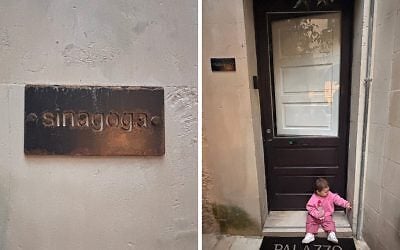 As we left, my granddaughter sat down on the stone step of the old synagogue doorway. She wore a pink sweatsuit and white sneakers and clutched a water bottle. Over her shoulder hung a little iron sign: sinagoga. She looked up at me and smiled.
She had no idea where she was sitting. To her, it was just a cool step at the end of a long day. But I saw it all at once: the empty slot where a mezuzah once hung, the mob of 1495, the mothers of 1946 holding their Leuca babies, and my own granddaughter, a Jewish child, sitting in the doorway of a synagogue that had been without a congregation for five centuries.
They tried to erase us here, as they have tried in so many places. Yet here we are: my daughter, my granddaughter, and me, three generations of one Jewish family, celebrating life in the heel of Italy.
Papimento’s Italian fantasy adventure will be a feast for the eyes, a treat for the palate, and a delight for the soul. The book isn’t finished yet, but Puglia has already given me plenty of inspiration. The adventures await, and the lessons will follow.