


Three lies about U.S. support for Israel
Their growing acceptance fuels conspiracy theories and threatens decades of sound U.S. policy
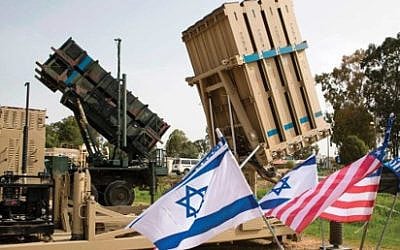
As we mark the third anniversary of Hamas’ October 7 attack against Israel and await U.S. and Israeli elections, Vice President J.D. Vance’s recent claim that President Trump has been more willing to break with Israel than any president in four decades has brought U.S.-Israeli relations under an even sharper microscope.
Legitimate disagreements between the two long-time allies help explain the increased attention. But so too do bad journalism, toxic social media, and yes, at times, old-fashioned antisemitism.
Combined, these and other dynamics are fueling three damaging myths: 1) U.S. aid to Israel is unconditional; 2) Washington never pushes back against Jerusalem; and 3) Israel receives support that no other country receives.
Promulgated so widely, these claims now pass for conventional wisdom.
But these assertions, with their undertones of nefarious Israeli and Jewish power, and potential to undermine sound U.S. policy, merit debunking.
1) The U.S. provides unconditional aid to Israel.
All U.S. foreign aid comes with strings attached. Israel is no exception. Over 500 pages of federal laws and regulations ensure it.
Stringent reporting, exclusive use of American vendors, human rights provisions, and support for the U.S. at the United Nations are just some of those conditions.
The $3.8 billion appropriated to Israel is entirely military aid, which carries additional limitations.
None of this is new or unique to Israel. With England facing Nazi Germany alone in World War II, the U.S. conditioned military aid to our closest ally. As recently as 2024, President Biden paused an arms shipment until Israel committed to additional, post-sale terms on its use in Rafah.
U.S. foreign aid has never been unconditional; claiming it is only for Israel is untrue.
2) The U.S. never pushes back against Israel.
Despite Vance saying Trump is uniquely willing to “break with” Israel, since 1948 every U.S. president has criticized Israel, conditioned aid, blocked arms, or opposed specific policies.
Truman imposed an arms embargo. Eisenhower threatened sanctions. Kennedy opposed Israel’s nuclear reactor. Carter labeled settlements “illegal,” and George H.W. Bush delayed $10 billion in loan guarantees.
American support for Israel has always coexisted with policy disagreements. That remains true under President Trump, who has threatened to withhold support if Israel annexes the West Bank, and differences remain over Gaza’s postwar governance, West Bank violence, and Israel’s continuing battles with Hamas, Hezbollah, and Syrian Islamists.
Even the closest of allies — America and England in World War II, the U.S. and Israel post-October 7 — clash publicly.
Saying D.C. and Jerusalem never clash is another fiction.
3) The U.S. provides aid to Israel that no other country receives.
Israel is one of many beneficiaries of American generosity. According to the State Department, in 2024, $72 billion of non-military support helped 213 countries and regions.
Meanwhile, we spend far more defending other allies: maintaining 200,000 U.S. troops on over 700 overseas bases in 80 countries costs some $200 billion annually — over 5,000% more than the $3.8 billion in “foreign aid” to Israel.
Security assistance to Israel is thus better understood as a mutually beneficial defense expenditure than as a unique foreign aid blank check. Unlike deploying our troops abroad, nearly every dollar to Israel is spent to purchase American-made products. This “buy American” requirement is yet another condition of the funding, creating over 20,000 direct jobs and thousands more indirectly, across more than 1,000 companies in 48 states.
Today, precisely because of such cooperative projects, Israeli air defense technology is helping protect American service members from Iranian missiles.
No matter how U.S. support to Israel is categorized, asserting that Israel receives support no other country does is baseless.
In fact, the U.S. only provides conditional aid to Israel, repeatedly challenges Israeli policies, and treats Israel like our other friends.
Denying those truths distorts public debate and amplifies harmful stereotypes about Israeli and Jewish influence.
Those lies also cast a shadow over U.S.-Israel relations, obscuring the already perilous path toward peace between Israel and the Palestinians. Israel achieved peace with Egypt, Jordan, the U.A.E., Morocco, and Bahrain. The proven route has been and remains paved with American support, illuminated by the truth.
The author is a retired Cold War-era U.S. Army officer who learned about Soviet weapon capabilities by inspecting equipment the Israeli Defense Forces captured and shared with the U.S.