

Mathematics Teaching Professor, Author
Thriving for Over 180 Years: Congregation Beth Israel of West Hartford, CT
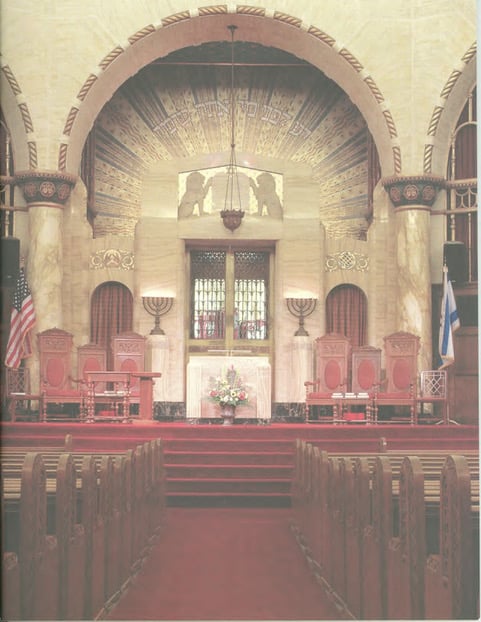
Sanctuary, Congregation Beth Israel, West Hartford, Connecticut (Source: Creative Commons)
Founded in 1843, Congregation Beth Israel in West Hartford, Connecticut, is one of the state’s oldest Jewish congregations and a vibrant Reform community serving about 700 families. For more than 180 years, it has provided a welcoming home for Jewish life, worship, learning, and tikkun olam, repairing the world, embracing people from diverse backgrounds who seek a supportive Jewish community.
I would like to thank the esteemed Jane Zande and Alison Hunt for their guidance.
Synagogue
Congregation Beth Israel in West Hartford, Connecticut, is known for its historic synagogue building, designed in 1936 by Charles R. Greco in a Neo-Byzantine/Byzantine Revival style with Art Deco influences. The structure is distinguished by its prominent twelve-sided dome and stained-glass windows depicting the Twelve Tribes of Israel. The building complex includes a sanctuary beneath the dome, a chapel, religious school, preschool, offices, meeting halls, a small museum, and a library. Recognized for its architectural and historic significance, it was added to the National Register of Historic Places in 1995 and later received the West Hartford Historic Preservation Award in 2006 for its careful restoration.
Religious Life
Congregation Beth Israel in West Hartford, Connecticut, centers its religious life around Shabbat, the weekly Sabbath, with welcoming services open to all and available both in person and online, serving as the foundation of community worship, reflection, and connection.
Throughout the year, the congregation also observes the full cycle of Jewish holidays with services, educational programs, and celebrations. During the High Holy Days, it offers a range of worship experiences for all ages, including services for young children, families, teens, and Yom Kippur afternoon and Yizkor services, creating opportunities for reflection and participation across generations.
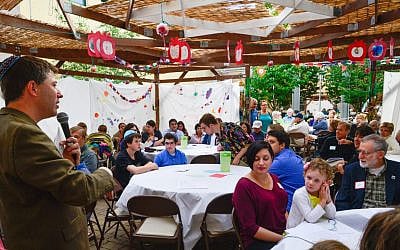
Seasonal festivals are marked with vibrant communal traditions. On Sukkot, members gather in the courtyard Sukkah for services and shared meals, giving thanks for the harvest and the themes of gratitude and impermanence. Purim is celebrated with a public reading of the Book of Esther, along with a lively Purim Shpiel and carnival that engage families and people of all ages in the joy and storytelling of the holiday.
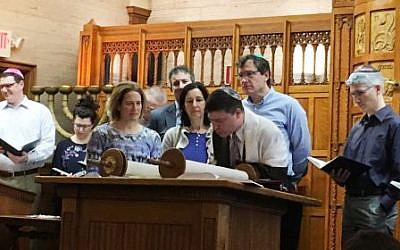
The congregation also celebrates Simchat Torah by completing the annual cycle of Torah readings and immediately beginning again, marked by the unrolling of the Torah scroll and communal dancing and singing. Passover is observed with community-wide seders that retell the Exodus from slavery to freedom, while Shavuot commemorates the giving of the Torah at Mount Sinai and includes special confirmation services for tenth-grade students completing their year of intensive study. Hanukkah is celebrated with festive Shabbat services, music, candle lighting, and traditional foods, bringing the community together in a joyful winter celebration.
In addition to holiday observances, Congregation Beth Israel marks important life cycle events that support members through all stages of life. These include Brit Milah and naming ceremonies, consecration of young students entering religious school, B’nai Mitzvah, Confirmation, conversion, weddings, and funerals. Together, these rituals and celebrations create a deeply connected and inclusive community grounded in tradition, learning, and shared spiritual life.
Culture
Congregation Beth Israel connects deeply with Jewish tradition through worship, holiday celebrations, lifecycle events, and lifelong learning, building a caring and inclusive community guided by Jewish values. These values extend beyond the congregation through a commitment to tikkun olam (repairing the world), connections to Israel and Jewish summer camp, and engagement in the broader world.
The congregation welcomes children, parents, grandparents, and friends of all backgrounds, including interfaith families, Jews by choice, people of color, and LGBTQIA+ individuals, and strives to be a supportive home for teens, seniors, and anyone seeking spiritual, emotional, or physical support.
Congregation Beth Israel’s Youth Engagement Program provides a welcoming Jewish education for students from Pre-K through high school, helping families build strong and positive Jewish identity. Beginning in early childhood, students learn about holidays, values, and traditions through songs, stories, crafts, art, and music, while gradually developing Hebrew literacy and prayer skills. As they grow, learning expands to include Jewish history, Torah, Israel, ethics, and culture through engaging and experiential approaches.
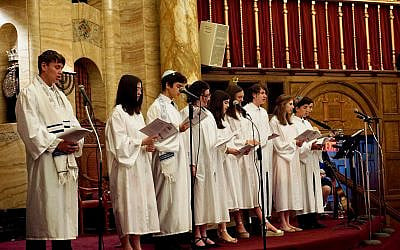
In high school, students deepen their involvement through programs that connect Jewish learning to contemporary issues and personal identity. The 10th grade Confirmation experience includes participation in the L’Taken Seminar in Washington, D.C., where students explore public policy through a Jewish lens and engage in advocacy. Congregation Beth Israel also partners with JTConnect to offer programming for grades 8 to 12 focused on Jewish learning, discussion, and social action projects that build community and engagement.
Music
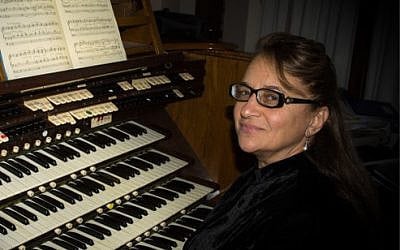
Organ Sounds is Congregation Beth Israel’s popular concert series, founded by former Music Director Natasha Ulyanovsky, which showcases the congregation’s historic 1934 Austin organ (Opus 1853) and often features guest soloists. The four-manual, approximately 3,000-pipe instrument, one of the last built by the original Austin Organ Company, was designed specifically for the sanctuary’s acoustics and was later recognized by the American Historical Society in 2004 for its historical significance.
Supported by congregants who helped restore the organ, the series keeps this majestic instrument alive through free concerts that are open to the public, held at Congregation Beth Israel in West Hartford and available both in person and via livestream, with donations welcomed to support ongoing musical programming.
Community Learning Center
The Ellen Jeanne Goldfarb Community Learning Center at Congregation Beth Israel provides a welcoming space for Jewish learning, reflection, and exploration. The two-story facility includes the Deborah Library with a 12,000-volume collection for adults and children, the Miller Reading Room, the Abraham J. Feldman Museum, and the Marjorie L. Rafal Archives, along with study and reading spaces such as a Torah study table and coffee reading area.
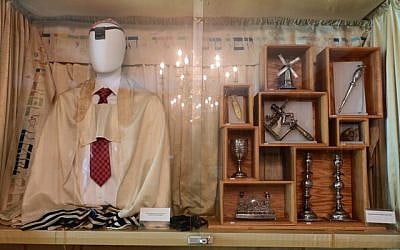
The Abraham J. Feldman Museum, located in the historic 1934 former library room, showcases the history of the congregation from the 1840s to present day, and highlights the intersection of Jewish heritage and Hartford history. Ritual objects used in past eras are also displayed. Guided tours of the museum and sanctuary are available by appointment.
Historical Background
In 1659, the area that is now the United States was largely inhabited and governed by Native American tribes, with small European settlements scattered along the East Coast and life centered on farming and survival. There was no United States at the time.
It was in that year, 1659, that the first recorded Jewish presence in Connecticut is believed to be “David the Jew,” a traveling trader who arrived in Hartford marking the beginning of a small but historically significant Jewish presence in the state, often under social and legal restrictions.
During the Revolutionary War, the Jewish population in Connecticut grew modestly as Sephardic, Spanish and Portuguese, Jews fled British-occupied New York, seeking safety and stability in Connecticut.
A permanent, organized Jewish community did not take root in Connecticut until the 1840s. During this period, the first sustained wave of Jewish settlers established themselves in downtown Hartford, marking the beginning of a continuous and organized Jewish presence in the state.
Which brings us to 1843.
In 1843, the United States consisted of 26 states, and John Tyler served as the 10th President. That year, the “Great Migration of 1843” began, as a wagon train of nearly 1,000 pioneers set out for the Pacific Northwest. At the same time, antislavery resistance was growing, and the Underground Railroad and “liberty line” networks continued to expand, helping enslaved people escape to freedom in the North and Canada.
It was in that year, 1843, Jewish residents of Hartford and New Haven successfully petitioned the Connecticut General Assembly to grant Jews the legal right to form religious societies, ending restrictions that had previously limited public worship and property ownership to Christian groups. This landmark change allowed Jewish communities in Connecticut to organize openly, build synagogues, and establish permanent congregations.
As a result, that same year, 1843, Congregation Beth Israel, along with Congregation Mishkan Israel community in New Haven, became the state’s the first two synagogues. Originally Orthodox, Beth Israel soon adopted Reform practices, influenced in part by German Jewish immigration.
Soon after its founding, a small group of German-speaking Jews in Hartford began meeting in private homes, and in 1876 Congregation Beth Israel built its first synagogue on Charter Oak Avenue in Hartford and today it is home to the Charter Oak Cultural Center.
The congregation later moved to its present home in West Hartford in 1936.
Throughout much of the mid-20th century, 1925 to 1977, the congregation was led by Rabbi Abraham J. Feldman, a nationally recognized leader in Classical Reform Judaism who shaped its growth and identity. Dr. Feldman authored several books, received numerous honors, and served in prominent civic and Jewish leadership roles, including with the Connecticut Advisory Committee of the United States Commission on Civil Rights and the American Jewish Committee. He was praised by President Dwight D. Eisenhower for his “outstanding leadership” and for bringing “strength to the nation and hope to the free world.”
Today, Congregation Beth Israel is one of the largest Reform congregations in the Northeast United States, serving approximately 700 families from diverse backgrounds through lifelong learning, spiritual enrichment, and a commitment to tikkun olam, repairing the world.
Contact Information:
Congregation Beth Israel, 701 Farmington Avenue, West Hartford, CT 06119
Phone: 860-233-8215
Email: bethisrael@cbict.org
Website: https://cbict.org/