

Tiberias Doesn’t Need Pity. It Needs a Plan
Israelis of a certain age cannot say the word “Tiberias” with a straight face. The reason is a 1960s comedy sketch — “The Cafeteria in Tiberias,” written by Nissim Aloni for the beloved trio HaGashash HaHiver — in which two elderly locals and a municipal official gravely debate whether to build a cafeteria on the lakeshore, until the humble snack bar swells into a monument that would scratch the skies of Tiberias, punctuated by the sighing refrain: ah, Tiberias, Tiberias… if only you were Safed. Israelis still quote it, because the joke is affectionate and because it stings: a gorgeous city, endlessly talked up, that never became what everyone agreed it should be.
Shimon Peres liked to say Israel had only two seas, and one of them was dead. Stand on the Tiberias promenade and the arithmetic feels unfair: here is the country’s other sea — fresh water, ringed by hills, layered with two thousand years of history, the kind of setting that elsewhere becomes Lake Como or the Lake District. Instead, the joke got there first.
And then the sirens made the joke impossible to tell. Since October 2023, Tiberias has absorbed wave after wave of alerts: Hezbollah barrages that sent shrapnel into its streets and set fires on its hillsides, Iranian ballistic missiles over the Galilee during the twelve-day war of June 2025, and the renewed Lebanon war that reignited in March 2026. The city has largely been spared mass casualties. What it has not been spared is economic devastation. Hotel occupancy — the lifeblood of a city whose identity rests entirely on lakefront tourism — fell by as much as 45 percent year-over-year at the war’s peak; national tourist overnight stays cratered by nearly 80 percent. Room nights in Tiberias, above 800,000 in 2018–2019, collapsed to just over 100,000 after COVID and three successive wars. Meanwhile the city took in some 10,000 to 12,000 evacuees from border communities, filling hotel beds not with tourists but with displaced families — a moral necessity that further froze the economy residents depend on. This is what “severely affected” looks like: not a city in rubble, but a city hollowed out while the world’s attention moves elsewhere.
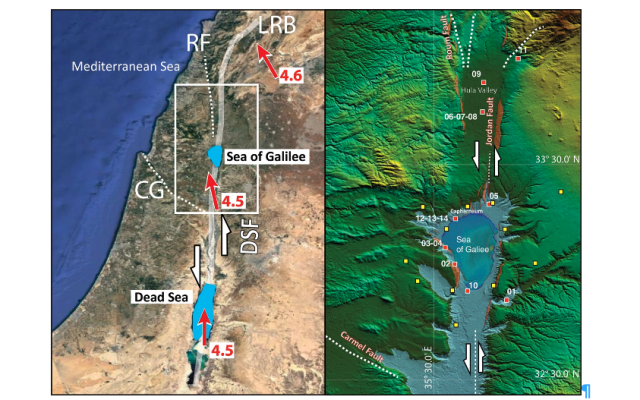
War only accelerated a decline already underway. Tiberias has spent decades as a case study in what happens to a periphery city national programs pass over: old building stock, thin private investment, dependence on a single seasonal industry. Nowhere is the neglect starker than in seismic policy. The city sits directly atop the Dead Sea Transform Fault, one of the most active plate boundaries in the region, and a Ministry of Interior–cited survey found roughly 2,092 of its 4,463 buildings are not earthquake-resistant. Yet TAMA 38, Israel’s flagship retrofitting program, has put some 77 percent of its activity into Tel Aviv and the center and less than 1 percent into the north — the region with the highest seismic risk. Between 2014 and 2020, national subsidies reached just 133 buildings across all peripheral cities combined, a pace that would take more than 80 years. War exposed how thin the city’s margins were; geology is a reminder of how much is still at stake.
This is precisely the moment when peripheral cities either fall further backward or find the tools to lean forward. Our new Financial Innovations Lab report for the Ministry of Science and Technology offers a mechanism, not a lament: the Tiberias Resilience District.
The idea is elegantly simple. Rather than wait for the national government to close the gap on its own timeline, a city with a shrunken tax base can generate ring-fenced revenue of its own and leverage it into far larger pools of national and private capital. The plan layers three tools. A Business Improvement District (BID) would levy a modest annual assessment — roughly 0.5 to 1.0 percent of assessed value — on commercial and mixed-use properties along the historic waterfront and central corridors, funding public realm upgrades, façade improvements, and district management. Versions of it underwrite district governance from Baltimore to Barcelona, where waterfront regeneration was largely paid for by capturing the value it created. A Tourism Tax District would add a small visitor levy of about 5 percent of room cost, or NIS 10–20 per night, on the model of Barcelona, Amsterdam, Berlin, and the Balearic Islands — a charge tourists barely notice that, applied consistently, yields millions of shekels a year hypothecated to the destination’s own improvement. And a seismic retrofitting package would offer owners grants covering 60 to 80 percent of certified upgrade costs, floor-area bonuses of 15 to 25 percent, expedited permitting, and temporary tax relief — financed by the district’s own revenue, not the municipality’s strained general budget.
What makes this more than a wish list is the leverage math. Modeling suggests combined BID and tourism revenues of roughly NIS 33 million over five years can be matched one-for-one by national grants and multiplied by private co-investment into a NIS 132 million capital program — and, layered with bond financing and development activity, an investment pipeline approaching NIS 350 million (about $95 million). That capital could retrofit 150 to 200 buildings, protecting an estimated 5,000 residents and 800 businesses from seismic risk, while lifting property values by an estimated 15 percent and international hotel nights by more than 20 percent within five years. Crucially, these streams are dedicated and off the municipal balance sheet — secured by assessments and levies rather than general obligation — so the city can act without further straining a fiscal position already battered by three years of crisis.
None of this is merely technical. Recovery cannot mean waiting for the sirens to stop and tourists to trickle back to the same fragile, undercapitalized city that existed before October 7, 2023. It has to mean using this moment of visible vulnerability — economic and seismic alike — to build something sounder: safer buildings, a tourism offering that moves beyond the lakeside-hotel model to the old city’s heritage and urban fabric, and a governance structure that gives residents, business owners, and investors a real stake.
And if Tiberias succeeds, the model does not stay in Tiberias. Safed, Acre, Nazareth, Kiryat Shmona, and Eilat face variations of the same story — real seismic exposure, real tourism dependence, real distance from the center’s attention and capital. A district that works becomes a template the rest of Israel’s periphery can adopt, turning one city’s hard three years into a national lesson in how war-battered, geologically exposed, historically overlooked places can finance their own future rather than wait for it.
Which brings us back to the cafeteria. The Gashash’s two old men were right about one thing: Tiberias deserves something monumental on its shore. They simply had no way to pay for it, so the vision stayed a punchline. This time there is a mechanism — and this time, whatever rises on that waterfront will be built to code. Tiberias has spent half a century as a joke about Safed and three years as a headline about war. It is ready to be neither. It does not need to become Safed, or Lake Como. It needs to become Tiberias — this time, with a plan.
See our recently published framework for enabling Tiberias’s local government to leverage urban economic assets for new development: Tiberias Resilience District Concept Plan, Milken Innovation Center–Van Leer Jerusalem Institute, August 14, 2026. Read it here.