An Engineer’s Perspective on Israel and Jewish Life
Tikkun Olam Begins at Home
I am not a rabbi or a scholar of Judaism. I am simply an American Jew who has watched with growing unease as Tikkun Olam, repairing the world, has become one of the defining ideas of Reform Judaism.
There is much about that impulse that I admire. Jews should care about injustice. We should care about the stranger, the vulnerable and the society in which we live. Our tradition tells us so.
But after October 7 and everything that followed, I find myself asking a question I might not have asked so pointedly before.
In our determination to repair the world, have we forgotten to repair and protect our own Jewish world?
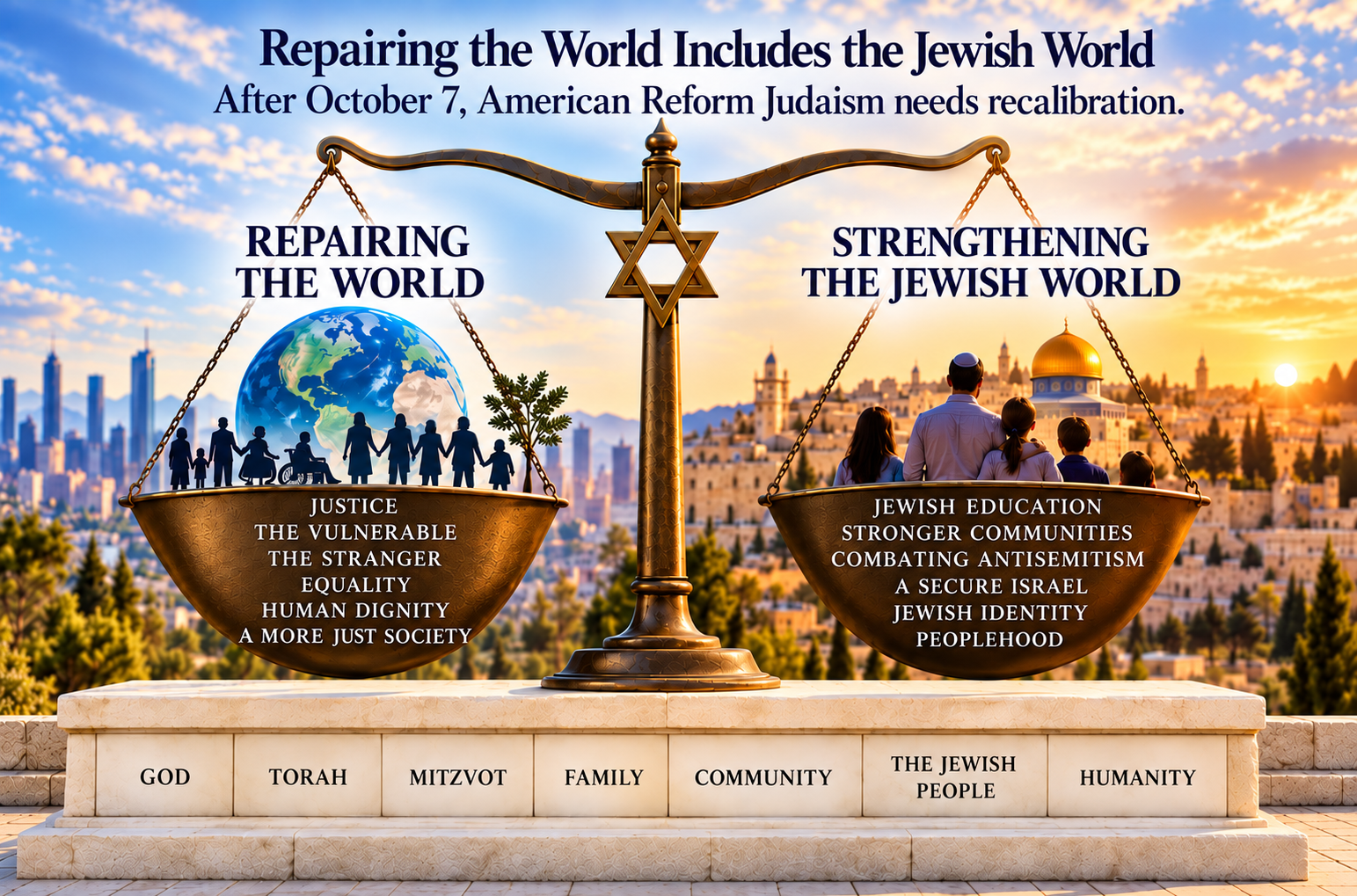
The above graphic captures the balance I have in mind. Repairing the world and repairing the Jewish world are not competing missions. Both rest on the same Jewish foundation.
Matthew Feinberg raised a version of this question in a recent essay, “This popular Jewish principle has completely lost its meaning.” His argument is deliberately provocative. Tikkun Olam, he writes, has been detached from its Jewish foundations and turned into a convenient Hebrew label for contemporary progressive politics.[1]
Feinberg states the case more sharply than I would. Still, the question deserves serious consideration.
How did Tikkun Olam become so important?
The prominence of Tikkun Olam in contemporary Reform Judaism is not something critics invented. The Union for Reform Judaism calls repairing the world a “hallmark of Reform Judaism.” The Reform movement’s 1999 Statement of Principles describes Jews as “partners with God in tikkun olam” and places social action and social justice at the center of Reform Jewish life.[2]
There is nothing troubling about that by itself.
But the contemporary meaning has traveled a long way from the phrase’s historical origins.
Tikkun Olam does not appear in the Hebrew Bible. Its early rabbinic use concerned legal rules intended to preserve social order. Centuries later, the Kabbalistic tradition associated with Isaac Luria gave tikkun a mystical meaning involving humanity’s role in repairing a shattered divine order.[3]
The familiar use of Tikkun Olam as a broad mandate for social activism came much later. Brandeis professor Jonathan Krasner has traced how the concept became increasingly universalized during the twentieth century, especially during the social movements of the 1960s and 1970s. By then it was being applied to causes ranging from opposition to the Vietnam War to environmentalism.[4]
That does not make social justice foreign to Judaism. Quite the contrary. “Justice, justice shall you pursue,” commands Deuteronomy. Amos calls for justice to “roll down like waters” and righteousness “like an ever-flowing stream.”[5]
The question is not whether Jews should pursue justice.
The question is whether pursuing justice has sometimes become a substitute for pursuing Judaism.
Over time, Tikkun Olam became one of the defining values of Reform Judaism, and Reform Jews can rightly take pride in our sustained efforts to advance justice throughout the world. But have we devoted comparable attention to the urgent needs of our own people, especially in the face of rising antisemitism?
A remarkable Jewish contribution
American Jews have a remarkable record of engagement with the problems of the larger society.
Perhaps nowhere was this more visible than during the civil rights movement. Jewish organizations, rabbis and individual Jews marched, organized, raised money and worked alongside Black Americans seeking rights that America had promised but too often denied. Some Jewish civil rights workers paid for that commitment with their lives. Jews participated prominently in the Freedom Summer of 1964, and Rabbi Abraham Joshua Heschel marched alongside the Rev. Martin Luther King Jr. at Selma.[6]
That history should make us proud.
Jews have also been prominent in many causes involving immigrants, refugees, poverty, religious liberty and other forms of discrimination and injustice.
We did these things because we believed they were right.
We did not march at Selma because someday we might need someone to march for us.
Moral action is not a bank account into which one makes deposits and later demands withdrawals.
And yet.
An uncomfortable question about reciprocity
October 7 changed many assumptions Jews held about the world.
The massacre itself was horrifying enough. Then came another shock for many American Jews. It was the reaction around us.
Before Israel had even buried its dead, demonstrations appeared that celebrated or rationalized what had happened. On some campuses, Jewish students encountered hostility not only toward Israeli government policy, but toward Zionism and, at times, toward Jews themselves. Some people and institutions from whom Jews expected solidarity were silent. Others joined movements whose rhetoric many Jews experienced as threatening.
Many non-Jews stood with us, too. Their courage and friendship matter, and we should not forget them.
Still, American Jewish institutions should be willing to ask a hard question.
Have the alliances into which we have poured so much moral energy produced the solidarity we reasonably hoped would be there when Jews themselves needed it?
That is not an argument for abandoning anyone. It is an argument for reassessment.
I spent much of my professional life as an engineer. Engineers learn early that a system built on sound principles can still drift out of balance. When conditions change, we test the assumptions, study the feedback and ask whether the system is producing the results we intended. We do not throw away the objective. We adjust the system.
Perhaps American Reform Judaism needs some of that discipline now.
Tikkun Olam is a worthy objective. But Judaism is a complex system of values and obligations to God, Torah, mitzvot, family, community, the Jewish people and humanity. Those obligations have to remain in balance. If one value grows so dominant that it crowds out the others, the answer is not to discard it. The answer is to rebalance.
October 7 was feedback of the most terrible kind. It exposed assumptions that failed catastrophically in Israel.
I believe it exposed another failure here in America. Our major Jewish organizations were built for an earlier communications world. They knew how to issue statements, work with political leaders, engage established news organizations and mobilize their memberships. But after October 7, the battle over Israel was being fought at extraordinary speed on social media, college campuses and across institutions that shape public opinion. Too often, they responded with familiar methods to an unfamiliar problem.
The organizations themselves seem to have recognized the problem. It was not until December 5, nearly two months after the massacre, that five of the largest American Jewish organizations joined forces to create the 10/7 Project, a centralized communications operation intended to provide rapid response and counter misinformation.[8] It was a necessary step. But it also raises an uncomfortable question. Why weren’t we prepared on October 8?
In engineering, when the environment changes and the old system no longer performs as intended, doing more of the same is not a strategy. You redesign the system. American Jewry needs to do that now.
At the same time, American Jews discovered that some alliances were less durable than we had assumed.
When assumptions fail, continuing exactly as before is not principle. It is refusing to learn.
Universalism and particularism
Judaism has always contained a tension between obligations to humanity and obligations to the Jewish people. We should not resolve that tension by erasing either side.
Reform Judaism’s own advocacy literature says this with unusual clarity.
“A universal concern for humanity unaccompanied by a devotion to our particular people is self-destructive; a passion for our people without involvement in humankind contradicts what the prophets have meant to us.”[7]
That sentence goes to the heart of the issue.
The problem is not Tikkun Olam.
The problem comes when universalism overwhelms particularism, when repairing the world receives greater moral urgency than sustaining Jewish life, teaching Jewish history, strengthening Jewish identity, defending Jews against antisemitism or maintaining the connection between American Jews and Israel.
There is nothing morally inferior about Jews caring about Jews.
Every healthy community has obligations to its own members. Those obligations do not prevent concern for others. They make such concern possible.
A Judaism that teaches its children to care deeply about every vulnerable population except their own has misunderstood something fundamental.
October 7 should change us
October 7 should also force American Jews to examine some of our own assumptions.
One of those assumptions may have been that if Jews consistently stood with others, others would naturally stand with Jews.
Sometimes they did. Sometimes they did not. We should learn from both.
This does not mean retreating behind communal walls or abandoning civil rights, immigrants, the poor or anyone else who suffers injustice.
It means restoring balance.
Jewish institutions, like all institutions, work with finite resources. Money, time, leadership, political capital and, perhaps most important, the attention of the next generation are all limited. Every allocation is a choice. Those choices tell young Jews what Judaism considers important.
Jewish education belongs near the top of that list. So do combating antisemitism and strengthening Jewish communities.
Young Jews also need to understand why Israel matters. That does not mean teaching that every Israeli government decision is correct. It means teaching why the existence and security of the Jewish state matter to the Jewish people.
And we should teach Jews that caring for their own people is not tribalism for which they should apologize. It is part of Judaism.
Repairing our own house
Matthew Feinberg concludes his argument by urging Jews to begin the work of repair closer to home.[1] On that point, I think he is right.
The lesson of this moment is not that Jews should retreat from Tikkun Olam. It is that we should recover its proper proportions.
We should continue to fight injustice when it afflicts others. That is part of who we are.
But we should devote at least the same moral energy, institutional resources and communal passion to strengthening Jewish life and defending Jews when they are threatened.
Universalism and Jewish particularism are not enemies. Judaism has room for both.
If Tikkun Olam obligates Jews to care about humanity, surely it cannot require them to care less about Jews.
The Jewish people, too, are part of the world.
And sometimes, Tikkun Olam begins at home.
Author’s Note
In preparing this essay, I used ChatGPT as an intelligent assistant in developing and editing it, including identifying and checking the historical and Jewish sources cited below, as well as generating the graphic. The ideas and conclusions are my own.
References
[1] Matthew Feinberg and the contemporary critique of Tikkun Olam. Matthew Feinberg, “This popular Jewish principle has completely lost its meaning,” Future of Jewish, May 6, 2026. Feinberg argues that contemporary usage has detached Tikkun Olam from Torah, mitzvot, Jewish peoplehood, covenant and Jewish communal obligations and transformed it into a broad justification for progressive political activism.
[2] Tikkun Olam in Reform Judaism. The Union for Reform Judaism describes Tikkun Olam as a “hallmark of Reform Judaism.” The Central Conference of American Rabbis’ 1999 Statement of Principles describes Reform Jews as “partners with God in tikkun olam” and affirms God, Torah, mitzvot, Israel and social justice as components of Reform Jewish life.
CCAR: 1999 Statement of Principles for Reform Judaism
[3] Tikkun in Lurianic Kabbalah. Scholar Lawrence Fine explains Isaac Luria’s sixteenth-century conception of tikkun, including the “shattering of the vessels” and the restoration of divine sparks through prayer, mitzvot and other religious acts.
Lawrence Fine: Tikkun in Lurianic Kabbalah
[4] Jonathan Krasner, “How Tikkun Olam Became Jewish Social Justice: The Origins and Evolution of a Jewish Value, Part 3,” January 19, 2021.
Read Jonathan Krasner’s article
[5] Justice in Torah and the Prophets. Deuteronomy 16:20 commands, “Justice, justice shall you pursue.” Amos 5:24 supplies the famous prophetic image of justice rolling down like waters.
[6] Jews and the American civil rights movement. The Religious Action Center of Reform Judaism documents extensive Jewish participation in the civil rights movement, including Freedom Summer and Rabbi Abraham Joshua Heschel’s participation in the Selma march.
Religious Action Center: Jews and the Civil Rights Movement
[7] Universal and particular Jewish obligations. The Reform movement’s 1976 Centenary Perspective, reproduced by the Union for Reform Judaism, recognizes the tension between obligations to humanity and obligations to the Jewish people and warns against abandoning either.
Union for Reform Judaism: Why Advocacy Is Central to Reform Judaism
[8] The post-October 7 communications challenge. Israel’s Institute for National Security Studies has documented serious weaknesses in Israel’s strategic communications during and after the Gaza war. In the United States, five major Jewish organizations, AJC, Jewish Federations of North America, ADL, AIPAC and the Conference of Presidents, announced the 10/7 Project on December 5, 2023. They described it as a new centralized communications operation focused on real-time information, rapid response and combating misinformation. The creation of that joint operation nearly two months after October 7 supports the argument that a faster, more coordinated communications structure was needed.
INSS: Israel’s Deteriorating Image as a Threat to National Security
AJC: Leading U.S. Jewish Organizations Launch the 10/7 Project
Related Topics