


Journalist, Musician, Poet
Time To Reset Relations With Bangladesh
The status quo in the Middle East and South Asia is shifting decisively. Most astute observers—regardless of political stripe—know the tides are turning. And how could they not? For all the doom and dread of recent years, things have actually gotten better.
Bangladesh is one of the countries undergoing revolutionary change. When people talk about the transformations since 10/7—like how Nasrallah and Assad are now gone—it’s easy to overlook that the former tyrant of Bangladesh, “Sheikh” Hasina Wazed, was ousted before either of them. She fled to India in August 2024.
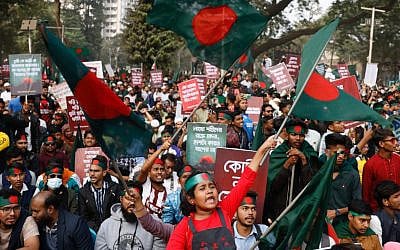
It all began in July of the previous year, when students at Dhaka University launched protests against a quota system in the country’s civil service. Hasina’s policy gave preference to descendants of liberation war veterans—effectively turning public service into a fiefdom for her Awami League party. The broader public saw this for what it was: a de facto caste system enforced by a state cult of personality centered on her father.
Hasina is one of two surviving children of Sheikh Mujibur Rahman, Bangladesh’s George Washington. He was assassinated in 1975 along with most of his family. Rahman had pursued a state-led economic path that displeased factions in the military, who—according to declassified U.S. records—conspired with Washington to carry out a coup, just two years after the CIA-backed golpe de estado in Chile. The young democracy never recovered, enduring a cycle of coups for the next decade.
Hasina, then a student in Europe, returned in the ’80s to rebuild the Awami League and challenge military rule. After several contested elections and assassination attempts, she gained power in the ’90s and remained in office from 2009 to 2024.
When the student protests broke out in July 2024, Hasina responded with brute force. Security forces shot and killed dozens in the opening days—some funerals were even raided. The crackdown, reminiscent of Kent State in the U.S., only drew more public outrage. Much of the repression came not from the army but from Awami League loyalists and secret police operatives, echoing the Basij in Tehran.
The uprising soon expanded beyond students. A nationwide united front emerged, drawing in people across age and geography. Opponents who had once disappeared under Hasina’s reign began reappearing. Every major political faction joined the movement.
In her final days, Hasina attempted “dialogue” with student leaders. They refused. Their message: our comrades died for freedom—there’s no going back. As pressure mounted, reports say her son had to plead with her to leave the country. The military, facing mass demonstrations approaching the presidential palace, refused to suppress the revolution. Instead, they shut down the internet—and told her the game was over.
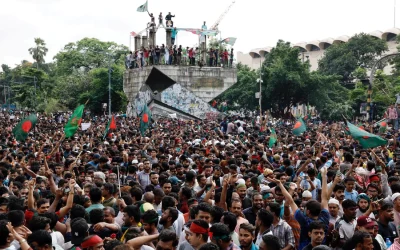
On August 5, the crowds reached her residence, which was overrun and looted, much like Assad’s palace would also be the upcoming winter. Hasina was helicoptered out. A transitional council was quickly formed. At its head: Nobel Laureate Muhammad Yunus.
Yunus, a global figure renowned for founding microfinance, was the only leader all factions could agree on. Known for helping millions of Bangladeshis escape poverty through small public loans, he represents secular, inclusive politics in a nation divided by religion.
Throughout the 2000s, Hasina engaged in a state-sanctioned persecution against Yunus, and seized all his banks and assets. She put him on trial for fraud and money laundering. Yunus was sentenced to six months in jail in January 2024 but was released upon appeal. Now, it’s Hasina who’s wanted in Bangladesh, for Crimes Against Humanity.
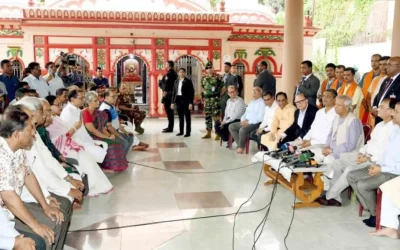
Although hesitant to accept the role, Yunus eventually stepped in after being asked multiple times. He has since met with Hindu minority leaders and worked to de-escalate sectarian tensions. In a show of unity, Muslims helped protect Hindu temples and festivals. Intercommunal relations in Bangladesh, as of now, are stronger than in neighboring Pakistan.
While the euphoria of the revolution has cooled, Yunus has resisted calls for immediate elections. He argues—correctly—that the previous regime left behind gutted institutions and rampant corruption. His transitional government is expected to announce a national roadmap any day now, with elections likely in December 2025.
It’s worth recalling: Israel was one of the first countries to recognize Bangladesh in 1972. Then-Prime Minister Golda Meir, deeply moved by the 1971 genocide carried out by the Pakistani military, recognized Bangladesh as an act of both moral clarity and geopolitical pragmatism.
Despite this, formal diplomatic ties never followed. Bangladesh’s identity as a Muslim-majority country aligned it with the Palestinian cause, freezing relations for decades. But a new chapter is unfolding. Just as Syria is rebuilding from the ground up, so too is Bangladesh.
This is a moment Israel should not squander. A “reset” with Bangladesh is overdue—and possible. Yunus is a leader with whom Israel can engage in good faith. His vision for a secular, pluralistic Bangladesh offers common ground. Yunus is the Mandela of our time, or if you’d like another comparison, the Indira Gandhi of Bangladesh.
Could Bangladesh eventually join the Abraham Accords? Maybe. India and Kosovo have. If India can sign on to the accords, then so can (and so should) Bangladesh with its nearly 200 million people which are 90% Muslim. Even entertaining the idea opens the door for unprecedented cooperation between Jews and Muslims. Bangladesh recognizing Israel would open the door for Pakistan to do likewise, especially if Saudi Arabia signs on. Bangladesh has a booming economy, a skilled young workforce, and is on track to match and even outpace India’s in coming years.
Netanyahu should pick up the phone and call Yunus, congratulating him on the first anniversary of Bangladesh’s Second Independence. And if Donald Trump really wants that Nobel Peace Prize, he should also call Yunus and ask for some pointers, or maybe a nomination recommend. (If you wanted a Nobel Prize nomination, dear reader, would you rather it come from Bibi or Yunus? Just asking.) We all, however, owe Bangladesh a salute.
The brave and courageous students of Dhaka, in their honorable struggle against discrimination, reminded the world last year that revolutions in the 2020s are possible.