
Tisha B’Av and the Fragile Miracle of Israel
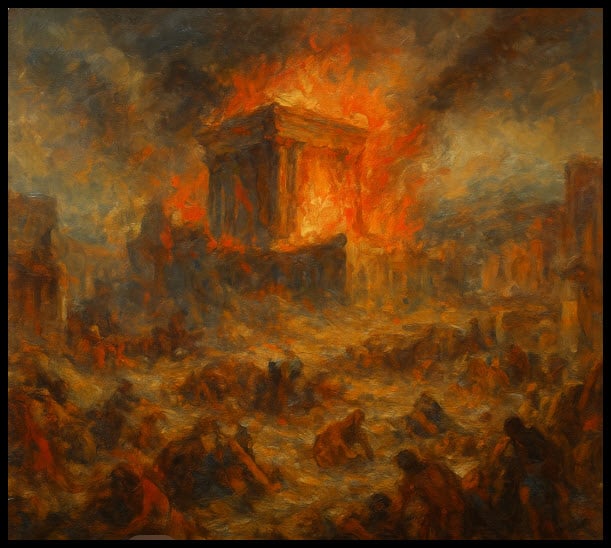
As we mark Tisha B’Av this Shabbat, the saddest day in the Jewish calendar, we are invited not only to remember destruction but to reflect on the internal conditions that made it possible. The First and Second Temples were not lost merely to foreign powers. They fell because of internal collapse—idolatry, corruption, sectarianism, and most famously, baseless hatred (sinat chinam).
This national day of mourning is not simply a ritualized grief for ruins. It is a mirror held up to each generation: Are we repeating the patterns that once shattered us?
The Internal Roots of Exile
The rabbis of the Talmud were clear: our tragedies were not random. They were the consequences of social fragmentation, moral decay, and political dysfunction. The Roman legions may have set fire to the Temple, but the kindling had been laid by a society that could no longer hold itself together.
This diagnosis is unsettling because it is not easily dismissed. It is not an external threat we can fight or outmaneuver. It is a call to honest self-assessment.
Tisha B’Av is the Jewish calendar’s most sobering theological insight: that the greatest danger to Jewish continuity is not what others do to us, but what we fail to do with and for each other.
Israel Today: A Fragile Miracle
The State of Israel is an extraordinary resurrection of Jewish sovereignty after 2,000 years of dispersion. Yet its continued survival is not assured. Israel is only 77 years old—still in its infancy compared to the First Temple period (~371 years) and the Second Temple period (~586 years), both of which eventually collapsed.
Existential threats today come not only from without but from within.
The Fragile Miracle: Israel’s Survival Is Not Guaranteed
The Perfect Creation and the Improbability of Continuity
The founding of the modern State of Israel was not only improbable—it was, in every sense, a defiance of the odds. Yet, as with all complex systems, its continued existence cannot be assumed. While much focus is given to external threats, the deeper dangers may lie within.
A perfect creation permits all possibilities but allows only that which is viable to persist. Israel, then, must constantly requalify its viability—not just militarily, but morally, socially, economically, and spiritually. The survival of a society is a long shot because so many things must go right, while failure can result from just a few fundamental breakdowns.
Here are fifteen critical areas in which Israel must succeed—not in absolute perfection, but in adaptive coherence—if it is to survive and thrive in the generations to come.
Top 15 Things Israel Must Get Right to Survive
1. Democratic Integrity
Preserve a functioning, pluralistic democracy that can evolve without collapsing into authoritarianism or internal paralysis.
2. Religious Pluralism and Secular Balance
Navigate the divide between Haredi, national-religious, traditional, and secular Jews in a way that prevents societal fracture.
3. Judicial Independence and Rule of Law
Maintain the independence of the judiciary as a constraint on populism and executive overreach.
4. Education for All Sectors
Ensure universal access to core curricula across all sectors, including the Haredi population, to prepare future generations for meaningful participation in society and the economy.
5. National Identity without Exclusion
Foster a cohesive Israeli identity that includes Arab citizens, Druze, Bedouin, and other minorities without demanding cultural erasure.
6. Military-Civilian Integration
Sustain a military that is respected but also reintegrated into civilian values, without becoming politicized or idolized.
7. Economic Sustainability and Equity
Balance innovation and growth with mechanisms to address inequality, housing shortages, and the cost of living.
8. Environmental Viability
Develop and enforce long-term strategies for water, energy, and land use to prevent ecological collapse in a fragile region.
9. Diaspora Relationship
Remain meaningfully connected to the global Jewish diaspora as a source of support, diversity, and shared identity.
10. Internal Security without Overreach
Protect citizens from terrorism and violence while avoiding the erosion of civil liberties or the normalization of perpetual emergency law.
11. Ethical Use of Power
Develop a national ethos of ethical responsibility in governance, military actions, and social conduct to avoid corruption and cynicism.
12. Adaptability of Halacha
Allow halachic thought to remain relevant through engagement with sovereignty, science, and modern life rather than retreat into rigidity.
13. Public Trust and Shared Narrative
Maintain a sense of shared story, meaning, and purpose that allows citizens to disagree passionately without losing trust in the system itself.
14. Conflict Resolution and Peace Strategy
Even in the absence of peace, Israel must develop mature, long-term approaches to its conflict with Palestinians that do not corrode its own soul.
15. Generational Continuity and Hope
Ensure that each new generation feels that Israel is worth inheriting—not just a defensive necessity, but a moral and cultural aspiration.
Conclusion: Viability Is a Moving Target
No single achievement guarantees Israel’s survival. Like any living organism or evolving society, it must continually self-correct, filter, and realign. The survival of Israel is not a miracle to be passively celebrated, but a responsibility to be consciously earned—again and again.
Let us not take for granted what history has never freely given. Let us build a society that is not only capable of surviving threats, but of sustaining meaning.
A Call to Conscious Continuity
This Tisha B’Av, let us mourn wisely, not with passive lament, but with active resolve. The survival of the Third Jewish Commonwealth depends on our willingness to face what previous generations refused to see: that our greatest enemy may not be beyond the border, but within the brokenness of our own bonds.
Israel is a fragile miracle. To keep it alive, we must be more than defenders—we must be rebuilders.
May this day of mourning awaken in us the courage to become worthy inheritors of a story still unfolding.