
Tisha B’Av: Mourning and Resilience.
 Contemporary Context to Fasting and Lamenting
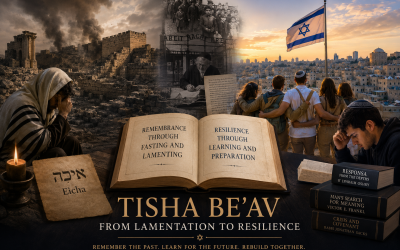
American Jews should pay more attention to Tisha B’Av because it offers the raison d’etre for American Jewry and all other great diasporas particularly this year when internal strife in Israel is at boiling point and Jews in America are anxious about their future. Against such a backdrop, Tisha B’Av should be experienced not merely as a day of mourning for past calamities, but also as an annual celebration of communal resilience even in case of doomsday. Fasting and lamenting will help you acknowledge the past, but learning will prepare you for the future.
Remembrance
Tisha B’Av, the ninth day of the month of Av, is the most solemn day in the Jewish calendar. It primarily commemorates the destruction of the First Temple in 586 BCE and of the Second Temple in 70 CE, which represents the loss of Jewish sovereignty in the Land of Israel and the beginning of exile. Traditional Jews mark Tisha B’Av with customs of mourning a tragic loss: We fast, sit low, read the searing words of Megillat Eicha and recite lamentations, kinot. At midday of Tisha B’Av, the mourning begins to ease, and six days later, by the 15th day of Av, Jews celebrate the “Jewish day of love”.
Tisha B’Av also memorializes later catastrophes, most of which did not actually happened on that date: the fall of the city of Betar at the end of the Bar-Kochva Rebellion in 135; the devastation by the Crusades in the 11th-12th centuries; burning of the Talmud in Paris in 1242; the expulsions from England in 1290 and Spain in 1492; and the mass deportation of Warsaw’s Jews beginning in 1942. As of 2024, some rabbis suggested special lamentations to commemorate the massacre of October 7. None of these events happened on Tisha B’Av, and some are associated with the collapse of Jewish sovereignty in the Land of Israel, while others commemorate calamities of Diaspora communities. Against this backdrop, Professor Ari Afilalo and I argued that Tisha B’Av should be the proper place for the memory of the Shoah particularly as Holocaust survivors die off.
Celebration of Resilience
Our tradition focuses Tisha B’Av on remembrance by fasting and lamenting. But what are its practical teachings, particularly for Jews who live in prosperity and security, notwithstanding our current existential worries? This question leads to the second claim Ari and I made: Tisha B’Av should become an annual celebration of Jewish resilience, when we remind ourselves of what would be required for surviving extreme hardship, scarcity and disruption.
Ancient Jewish catastrophes left relatively little detailed evidence of to endure. The Shoah, by contrast, generated an extraordinary documentary record on how Jews maintained solidarity, judgment, faith and dignity while in the abyss. Most recently, we have evidence of the captives in Gaza, who told us what they did to preserve their sanity and wellbeing in Hamas tunnels. Other nations have relevant testimonies as well. Such knowledge is a key to future resilience and should be studied annually on Tisha B’Av.
Rabbi Ephraim Oshry’s five-volume Responsa from the Depths, is one of the most important of such records. In the Kovno Ghetto, Rabbi Oshry recorded hundreds of profound halakhic, practical, spiritual and ethical questions brought forward by Jews who struggled to remain alive and humane. Other rabbis too contended with horrifying questions, but Oshry’s record is the most extensive. Examples include whether to wear clothing taken from the dead; how to divide food in times of scarcity; or whether to save one’s life, knowing that dependents may die. These questions represent excruciating dilemmas, where every choice requires unimaginable strife. Their Responsa clarified Jewish law, helped navigate moral dilemmas and even restored agency. Their effect parallels Viktor Frankl’s argument in Man’s Search for Meaning that when people don’t control their circumstances, their capacity to shape their response becomes existentially important. Indeed, the work of rabbis helped preserve the Jewish community and society in the face of uncompromising Nazi onslaught.
Rabbi Lord Jonathan Sacks called this quality “covenantal resilience.” In Crisis and Covenant, he argued that the preservation of religious and moral Jewish life during the Holocaust and its renewal afterwards testifies that the covenant between the Jewish People and God survived. In fact, he supported incorporating the memory of the Shoah into Tisha B’Av many years ago, claiming that “…reimagined in this way, Tisha B’Av would affirm that … Jewish identity, responsibility and moral agency can endure even in the valley of the shadow of death.
In other words, Tisha B’Av should become an annual fire drill for Jewish resilience and survival. The next calamital crisis will not replicate the destruction of Jerusalem, expulsion from Spain or the demolition of European Jewry. So straightforward Holocaust analogies should be taken with a grain of salt. Yet many of the spiritual muscles we may need will be similar and familiar. Tisha B’Av should become as much a handbook as a history book: a day on which every Jew learns how to survive as a Jews—and then how to rebuild as a community and people.
The Capacity to Pivot
The structure of Tisha B’Av itself points toward the idea of rebuilding. The night and morning are spent in mourning reciting gut-wrenching lamentation. As of halakhic midday, we may sit upright and wear tallit and tefillin which are signs of dignity, and ask for consolation and rebuilding of Jerusalem. While the fast continues, we transition “back to life” by cleaning and working. In other words, Tisha B’Av contains a disciplined pivot: from low to high, grief to hope, helplessness to agency and legacy to destiny.
This process is a metaphor for the fate of our people. After the destruction of the First Temple, the great Babylonian Jewry was born and after the Second Temple, rabbinic Judaism was launched. After the expulsion from Spain, the great Jewish communities of The Netherlands and Poland emerged and the destruction of the Pale of Settlement propelled the rise of American Jewry; and the Holocaust played a pivotal role in the establishment of Israel.
In other words, the seeds of our renewal are sown in the moments of our devastation and made possible by the individual and collective resilience of our people. For some, Tisha B’Av is a scary reminder that the worst that will happen. But it can also be a day when we celebrate our eternal resilience during and after the calamities that will come upon us.