Tish’ah B’Av: Thinking the Unthinkable
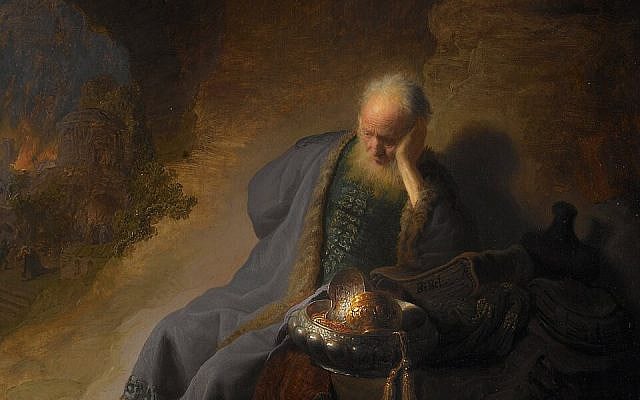
Tish’ah B’Av is more relevant today than ever.
Since the founding of the State of Israel and especially since the Six-Day War, there has been a growing sentiment among religious Zionists that mourning the destruction of the temple in Jerusalem is somewhat outdated given the return of sovereignty and the widespread belief that this represents the ushering in of the messianic era. The discontent ranges from the awareness of the dissonance between the traditional prayers of Tish’ah B’Av (which describe Jerusalem as desolate and laid waste) and the present-day reality, to calls to convert the day into a minor fast beginning only in the morning or ending mid-day. The reason given for not abolishing the fast day altogether is that the redemption is not yet complete, the Temple has not been rebuilt, and Universal Peace is still a distant dream.
The reasoning behind this line of thought is that Tish’ah B’Av commemorates a calamity of the past, and that those circumstances have thankfully been transformed.
The Malady
In more recent years there is an increasingly emergent reality which harks back, not to the suffering of the past, but to the circumstances which prevailed prior to the Destruction. And those circumstances, far from being transformed, are actually taking root in the present.
Based upon the prophets, the period leading up to the destruction of the temple and the exile was characterized by violence toward the helpless; the poor and the alien.
“Thus says the Lord: Act with justice and righteousness, and deliver from the hand of the oppressor anyone who has been robbed. And do no wrong or violence to the alien, the orphan, and the widow, or shed innocent blood in this place… But your eyes and heart are only on your dishonest gain, for shedding innocent blood, and for practicing oppression and violence.” (Jeremiah 22:3)
This violence and injustice was all the more severe because it is perpetrated by the government:
“See how each of the princes of Israel who are in you uses his power to shed blood. In you they have treated father and mother with contempt; in you they have oppressed the foreigner and mistreated the fatherless and the widow.” (Ezekiel 22:6–7)
And finally, the justice system was undermined and the religious and civil institutions corrupted.
“Her leaders judge for a bribe, her priests teach for a price, her prophets divine for money.” (Micah 3:11)
The unifying characteristic between biblical times and today, as opposed to the days of statelessness, is that today we hold power and its accompanying responsibilities. Hence, today we suffer from the type of corruptions analogous to those of the past: abuse of power and attempts to corrupt the legislative and legal systems. Witness the flurry of sickening legislative activity to expand Haredi privilege at the expense of those who serve, ongoing violence against Palestinian civilians, incitement to violence by members of the government and the continuing onslaught against our legal system.
Unfortunately, corruption, self-interest and evil nastiness do not really require an explanation. However, there is an aspect of the prophecies of doom which can enlighten us as to a corrupt and religiously based dynamic which is happening now and which will express itself particularly on the Tish’ah B’Av.
There is a noticeable movement seeking to co‑opt Tish’ah B’Av, shifting it from the traditional day of mourning and self‑scrutiny to one centered on the exercise of power and the literal pursuit of rebuilding the Temple. They believe that the mourning and inwardness must be cast aside for the sake of building the future (as they understand it). This new “Temple sect” is evidenced by illegal brown road signs fabricated to imitate official tourist signs which direct toward the “Mount of the House of the Lord.”
Tish’ah be Av and the Flawed Theology of Certainty
Even though this “Temple cult” is relatively recent in modern Israeli terms, it is rooted in ancient tradition going back to biblical times.
Do not trust in lying words, saying, “The temple of the Lord, the temple of the Lord, the temple of the Lord.” (Jeremiah 7:4)
In the ancient world, it was inconceivable that a god would allow the destruction of his temple. Such an event would indicate the weakness and defeat of that god. To claim, as Jeremiah prophesied, that the God of Israel would destroy His own sanctuary sounded to the people like pure madness. If Nietzsche was to proclaim the death of God 2,500 years in the future, Jeremiah was declaring the suicide of God now.
What was inconceivable to the deaf ears of the Temple sect in the time of Jeremiah remains inconceivable to their spiritual heirs today. They assume, in the words of the prophet Micah, “…yet they lean upon the Lord and say, ‘Is not the Lord in the midst of us? No disaster shall come upon us.'” (Micah 3:11).
I believe that this assumption that God is with us, no matter what, which is shared by many religious Zionists – but not only – is the source of hubris, reckless conduct and policymaking. We need to explore its roots.
The Third Redemption Has No End
There is a midrashic tradition that the third in-gathering of the Jews will never suffer destruction and exile again. This belief was popularized by Rav Herzog in 1942 when facing the dread of Nazi conquest of Palestine, he reassured the Yishuv (Jewish Community) that, “A third destruction there will not be.” Rabbi Kook had already written in a similar vein. (Orot p. 77)
It is precisely because of the popularization of this belief that Tish’ah B’Av is acutely relevant today. The rabbinic reassurances referred to above were just that – reassurances, addressed to the people in need of hope. These reassurances were issued at a time when Jews were vulnerable and powerless. In later years, these ideas were voiced as doctrine and a basis for political policy. We remember rabbis who stated with certainty that the disengagement from Gaza would not happen because there could be no retreat from the process of redemption. They were left with egg on their face, but many who followed them suffered. Today these assumptions and beliefs continue to contribute to a state of mind among the “believers” which is characterised by irresponsibility and hubris. To assert otherwise, in their minds, is a sign of weakness of spirit and lack of faith in God and His Promise.
The Antidote: Radical Humility
What can we say about relying on divine promises? Wouldn’t calling them into question be a lack of faith?
The words of Rabbi Avraham Yeshaya Karelitz, known as the Chazon Ish (1878-1953), are instructive:
“Another error regarding the concept of Bitachon (trust in God) …there is a [mistaken] obligation to believe, in every situation a person encounters that places him before an uncertain future where his future paths are not clear, in one good outcome and not bad—that the good will surely happen, without doubt, and that one who is in doubt of this lacks trust in God.
But this definition of trust is not correct. For as long as the future outcome has not been clarified through prophecy, the future is not determined, for who can know the judgments of God and His retributions, blessed be He? Rather, the matter of trust is the faith in one’s heart [that no] occurrence in the world, and everything done under the sun, is entirely by necessity from Him, blessed be He…” (Emunah uBitachon Ch.2)
Much has been written about Human free will. Many seem to have forgotten that God enjoys free will as well. The sign of the spiritually mature person is their ability to tolerate and hold the uncertainty which this entails.
An illustration of this point emerges from the words of R. Mordechai Yosef of Izhbitza (1800-1854) regarding Moshe’s state of mind during the exodus from Egypt.
For when Moshe saw that even after the exodus, Pharaoh was still pursuing them, an uncertainty arose in his mind: perhaps Israel were not yet sufficiently refined [to be redeemed]. Likewise, when he saw that God did not lead them by way of the land of the Philistines lest the people relent—from this too he understood that they had not yet attained ultimate refinement.
The Holy One, blessed be He, conceals His deeds and hides His intention from human beings, and a person does not know the will of the Holy One, blessed be He, in this endeavor—just as was the case here, which was a wonder in Moshe’s eyes as to why the Lord did not lead them by way of the land of the Philistines.
The moment of the Exodus from Egypt is surely THE moment of clarity in the Jewish historical narrative. What redemption could be clearer; the prophecies and the plagues? But the clarity is only ours in hindsight. Even for Moshe, it is described as a time ridden with uncertainty, a time of the hiding of the Divine countenance, hester panim.
The lesson here is one of radical humility. Despite what exterior signs may lead one to believe and how indisputable those signs may seem, and despite the native desire to grasp onto certainties, acknowledging the greatness of God involves resisting those inclinations and internalizing the reality that we can not be sure of the outcome of our situation.
Rabbi Menachem Mendel of Vitebsk and Ya’akov’s Fear
For many, the biblical story of the fear which gripped Ya’akov on the eve of his encounter with his brother Eisav is the anchor for discussing the issue of faith and trust in God. The midrash says that even though Ya’akov was armed with an explicit promise from God guaranteeing his safety, Ya’akov was still afraid lest he sinned against God in some way and this would nullify the divine promise. Commenting on this, R. Menachem Mendel of Vitebsk (c. 1730-1788), mentor and colleague of the Ba’al HaTanya and leader of the first aliya of the Hasidim in 1777, took the idea of not relying upon divine guarantees further.
And even if the Holy One, blessed be He, promises all good things and ultimate protection, the righteous still fear ‘lest sin cause’ namely the vulgarity of their heart to grow because of this very promise, causing them to become distant from Him…
Menachem Mendel starkly admonishes against the hubris which come with the cocky self-assurance of a divine guarantee. The promise itself becomes a spiritual hazard which is to be feared.
We may be forgiving of the “Temple sect” of Jeremiah’s day for leaning so heavily on some imagined promise that there would be no destruction of God’s Sanctuary and no exile; after all, they had no historical precedent in their collective memory which could make that possibility real for them.
For us who benefit from the historical context, Tish’ah B’Av demands that we think the unthinkable — that no promise, no sovereignty, and no sense of divine favor exempts us from the consequences of injustice, and that the Temple’s destruction was not an aberration but the direct fruit of the corruption and hubris the prophets decried. We must guard this day as a time of mourning and reflection rather than dissolve it into triumphalism or paper over it with certainty. We must resist the urge to rebuild outwardly before we have rebuilt inwardly — cultivating the radical humility and self-scrutiny that can hopefully guard us from repeating the very arrogance that laid Jerusalem waste.