
To Be or Not to Be at Stalag X-B
Shakespeare in a Nazi prison camp and the ten-year-old little girl who kept the album

In the winter of 1944, two Jews were hiding in plain sight inside a Nazi prisoner of war camp in northern Germany.
One was directing Shakespeare for the Germans.
The other was ten years old.
One was a celebrated French actor named Marco Béhar.
The other was a Polish girl named Edna, living under a false name and a false religion.
She was a real soldier. She had earned her medal.
What she was hiding was that her name was not Stefcia Skolkowska.
And that she was Jewish.
Two Jews hiding in plain sight inside a Nazi prisoner of war camp.
Marco Béhar’s secret was kept by almost no one.
According to the son of Sylvain Masson, a member of L’Équipe, the camp’s French prisoner theater troupe, only a recording employee and one high-ranking German official responsible for overseeing POW theater troupes and orchestras knew that their director was Jewish.
How the German official came to know, and why he apparently said nothing, belongs to the long list of wartime mysteries that died with the people who lived them.
What we know is this.
Béhar directed Hamlet inside Stalag X-B.
The Germans approved it.
They stamped the photographs geprüft.
They had no idea, or someone with authority had decided not to care, that the man running their cultural program was precisely the kind of person the Reich was trying to exterminate.
A Jewish director staging Hamlet for the Nazis.
After the war Béhar returned to France, resumed his career, and eventually became a member of the Comédie-Française, the oldest national theater in France and the pinnacle of French theatrical life.
He became exactly what he had always been.
A great man of the theater.
The war years folded back into silence.

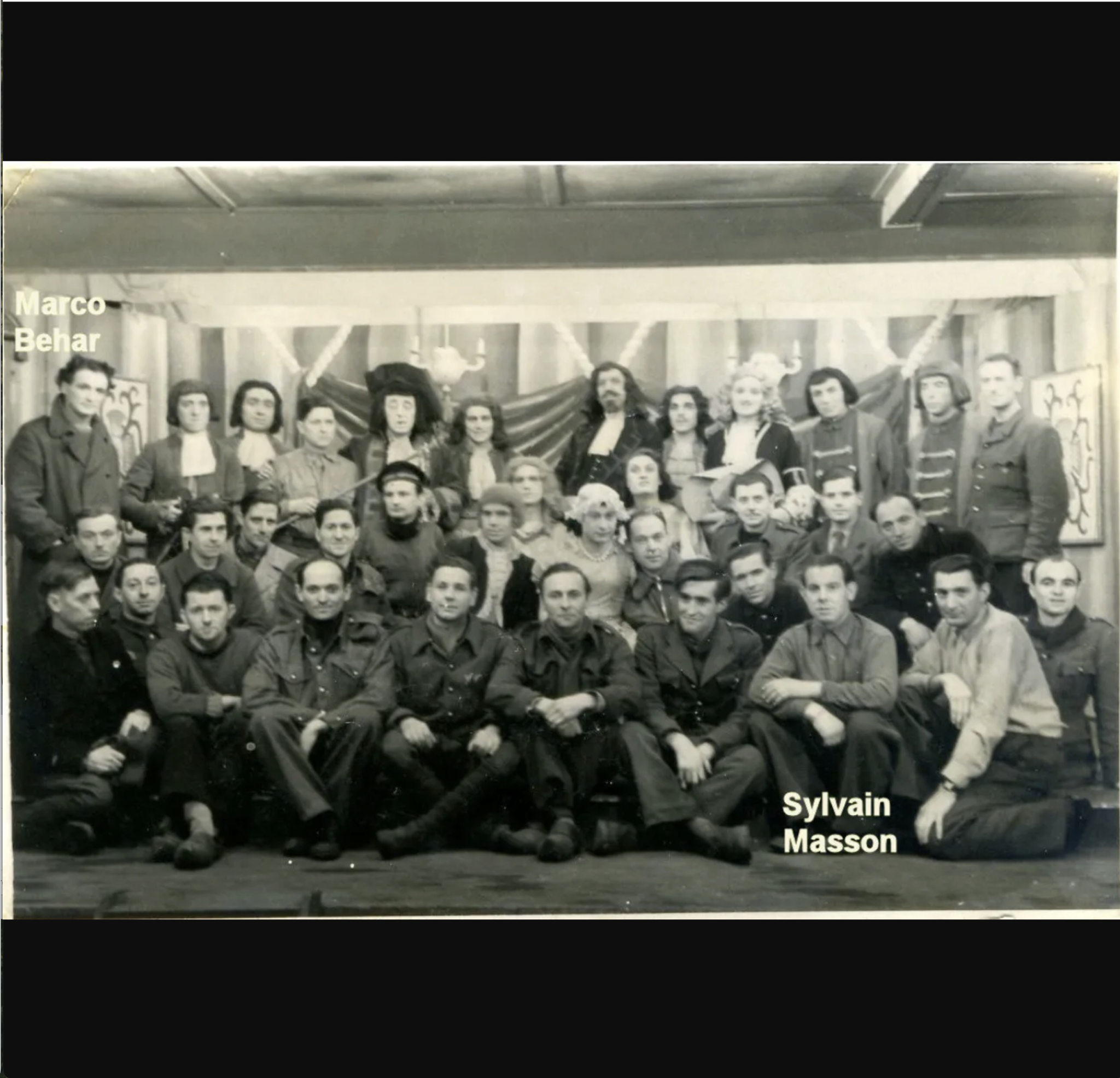
In the company photograph he is easy to spot. He is one of the few men not wearing a costume.
Inside a prison camp he somehow conjured elaborate Renaissance costumes. Geometric doublets. Flowing gowns. Wigs for the men playing women. All of it made from whatever fabric captivity could yield.
He was the man who made the production possible but never stepped on stage.
And he documented everything.
Every scene of Hamlet.
Every face of the troupe.
The full company assembled on the day of the performance.
He captioned each photograph with the exact lines being spoken in that moment.
On the back of every photograph was the German censor’s stamp.
geprüft

Souvenir de ma Captivité
On the title page he wrote two words.
Aimer et Souffrir
To love and to suffer.
Masson never spoke publicly about any of it.
According to his son, he occasionally watched television in the 1960s and 1970s when a play came on starring Marco Béhar.
He watched.
And said nothing.
Among the pages of the album is Masson’s membership card.
Signed:
Le Directeur, Marco Béhar
15 Juin 1944
The signature of a Jewish man hiding in plain sight.

Edna also said nothing for a long time.
Not about everything.
She arrived at Stalag X-B in October 1944.
She was ten years old.
She carried a dead child’s name.
She was Stefcia Skolkowska.
She was Catholic.
She had a medal for valor from the Polish Home Army, awarded after the Warsaw Uprising, because she had fought for it.
She was the youngest decorated soldier in Polish military history.
The medal was real.
The name was not.
The medal was real. The name was not.
Edna had smuggled food through the walls of the Warsaw Ghetto at seven.
She joined the resistance at nine.
She and her sister Miriam were also seasoned performers.
They came from a musical family. Their mother was a trained opera singer. Their father was a violinist.
On the Aryan side of Warsaw the two girls survived by singing and dancing on street corners as perfect little Catholic orphans.
They even performed for the Gestapo.
And walked out alive.
By the time they arrived at Stalag X-B, performance was no longer simply a talent.
It was a survival strategy.
Performance was no longer a talent. It was a survival strategy.
Perhaps that is why the photographs of L’Équipe mattered to her.
Edna understood exactly what those French prisoners had done inside that camp.
They staged Hamlet.
Men in Masson’s extraordinary costumes performed Shakespeare’s tragedy about a man trapped in an impossible situation, surrounded by enemies he cannot name, surviving through performance.
The resonance for every prisoner in that audience was not subtle.
Whether Edna and Miriam saw the production we cannot know for certain. As POWs rather than concentration camp prisoners, they moved with more freedom than history sometimes assumes.
And their friend Captain Oscar Friedman, a Belgian Jewish officer with considerable standing at Stalag X-B, had access to both sides of the wire.
Perhaps a ten-year-old Jewish girl, hiding behind a dead child’s name, once sat in a prison camp audience and watched a Jewish man direct Hamlet.
Perhaps neither of them knew the other’s secret.
Perhaps they recognized something in each other anyway.
What we do know is this.
Sylvain Masson chose to give his album to Edna.
She kept it for more than seventy-five years.
I am Edna’s daughter-in-law.
I have the album.
Looking at it now, the photographs of Hamlet, the handwritten captions with the exact dialogue spoken in each scene, Masson’s membership card identifying him as Tailleur, the geprüft stamp on the back of each photograph, I keep returning to the same question.
Did Edna know?
Did she sense, in the way hidden people sometimes sense each other, that Marco Béhar was also living inside a performance?
That somewhere in this camp of barbed wire and borrowed identities, she was not entirely alone?
Two hidden Jews in Stalag X-B.
One directing Shakespeare.
One a decorated child soldier hiding her name, performing her way through the war with her sister beside her.
Edna eventually gave her full testimony to the USC Shoah Foundation.
About the album she said nothing.
And sometimes I think about the line that must have echoed through that barracks theater in 1944.
To be, or not to be.
For the prisoners of Stalag X-B, it was never philosophy.
It was the question of the war itself.
Masson’s album outlasted them both.
Masson’s album outlasted them both.

Janet Bond Brill, PhD, is the author of Little Edna’s War, based on her mother-in-law’s Holocaust testimony, published on January 27, 2026, on International Holocaust Remembrance Day. Order Now