
To Defeat Antisemitism, Target the Lies of Anti-Zionism
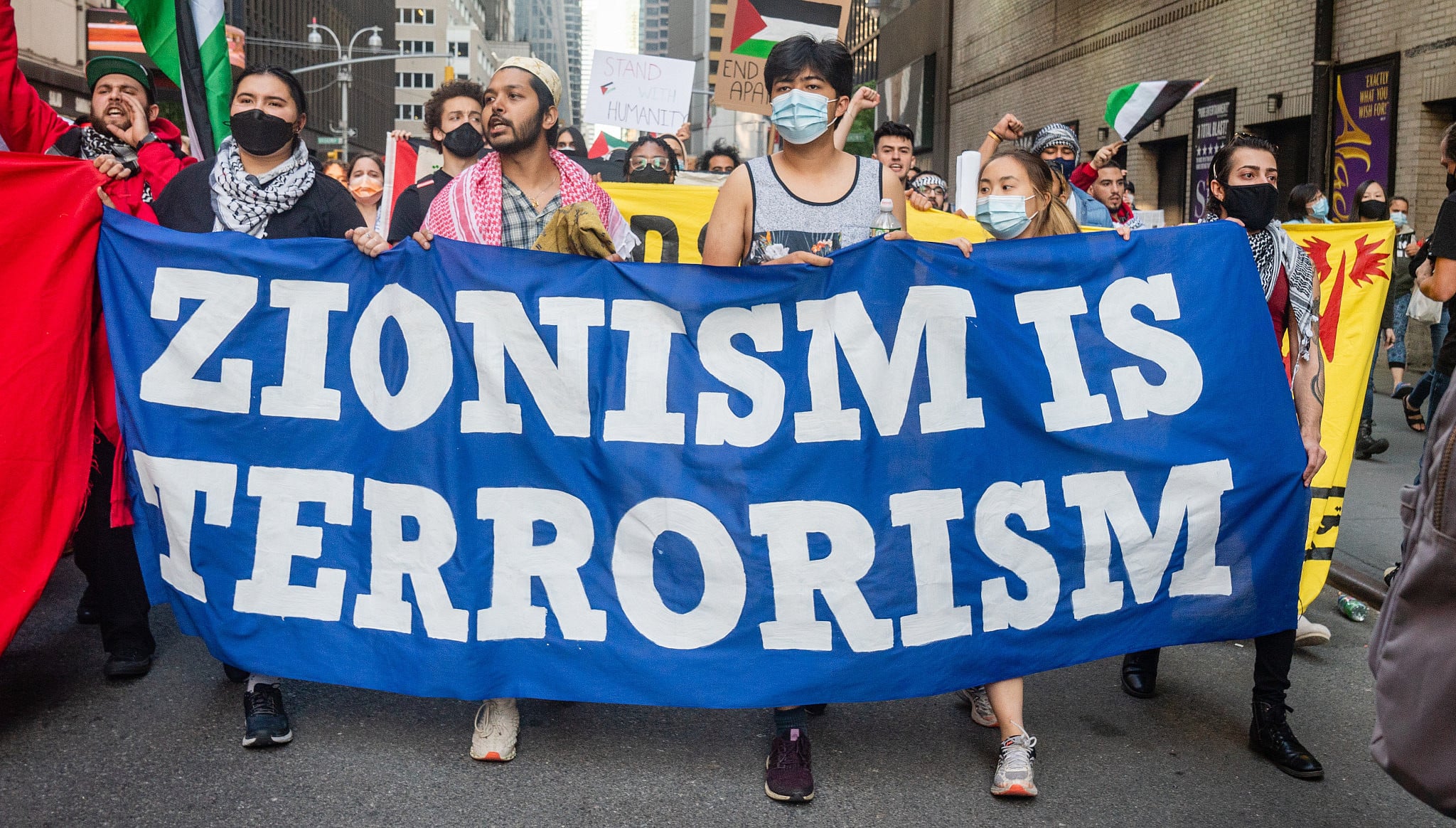
Are efforts to combat antisemitism useful? Do they help reduce antisemitism? Or are they just a waste of time and resources?
Those questions have moved to the center of Jewish communal discourse. On March 1, the 92d Street Y in New York will host a debate between Dara Horn and Deborah Lipstadt, titled “Is Fighting Antisemitism a Losing Battle?” And just last week, New York Times columnist Bret Stephens declared that “the fight against antisemitism, which consumes tens of millions of dollars every year . . . is a well meaning but mostly wasted effort.”
But is it really true that all efforts to counter antisemitism are futile? The “Yes” camp points to decades of Holocaust education and similar efforts that have done little to blunt anti-Jewish hostility. Dara Horn powerfully made that case in her April 2023 Atlantic essay, “Is Holocaust Education Making Antisemitism Worse?” Notably, that essay appeared months before Hamas’s October 7 atrocities — atrocities that unleashed a shocking wave of Israel-hatred both on elite campuses and in oft-described “progressive” cities.
But to conclude from this that the fight against antisemitism is hopeless rests on a faulty premise, namely, that initiatives like Holocaust education and the ADL’s “No Place for Hate” workshops are the only serious remedy for this ideological malady. As in medicine, properly treating the malady requires that its actual cause(s) be diagnosed. And lack of Holocaust knowledge or failure to offer anti-bias training is not what drives contemporary antisemitism.
Among the varied causes of contemporary antisemitism, one has stood out most prominently since October 7: Anti-Zionism, that is, opposition to a Jewish nation-state (while supporting nationhood for virtually all other peoples). In its current form, anti-Zionism rests on a scaffolding of historical falsehoods about Israel’s origins and conduct, all designed to cast Israel as uniquely evil.
The causal link between those falsehoods and rising antisemitism becomes obvious with the following simple thought experiment:
Imagine a college student having little knowledge of Israel and the Middle East. She has repeatedly heard her professors and peers recite the following three falsehoods as if they were well-established facts (which is actually a common occurrence on Western campuses):
- Israel is a “settler colonial” project in which European Jews stole Arab land with Western imperial backing.
- When granted statehood in 1948, Israel launched a genocidal campaign that expelled at least 600,000 Palestinian Arabs.
- Ever since, Israel has violently blocked every Palestinian attempt at statehood.
Now imagine those same professors and peers urging this student to condemn Israel for its supposed ongoing oppression. Would she believe them? Would she join protests demanding a Palestinian state “from the river to the sea”? Would she direct her rage at Jewish classmates?
The questions effectively answer themselves. What else could she conclude after being immersed in a constant, unchallenged stream of misinformation portraying Israel as a monstrous state?
Now consider the opposite scenario, one in which this same student repeatedly hears the actual historical record from her professors and peers (which actual history in fact rarely gets taught or even mentioned on Western college campuses):
- Modern Israel emerged through the return, the painstaking labor, and the lawful land purchases of the region’s indigenous people, the Jews – whose return followed an almost 2,000-year exile marked by constant persecution and repeated mass slaughters.
- In 1948, Israel accepted a UN statehood plan that required the Jews to surrender half their ancestral homeland for an adjacent Palestinian state. But the Palestinian leaders effectively said “No, We want it all,” and allied with neighboring Arab leaders to launch a genocidal war that they openly declared would drive every last Jew into the sea. Israel barely survived the war, which claimed the lives of over 6,000 – one percent of its citizens.
- Since 1937, Israel has endorsed at least six proposals for a sovereign Palestinian state carved out of the Jews’ indigenous lands. Palestinian leaders rejected all such offers – and after each rejection, resumed their century-long terror and propaganda war to obliterate all Jewish presence from the land. That war continues today.
If this student had heard those facts, would she call for Israel’s destruction? Would she blame Israel for the Palestinians’ lack of a state? Again, the answer is self-evident. No morally serious person, armed with the truth, would endorse Israel’s annihilation, or blame it for the Palestinians’ self-imposed lack of statehood.
The reaction to October 7 shined a light on this sordid reality, namely, that anti-Zionism is now a central driver of antisemitism. Far from producing sympathy for Jews on elite campuses, Hamas’s genocidal atrocities across southern Israel triggered an explosion of Jew-hate – all driven by the above-noted big lies about Israel. Protesters enthusiastically repeated those lies, embellishing them with further absurd claims of “mass starvation” and “genocide” – even as Israel delivered half a million tons of food aid into Gaza, exceeding international nutrition standards. And protesters targeted all Jewish students for harassment and violence, regardless of whether such students had connections to Israel or expressed support for Israel.
Despite this impactful reality, many of the West’s most influential institutions — universities, major media outlets, and NGOs — continue to amplify those anti-Zionist falsehoods. They repeat, as if factual, that Israel is a settler colonial project, that it committed genocide in 1948, and that it has always blocked Palestinian statehood. And when those lies are accepted as fact, all the other defamatory falsehoods about Israel – and about Jews – come to seem plausible.
This changes the entire debate about the effectiveness of fighting antisemitism. Jewish organizations have poured immense resources into Holocaust education, anti-bias training, interfaith dialogue, and security measures. But they have never invested in a sustained, proactive effort to counter the flood of anti-Zionist lies that now fuel antisemitism. To be clear, the media-monitoring group C.A.M.E.R.A. does highly admirable work in this lane, but those efforts are largely reactive – correcting falsehoods after they spread. No major Jewish institution has yet mounted a proactive, long-term campaign to tell the truth about Israel’s history and expose the ideological machinery that distorts it.
This is why Bret Stephens’s recent declaration was only half right. Yes, past efforts against antisemitism have largely failed. But no, an effective fight against antisemitism has yet to be actually tried.
In sum, the core driver of contemporary antisemitism is the ecosystem of anti-Zionist falsehoods embraced and proliferated by universities, the legacy media, and the NGO sector. As the late Rabbi Jonathan Sacks warned in his later years, “Anti-Zionism is the new antisemitism.” If that is true – and the evidence for it is overwhelming – then Jewish organizations must finally confront the problem at its source. They must launch a sustained, unapologetic effort to refute and dismantle the lies of anti-Zionism. And they must expose the deeply entrenched institutional biases that continue to foster and reinforce those lies.
This work is essential not just for today’s climate but also for the future. Universities and media outlets shape the worldview of the next generation of leaders. To be clear, the goal is not to persuade the hardened ideologues who spread those falsehoods, but rather to educate the far larger number of students and citizens who absorb the lies uncritically because they hear nothing else.
Such a campaign will not eliminate antisemitism entirely. But it will strike at the most influential vector shaping elite opinion today. And it would honor one of the twentieth century’s greatest moral voices against evil, Alexander Solzynitzen, who famously urged people of conscience to “Live not by lies.” But to make this happen, the truth needs robust defenders, broad audience access, and a serious, long-term commitment. Let the battle finally begin.
(The author wishes to thank Gene Weiner for his extensive editorial assistance with this essay.)