


To Lift Up Our Eyes and See
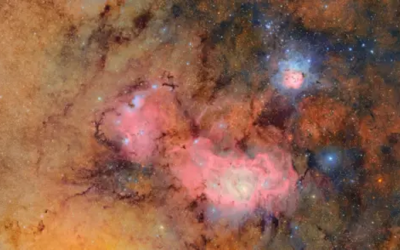
The secrets of the universe, captured by the extraordinary new Vera C. Rubin Observatory, are as astonishing as they are stunning. In particular, the hot pink Trifid and Lagoon nebulas, whose images grace this post, are almost too dazzling to behold. Called “the greatest astronomical discovery machine ever built” (by astrophysicist Željko Ivezić),[1] the Rubin Observatory, which boasts the largest digital camera ever built, will take in more data about our universe than all other optical telescopes have throughout history, combined![2] It is a marvel of astronomical proportions, to be sure.
And there is so much more yet to discover, so many thrilling and tantalizing breakthroughs just beyond the horizon. Indeed, the cosmological ride of our lives is only just beginning; a scientific revolution is afoot, and we have the monumental opportunity to share in it and bear witness to its transformative power. It is a gift of unfathomable proportions to see our universe revealed in such vivid and vibrant detail. For it is as mind-blowing as it is awe-inspiring, as ground-shifting as it is heart-humbling. But only if we lift our eyes to see it.
Truth be told, in these frenetic and chaotic times, we don’t often lift our eyes from the tasks and responsibilities directly in front of us. We are overwhelmed by the harried and demanding lives we lead, and our focus is often laser thin, sometimes by choice but often out of what feels like necessity. Sometimes, we cast our eyes down so that we might purely survive. And yet, in doing so, we miss so much, closing ourselves off from worlds upon worlds we simply do not see.
Writes Abraham Joshua Heschel in his book God in Search of Man, “Small is the world that most of us pay attention to, and limited our concern.” In order to ascertain what he describes as “the sublime, wonder, mystery, awe, and glory,” around us, we must, he says, “Lift up [our] eyes and see.”[3] It is as simple as it is complex, as easy as it is unbelievably hard.
In this week’s Torah portion, Parashat Balak, we bear witness to this very challenge, as we follow the seer Balaam, a man who, ironically, does not see much of what exists before him. Balaam is famous for blessing the Israelites when called upon to curse them, but he is also known for cruelly beating his donkey when he stops three times along their path. Balaam doesn’t realize that the donkey is halted by a messenger of God. Only when God “uncovers Balaam’s eyes”[4] is Balaam able to not only recognize the error of his ways, but to see the Divine Presence before him, the glory in his midst. For all the whimsy in our text, Balaam, in this moment, stands in for so many of us who essentially walk blindly through the world, likely missing many manifestations of the Divine along the way.
But the unfurling of our universe is one manifestation we ought not miss. We are awash in celestial glory at this staggering moment in history. We have peered into the deep wells of space and discovered phenomena we’ve only dreamed of. We have stumbled upon starry visions that rival the most iconic works of art, feasts for our eyes and spiritual jolts for our souls.
In a world so infused with hardship and horror, there is tremendous hope in these magnificent discoveries. To be united in our sense of collective awe is something magical and meaningful, and sacred. Let us look upon the heavens and stand awestruck! Let us gasp at all that nature beholds! Let us lift up our eyes and savor the incomprehensible vastness of our universe!
Rabbi Zalman Schachter-Shalomi teaches, in our search for God, “we start with wonder.”[5] So it is with us, gazing into the veritable depths of our universe. Wonder abounds, and the search has just begun.
[1] https://www.nytimes.com/2025/06/23/science/vera-rubin-telescopes-first-images.html
[2] https://rubinobservatory.org/news/first-imagery-rubin and https://www.npr.org/2025/06/23/nx-s1-5355034/vera-c-rubin-observatory-first-images
[3] Heschel, Abraham Joshua. God in Search of Man (p. 33). Farrar, Straus and Giroux. Kindle Edition.
[4] Numbers 22:31
[5] Schachter-Shalomi, Rabbi Zalman. Jewish with Feeling . Turner Publishing Company. Kindle Edition.