To see or not to see, that is the question
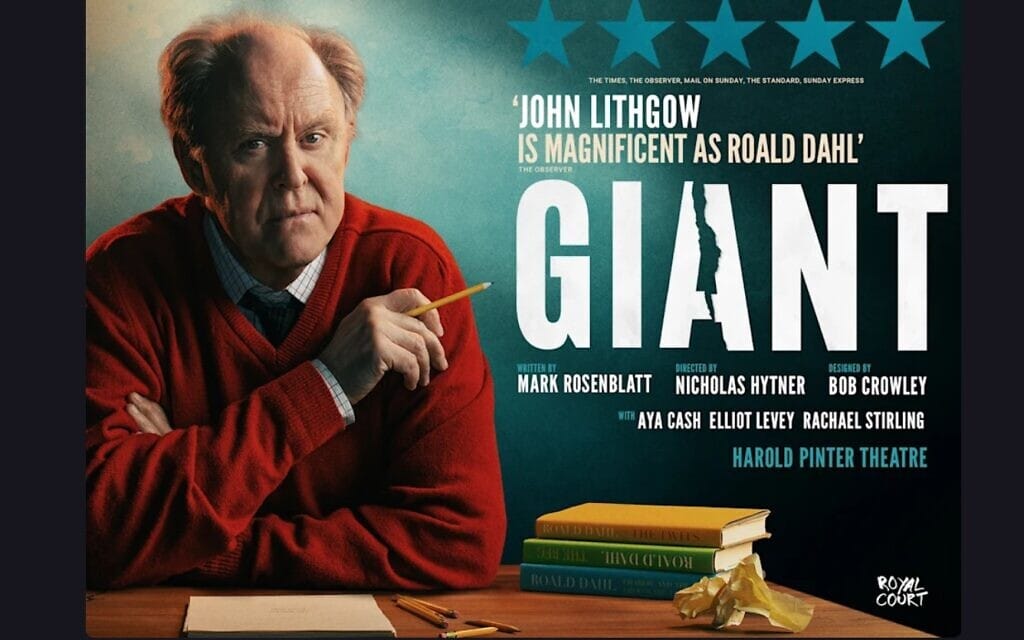
Anyone who enjoys theater and plans to be New York soon, will hear about “Giant,” starring John Lithgow, a play with several Tony nominations, to be announced this coming Friday. I saw it in London last year, and am here to help anyone who is debating whether to invest their time and money in it. Hint: for two hours I didn’t feel as though I was watching a play, but rather as if I were listening to troubled Jews abroad, forced to grapple with themselves and with their surroundings at a time when Israel and its image are under heavy strain.
The giant is the late children’s author Roald Dahl, 6 feet 6 inches tall. He is the father of “The BFG (Big Friendly Giant)”, “Matilda” and “Charlie and the Chocolate Factory,” and an unabashed antisemite – his family was to apologize for it. The play is set in 1983, after Dahl wrote a review of a book about Israel’s conduct during the First Lebanon War, in which he repeated stereotypes about Jewish control and cowardice and compared us to the Nazis. In a subsequent interview, he explained that there is something in the Jewish character that arouses hostility; even a stinker like Hitler, he said, did not pick on them for no reason.
The play features two Jewish characters, one real and one fictional. The real one is Tom Maschler, Dahl’s reserved British publisher, who was born in Berlin in 1933 and as a child, escaped with his parents to Britain. The invented character, Jessie Stone, a New York Jew, represents Dahl’s American publisher. Fearing that the controversy will hurt everyone’s livelihood, a meeting in set up in Dahl’s home in an English village, in an attempt to persuade him to apologize (spoiler: they fail).
Throughout the play, I thought mainly about Maschler, who helped turn Dahl into a global phenomenon and a very wealthy man. He, too, is not exempt from the author’s antisemitism: Dahl views him as a “good Jew,” yet one who remains loyal to his people. Maschler, who spent time on a kibbutz, says he does not yearn for Jerusalem – he clearly prefers his life as a member of a minority in Britain. Even so, he refuses Dahl’s request to admit that Israel is the problem.
Like me, Maschler’s persona felt uncomfortable with the conversation taking place on stage. Because of Dahl’s antisemitism, the discourse is tainted from the outset: there is no way – or reason – to argue with someone who sees Jews as inherently flawed and, by extension, views their state the same way. But Maschler and I both know that even when criticism of Israel springs from a primal prejudice, that does not automatically invalidate it.
If Maschler shares that criticism, in whole or in part, what is he to do? Speak out, and thereby provide ammunition to antisemites, the very people who victimized his family? Given his intimate knowledge of the danger which antisemitism poses, is it his duty to stand up against Israel’s critics, and thus betray his conscience? And why should he have to face this dilemma at all? He is a cosmopolitan man of culture; what connection has he to a conflicted country in the Middle East?
The fictional Stone, a successful woman in a cut‑throat field, is sure of herself and of her American‑Jewish identity, and is determined to stand her ground, even at a financial cost. I wonder how the playwright would portray Stone’s character and positions now, in light of Israel’s rapid decline in American public opinion, among Democrats and Republicans alike, as well as among Jews. This even as criticism of Israel increasingly spills over into antisemitism, the line between them grows ever more blurred, and it becomes part of a political conflict, for example between the administration and academia, or within the Democratic party, which most Jews support. What are they to do, when the heart is with Israel, but the mind is with liberal values, which the Jewish state is steadily rejecting?
The reviews I read of the London production focused on the gap between Dahl’s greatness as a writer and his smallness as a human being; on the boundary between prejudice and legitimate criticism; on freedom of expression; and on whether one can separate the artist from the person, a question familiar from the antisemitic composer Richard Wagner, filmmaker Woody Allen, and others.
I saw no reference to the angle that preoccupies me: the distress of Jews in the Diaspora when Israel’s standing is shaken. Is it their duty to rally to its side, because even if it is flawed, Jews have no other state? Should they demand that it live up to their expectations? Perhaps those who do not live in Israel have neither the right nor the obligation to take a stand? What, in fact, is the connection between them and it, if at all? What are the implications of the connection or lack of it, for them as well as for Israel? All this even before asking who is a Jew…
I picture an audience in New York watching the play at this time, when the claim that Israel dragged America into a war that is not its own is gaining ground. I try to imagine what goes through the minds of Jews sitting in the theater, and of non‑Jewish spectators. Is their right to an opinion identical, or different? What do they think and feel when the curtain falls? What do say to one another?
So, to see, or not to see? Anyone who wants to understand the current predicament of Jews in the West, will find in the play much food for thought, and for concern. But anyone looking to unwind would be better off choosing some other entertainment.