
To Serve As One

Back in the ’80s, during my GAP year in Israel, I had one dream: to serve in the army. I longed to wear the uniform, stand shoulder to shoulder with my Israeli peers, and feel that deep sense of belonging.
My Israeli cousins kept saying I was crazy.
“You don’t know what you’re letting yourself into,” they warned me — endless drills, sleepless nights, no personal freedom. But my persistence wouldn’t let me give up.
Finally, they relented. “Okay,” they said, “we’ll arrange an appointment for you with a Volunteer Recruitment Officer.” They gave me the address in Be’er Sheva and clearly explained which buses to take.
In my excitement, I bought a green army-style T-shirt and boots. My cousins advised me that getting a taste of basic training would improve my chances of being accepted, so they put me through their own “boot camp” in the local park — long runs carrying a 20-kilo rucksack, endless push-ups, pull-ups on the bars, and crawling drills under the climbing frame until my elbows were raw.
For weeks, I pushed myself hard, counting down the days until the big moment.
The day before my appointment, I even went to get a sharp crew cut, wanting to look every bit the part of a young recruit.
That morning, I stood in front of the mirror. The T-shirt sleeves stretched tight around my biceps. My shoulders were squared, posture taller, frame leaner, stronger. I barely recognized myself. I adjusted my mirror sunglasses, gave myself a firm nod of approval, snapped a quick salute, and clicked my heels together.
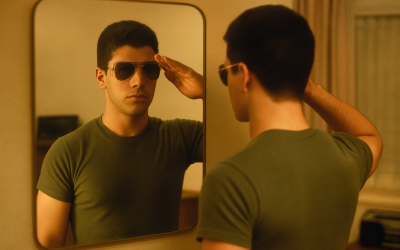
This was it. Today, my dream began.
Adrenaline coursing through me, I set off on the hour-and-forty-five-minute journey to Be’er Sheva, buzzing with anticipation.
I double-checked the address, straightened my shoulders, and then walked into the building, stepping into a brightly lit reception area. Feeling confident, I strode up to the front desk and said proudly:
“Hi, I’m here for my interview… volunteer military service.”
The receptionist looked up, puzzled.
“Ma?” (“What?”)
I peered over my sunglasses and leaned slightly forward, repeating myself — this time slower, smoother, more assured:
“I’m here for my interview… volunteer military service.”
Her brow furrowed. Concern spread across her face. Finally, she said gently:
“This… is a private psychiatrist’s clinic. There’s no recruitment office here.”
I froze, my face flushed deep red. Out of the corner of my eye, a man in a white coat appeared at the office doorway, standing quietly, watchful — as though making sure everything was under control.
“Er… I must have the wrong building,” I stammered. “Sorry to trouble you.”
She gave me a soft, sorrowful look and added kindly,
“There’s no army office anywhere in this area.”

I nodded, cleared my throat, and slowly backed out of the building, beads of sweat running down my forehead.
And did sweet revenge come back my cousins’ way?
That’s another story, for another time.
I didn’t know it then, but the journey toward serving Am Yisrael was only beginning.
A decade and a half later, I returned to Israel — this time as a more mature and wiser yeshiva student. With no plans to enlist during my short stay, I watched the young men around me balancing Torah study with army service.
You couldn’t miss the quiet dignity they carried as IDF soldiers. It wasn’t just about wearing the uniform — it was about shouldering responsibility for the people, the land, and our shared future.
Many made aliyah and went on to complete full army service, inspired by the deep connection between serving Am Yisrael and serving the G-d-given land.
To me, that’s what Israel is truly about: living it, keeping it, and serving it.
Exempt to Serve
In Parashat Shoftim (Devarim 20:5–8), the Torah describes a striking moment as the nation prepares for battle. The officers step forward and announce four exemptions, sending entire groups of soldiers home before the fighting even begins:
Who has built a new house and not yet dedicated it? Let him go home.”
“Who has planted a vineyard and not yet enjoyed its fruit? Let him go home.”
“Who has betrothed a woman but not yet married her? Let him go home.”
“Who is afraid and fainthearted? Let him go home.”
It’s astonishing: a nation on the brink of war — and yet thousands are told to leave the battlefield.
At first glance, these exemptions seem practical: distracted soldiers are more vulnerable in battle. But our Sages reveal something deeper:
Service to Am Yisrael is not one-size-fits-all.
-
Some strengthen the nation by building homes and communities.
-
Others serve by planting and cultivating the land.
-
Others dedicate themselves to building families and securing our future.
-
And sometimes, even stepping back when fear would weaken others is itself an act of courage and responsibility.
The Torah teaches us that every role — spiritual, physical, and emotional — is essential for the survival and flourishing of the Jewish people.
And yet, Jewish history reminds us there are moments when even those devoted to sacred service must stand shoulder to shoulder with their brothers.
During the time of the Hasmoneans, when the Greeks invaded and tried to erase our faith, the Kohanim — priests entrusted with holy Temple service — put aside their sacred tools and took up arms. Side by side with their fellow Jews, they fought fiercely to defend our people and reclaim our spiritual independence.
Sometimes, the highest form of service is setting aside your usual role to meet the nation’s urgent need.
Shoulder to Shoulder
Today, we face a similar call.
Since October 7th, we’ve endured relentless threats on every border and growing tensions within — pressures intensified by international debates over a proposed two-state solution.
In moments like these, the Torah’s message is clear: our survival depends on our unity.
Kol Yisrael arevim zeh bazeh” — all of Israel is responsible for one another.
That responsibility takes many forms:
-
Some defend us on the battlefield.
-
Others protect us through Torah and prayer.
-
Many serve by holding families and communities together.
But today, our reserve soldiers are being called up again and again — disrupting studies, careers, and family life — often carrying more than their share of the burden. At the same time, while many yeshiva students must continue full-time Torah learning, others may be called upon to contribute directly alongside our soldiers, supporting where they are most needed.
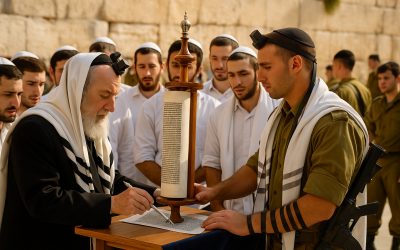
Just as the Maccabees once set aside Temple service to fight with their brothers, there are moments in history when every Jew must feel the weight of shared responsibility.
Those who learn, those who fight, and those who build must see themselves as partners in one sacred mission: protecting Am Yisrael and Eretz Yisrael.
When we serve as one — each in our way, united by faith, love, and responsibility — Am Yisrael stands unbreakable.
שבת שלום
שמואל