To the Royal Commission on Antisemitism
First and foremost, I would like to thank you for the important work of this Commission, which gives hope not only to the Jewish community of Australia, but to Jewish communities around the world that have experienced a troubling rise in antisemitism in recent years. Hope that, through your important work, a real, sustainable, and long-term solution may be found for Jewish communities currently struggling to maintain their way of life and sense of security.
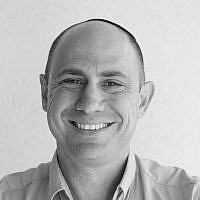
My name is Meir Holtz, and I am the CEO of Masa Israel Journey. Masa is the largest immersive, long-term educational experience for young adults ages 16-35. On its programs that range from several weeks to a year, Masa offers an authentic, unmediated, and challenging journey into Israeli society, culture, and history – and acts as the largest provider for global Jewry to access the finest Israeli businesses, social enterprises, and academic institutions. Since its 2004 founding by The Jewish Agency and government of Israel, Masa has served over 220,000 young people from more than 60 countries.

Over the past five years, approximately 1400 young Jewish Australians have participated in Masa programs. These young people return to Australia at the end of their program, and many of them hold key leadership roles within the Jewish community, while others contribute meaningfully through the private sector, public service, education, and many other fields in which their impact is invaluable. This is our mission as an organization: to cultivate leadership through transformative educational experiences.
In addition to my current role, I have spent many years deeply connected to Jewish communities around the world. I myself was born in the United States and immigrated to Israel with my family as a child. Several years ago, I served as an emissary to the Jewish community in Sydney, Australia. During my time there, I worked at Moriah College, with youth movements, synagogues, and in partnership with the Zionist Counsil of NSW and the ZFA.
My family and I lived in Australia as locals in every sense of the word. My children, though not Australian citizens, felt like an integral part of the local Jewish community. They studied in local schools and developed deep personal friendships and connections with Australian Jewish children. The personal relationships that the kids, my wife and I built during those years continue to this day. We will always feel connected to the extraordinary Jewish community of Australia and to the country that welcomed us so warmly.
During our time in Australia, 15 years ago, any antisemitic remark directed toward a member of the community would immediately alarm the wider Jewish population. Such incidents were not common and were never treated lightly. Historically, Australia was considered one of the safest places in the world for Jews. Jewish Australians, and at the time I considered my children as such, lived openly and peacefully, free to practice their faith, walk the streets wearing a kippah or other Jewish symbols without fear, while maintaining strong and positive relationships with their non-Jewish neighbors and broader Australian society.
In recent years, however — and especially since the October 7 massacre — we have witnessed a deeply alarming rise in antisemitic incidents. The horrific attack in Bondi was a tragic and violent escalation, but one of the most frightening things about it was that many Jews have shared that it did not entirely surprise them. Rather, it felt like the culmination of repeated incidents and growing hostility over time. Statements and acts that once shocked the community because of their rarity are now increasingly met with resignation, almost as though they have become routine. That is what should concern us all most, when hate crimes are acceptable, when living in fear is to be expected, when hiding who you are is a necessity.
And that is the most alarming issue of all: when hate crimes become acceptable; when living in fear is to be expected; when hiding who you are is a means of survival; that is when a society starts to crumble. No democratic and liberal country should ever accept such a reality as normal.
One of the reasons I chose to contribute my submission to this Royal Commission on Antisemitism and Social Cohesion, despite no longer living in Australia, is because of a conversation I recently had with a Masa participant. A young Australian Jewish man currently in Israel through one of our programs who approached me after one of our recent events and asked — almost pleaded — that I write to you from my perspective.

He spoke about young Jews in Australia who no longer feel safe in their own homes. Young people who once felt comfortable walking outside wearing a kippah or a Star of David necklace now hide every visible sign of their Jewish identity out of fear for their safety.
As mentioned earlier, it was not always this way. Many of them still remember a childhood in which being Jewish was ordinary — something that did not make them different, isolated, or targeted.
It was important to him that the voices of young people also be heard. He wanted this Commission to understand that the antisemitism currently being experienced in Australia is not merely an internal Jewish issue, but a problem affecting Australian society as a whole — and perhaps even the wider world.
If history teaches us anything, it is that societies in which antisemitism is allowed to flourish cannot prosper for long.
And this young participant does not stand alone. Because of the nature of Masa’s work, we are exposed to the thoughts and emotions of many young Australian Jews — feelings they do not always express publicly, and often, sadly, feel more comfortable sharing here in Israel, far from home.
We hear similar things repeatedly: feelings of isolation, anxiety, uncertainty about the future. They describe hostility on university campuses, fractured friendships, and fear of expressing even the most basic emotional connection to Israel because of the disproportionate reactions it may provoke. Some even feel the need to hide the fact that they spent time in Israel because of the social cost they may pay; losing friends over the fact that they are Jewish or believe in Israel’s right to exist.
We hear similar concerns from young Jews in many other parts of the world as well. That is why I believe your work has the potential to resonate far beyond Australia’s borders. It is difficult to overstate the importance of what the decisions, and more importantly the actions of this honorable Commission can achieve.
As you have likely understood from my words, Australia and the Jewish community of Australia are very dear to my heart. It is a strong, proud, caring, and deeply engaged community — committed both to Jewish life and to Australian society as a whole. It is also a community that always felt it belonged. Sadly, that sense of belonging is beginning to erode.
But this is not inevitable. Antisemitism is a disease that can be confronted and healed, and the first step toward healing is the one you, the honorable members of this Commission, are taking now.
I write these words not only as an individual who knows Australia well and cares deeply about what is happening there, but also as someone speaking on behalf of thousands of young Australian Jews — the future generation of leaders in the general Australian society and the Australian Jewish community.
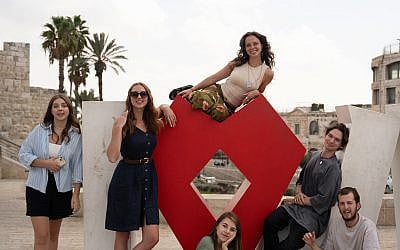 I write on their behalf because it is important to me that their voices be heard as well: the voices of young people watching the world around them change in ways they do not fully understand. They are not asking for special treatment. They are asking for support, for tools to cope with a changing reality, and for the opportunity to help rebuild an Australia where Jewish life can once again flourish openly and safely.
I remain hopeful and believe that this reality can change, and a better future awaits Australian Jewry and Australian society
Respectfully,
Meir Holtz
CEO, Masa Israel Journey