To Weep for the Troubador
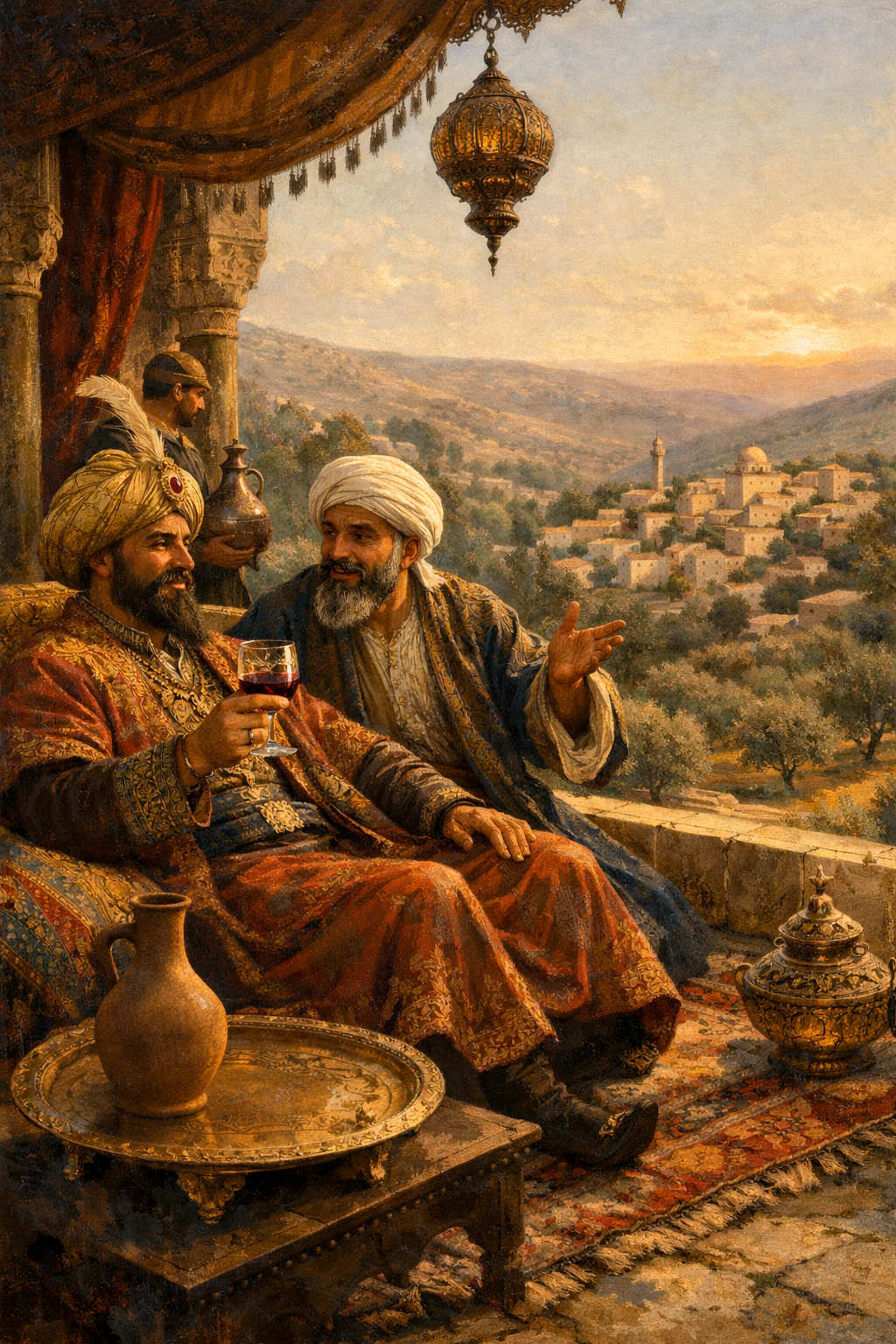
Long before Aqraba by way of Jericho sat the small village of Rammun, where the Sultan liked to go and drink wine. He arrived by evening straight into the secluded farm of the Emir on the hills, where the dark village below, lit only with the occasional oil lamp turned low, could be seen in its entirety. The guards would remain outside. He sat on the small terrace with a low table, two cushions, and a clay jug sealed with wax stood alone with a porcelain glass waiting for him. A servant would then pour the wine without meeting the sultan´s eyes. The wine was dark, almost black, drawn from vines older than memory. For a few moments guarded by the bitterness of the grapes, the sultan would feel Cairo far and Damascus further still. No petitions, no judges, no crowds chanting his name. Just stone walls and the low wind passing through the olive leaves like a whisper in the corridors of time.
Certain summer night, emboldened by courage and political greed, the emir joined the sultan.
“I hope the wine is of your majesty’s pleasing.”
“The lord Emir knows I do not come here for the wine.”
“I have a story to share that may be of the Pedisha’s* liking.”
“Be brief, lord emir, I like to enjoy my solitude.”
“I wanted to share with your grace the news that a troubadour wandered into the shuk of Rammun last week. He was a Spaniard, carrying nothing but his rags and his voice. He sang of Averroes, love, and heroism…”
“A poet from Al Andalus on my domains, why would he be here? “
“He mocked our tradition. A man does not sing. Music is not allowed in our din. I had him arrested.”
“Why not just expel him?”
“He could have contaminated the population with his ways, seduced the young women. We make sure customs are kept, shaaria is respected.”
“Who was this troubadour?”
“He said he was a Jew looking for the caves of Benjamin, escaping the flames of persecution.”
“He should be protected then. Where is he? I wish to meet him.”
The emir backed away nervously.
“Impossible, your grace.”
“I am the Commander of the Faithful, Lord of Egypt and Syria, the most splendid master, the learned, the just, the fighter in the holy war and warrior on the border, victorious in battle, Sultan of Islam and the Muslims, dispeller of rebellious deviators, the renewer of justice across the world. How dare you deny my request?”
“Well, lord of lords, I had the troubadour decapitated on the main square. The village was filled with joy. No one wept for him. I did it to glorify your name.”
The sultan paused, smiled, drank the wine in his cup and breathed the fresh air of Rammun. Then he shouted for his guards, who quickly came onto the terrace.
“Arrest this man, I want his head to be cut out.”
The emir pleaded for his life.
“I did it to glorify your name! I did it to glorify your name!”
As the emir was being dragged off, the Sultan laid his sentence from under his tired breath.
“Yes, but you need to learn that no one bothers me while I drink my glass of wine, and no one, no one applies justice in my domains without my permission.”
As the emir was dragged outside to his sad end the Sultan, now alone with his wine and the sound of the olive groves, sang the Andalusian song Lamma Bada Yatathanna.
“When she appeared, moving with grace, her beauty shone;
The hearts of all who saw her were captivated,
And the soul of the admirer was lost in longing.”
–
*Padishah: an emperor or supreme ruler, especially the Mamluk sultan.