Jewish Leader and Activist from Guatemala
Today’s Jewish Sociopolitical Generations
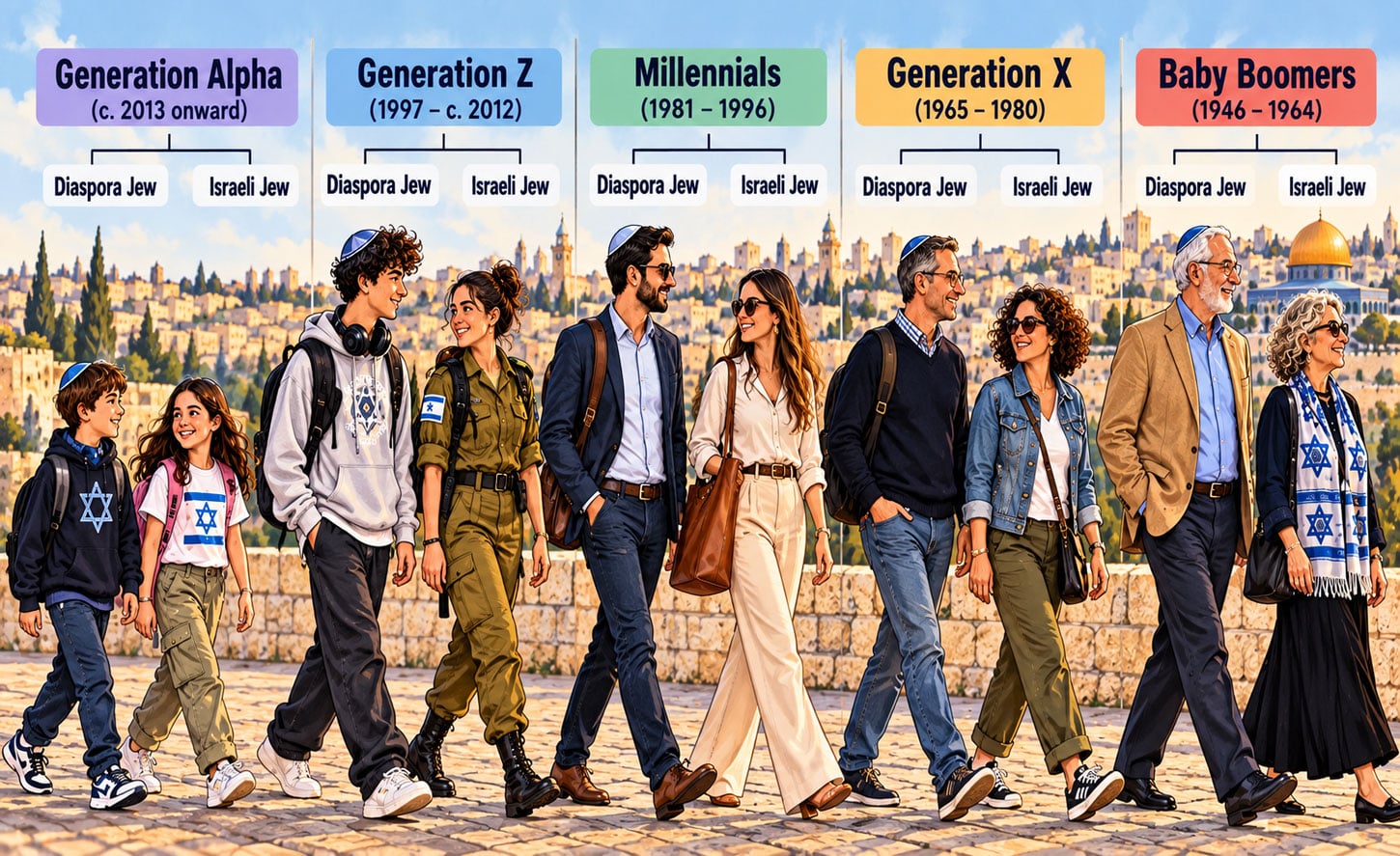
(ChatGPT)
Every generation sees the world through a different lens, shaped by the defining events, conflicts, hopes, and disappointments of its time. From the aftermath of World War II to the upheavals of the present day, these experiences have profoundly influenced how successive generations understand politics, society, identity, and belonging.
What follows is an attempt to trace this ideological evolution. I examine each generation through three distinct lenses: first, its broader sociopolitical outlook within the occidental civilization; second, how those trends are reflected within the Jewish world; and finally, how they have taken shape within Israeli society.
There is little doubt that today’s society is deeply divided along sociopolitical lines, not only within generations, but increasingly between them. By presenting these different perspectives, my intention is not to deepen those divisions, but to better understand where they come from, and perhaps to identify common ground that still connects us.
When discussing the Jewish world outside Israel, I highlight American Jews, who account for more than 70% of the global Jewish Diaspora.
NOTE: I would like to thank the Pew Research Center for the invaluable wealth of information it has published on the subject addressed in this article.
Baby Boomers (1946–1964)
Among Occidental Civilization, Boomers tend to place relatively greater value on established institutions, patriotism, personal responsibility, economic stability, and more traditional social norms, although the generation itself remains politically divided.
Among Jews, Boomers tend to have stronger institutional Jewish identities, synagogue affiliation, established Jewish organizations, communal philanthropy, and a stronger emotional attachment to Israel than younger American Jews; their worldview was profoundly shaped by the memory of the Holocaust, Israel’s early decades, the Six-Day War and Yom Kippur War.
Among Israelis, this generation grew up during Israel’s formative and existential wars, so national security, military service, Zionism and collective responsibility tend to occupy a particularly central place in their political identity; the traditional Labor-Zionist establishment was dominant in their youth, though many later shifted rightward, particularly after the wars, terrorism and failed peace processes of subsequent decades.
Generation X (1965–1980)
Among Occidental Civilization, Gen X is often characterized by independence, pragmatism and skepticism toward government and large institutions; socially it tends to fall between the more traditional Boomers and more liberal Millennials.
Among Jews, Gen X generally maintains substantial attachment to Jewish communal life and Israel, but is less institutionally oriented than Boomers and more comfortable separating support for Israel from support for any particular Israeli government; denominational affiliation also becomes somewhat less central. Data broadly show this age gradient, with older American Jews more attached to Israel than younger Jews.
Among Israelis, Gen X came of age around the Lebanon War, the First Intifada, Oslo, Rabin’s assassination and the Second Intifada, experiences that produced both a generation of peace-process idealists and a large group that became deeply skeptical of territorial concessions and Palestinian intentions. Security tends to remain a much more immediate political issue for Israeli Gen X than for Western Gen X.
Millennials (1981–1996)
Among Occidental Civilization, Millennials tend to be more socially liberal, secular, multicultural and supportive of LGBTQ rights, environmental action and government intervention to address inequality than older generations; they are also less deferential to traditional institutions.
Among Jews, Millennials broadly follow this liberalization, particularly among non-Orthodox American Jews, and tend to be more willing than older Jews to criticize Israeli government policy while still identifying as Jewish; importantly, however, younger American Jewry is becoming increasingly polarized between a large secular/unaffiliated population and a smaller but growing Orthodox population, which tends to be considerably more socially and politically conservative and strongly attached to Israel.
Among Israelis, Millennials do not simply reproduce the Western Millennial shift to the left: they grew up during suicide bombings, the Second Intifada, repeated Gaza conflicts, Hezbollah and Iran-related security threats, which contributed to considerable skepticism about the peace process. Thus an Israeli Millennial can be socially modern, technologically cosmopolitan and economically globalized while remaining quite hawkish on security and strongly nationalist or Zionist.
Generation Z (1997–c. 2012)
Among Occidental Civilization, Gen Z has grown up with social media, identity politics, climate change and intense political polarization; it tends to be socially progressive, highly comfortable with diversity, skeptical of traditional authority and more willing to view social problems in terms of systemic inequality.
Among Jews, Gen Z shows perhaps the greatest internal divergence: many non-Orthodox young Jews are highly progressive, less institutionally religious and less automatically supportive of Israeli government policies, while Orthodox Gen Z is disproportionately religious, communally connected, politically conservative and strongly Israel-oriented. Even before October 7, Jews under 30 were substantially less emotionally attached to Israel than Jews 65+, illustrating this generational gap.
Among Israelis, however, Gen Z has had a dramatically different formative experience from Western Gen Z: military service, rockets, terrorism, October 7, the Gaza war, the hostage crisis and regional threats have made questions of physical security exceptionally personal. Consequently, young Israelis can be culturally very modern and socially liberal on some issues while simultaneously being more security-conscious, nationalistic or distrustful of a Palestinian peace process than one might expect from Gen Z elsewhere.
Generation Alpha (c. 2013 onward)
Among Occidental Civilization, Alpha is still too young for meaningful political classification; it is the first generation being raised completely inside a smartphone, algorithmic and increasingly AI-mediated environment, so predictions about its eventual ideology are premature.
Among Jewish Alpha, identity formation is occurring amid unusually visible antisemitism, intense debate over Israel and Zionism, and greater polarization between highly assimilated/secular and highly observant Jewish communities; how this affects their eventual politics is not yet knowable.
Among Israeli Alpha, the formative environment is even more distinctive: many have experienced October 7 and the subsequent war as children, including rockets, evacuations, reserve mobilization of parents, hostages and national bereavement. It is therefore reasonable to expect security and national identity to be unusually salient for them, but it is far too early to say whether that ultimately makes them politically right-wing, left-wing, religious, secular or something substantially different from today’s categories.
Western generations generally move from more traditional to more socially progressive as they get younger. American Jews broadly follow that trajectory, but with a growing Orthodox countertrend. Israelis do not follow it nearly as cleanly, because each Israeli generation has been politically shaped by a different set of wars, terrorism, peace processes and security shocks.
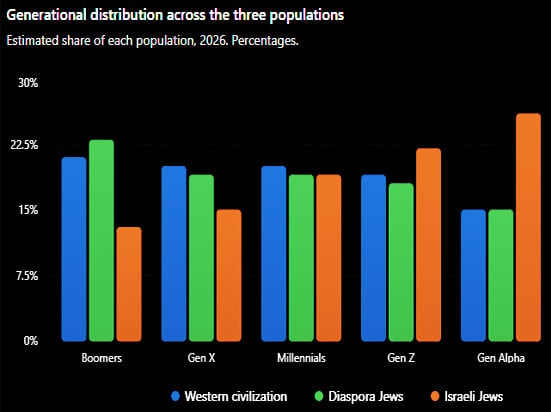
To conclude, I would like to present the following table comparing the estimated generational distribution of these three populations as of 2026: