The views expressed herein are solely mine.
Toledo’s ‘Three Cultures’ Mirage
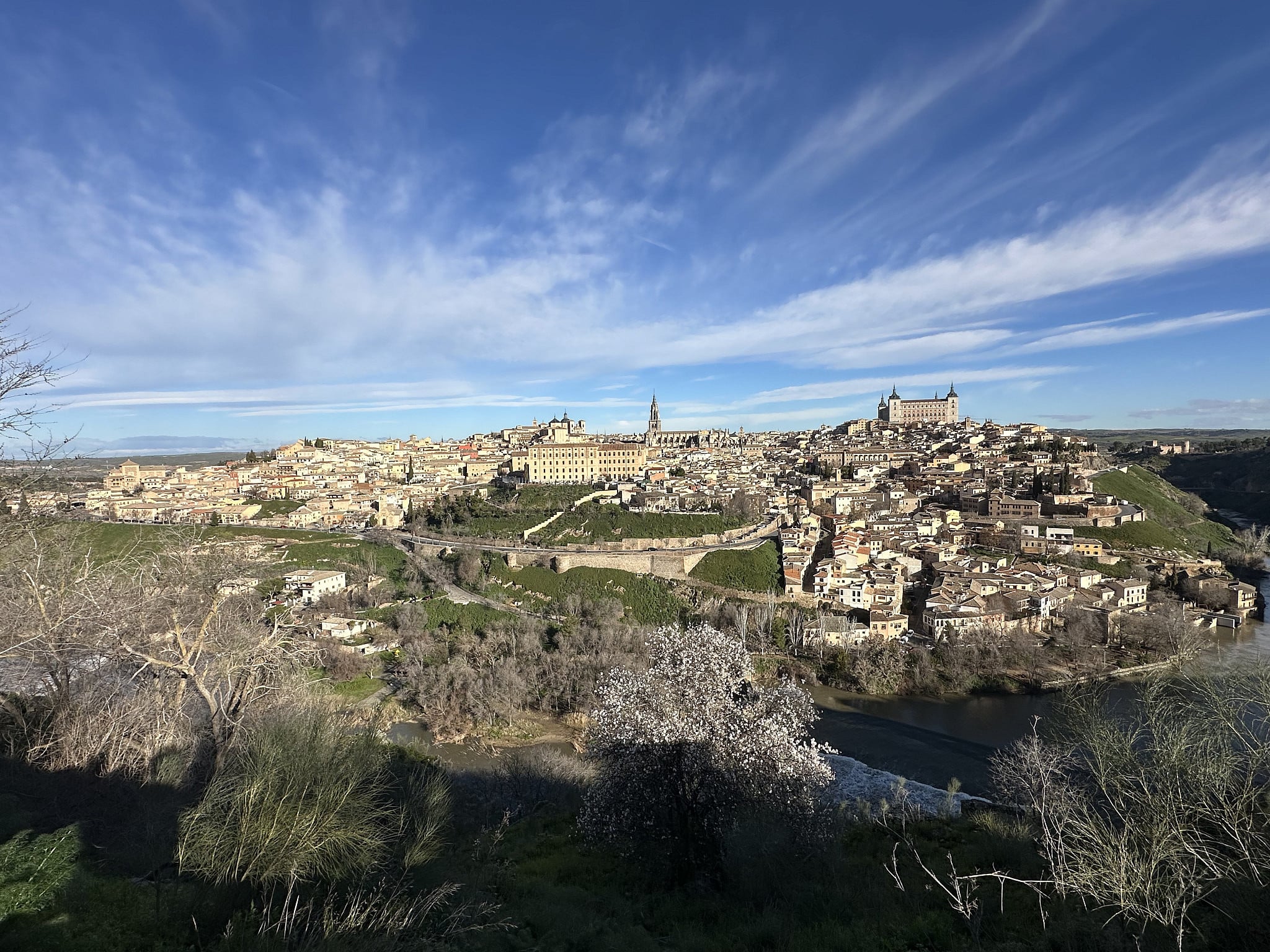
From the Mirador del Valle, Toledo rises above the Tagus in a tight maze of stone roofs, crowned by the Alcázar and the cathedral.
For decades, Spain has marketed Toledo as a medieval paradise where Christians, Muslims, and Jews supposedly lived in mutual respect and cultural harmony.
The slogan “city of three cultures” has become a cornerstone of national identity narratives, tourism campaigns, and even educational curricula.
Yet this image—repeated so often that it feels unquestionable—collapses under historical scrutiny.
The more rigorously we examine Toledo’s social, legal, and political structures, the clearer it becomes: Toledo was not a model of coexistence. It was a hierarchical society defined by asymmetric power relations, coercion, and recurring waves of religious violence.
Thus, it is essential to emphasize that this argument does not emerge from disdain or hostility toward the city—quite the opposite.
Toledo is, without question, my favorite city in Spain—and perhaps in the world.
Every time I return, I experience a profound sense of connection and belonging that is difficult to articulate.
Walking through its medieval streets, especially the narrow alleys of the old Jewish quarter, I feel an almost physical awareness of the layers of history embedded in the stones: the echoes of prayers once recited in synagogues, the footsteps of artisans and scholars, the quiet persistence of a community that ultimately vanished under violence and coercion.
From the moment you touch its walls and walk beneath its archways, the city’s textures carry an emotional weight that transcends mere tourism. It feels alive, and it speaks.
And then, there is the Mirador del Valle—a vantage point that reveals Toledo in its full medieval majesty, reminding me why this city is so special.
Each time I stand there and look across the Tagus toward the walled city, the view strikes me with the same intensity, as if I were seeing it for the first time.
The skyline, crowned by the Alcázar and the cathedral, rises above the cliffs with a quiet authority that inspires both awe and reflection, grounding my personal connection in the weight of history and the enduring spirit of the city.
From that vantage point, Toledo appears eternal and serene, yet knowing its history transforms the landscape: the beauty becomes intertwined with loss.
As a result, the contrast between the breathtaking panorama and the historical reality of expulsions and forced conversions makes the myth of harmonious coexistence feel not just inaccurate, but unfair to those who suffered. That emotional tension is precisely why historical clarification matters.
In my opinion, to idealize Toledo’s history is to flatten its complexity and silence the experiences of the communities that shaped it.
In medieval times, legal frameworks governing minority populations made the power dynamics explicit, codifying their subordinate status and institutionalizing the limits of their rights and protections.
Under Muslim rule, Christians and Jews occupied the status of ‘dhimmis’, tolerated only upon payment of the jizya tax and the acceptance of judicial and social inferiority.
They were allowed to exist, not as equals, but as subordinated communities whose rights depended entirely on the goodwill and strategic interests of the ruling elite.
Subsequently, when Toledo fell to Christian forces in 1085, the paradigm did not fundamentally change—only the hierarchy did. Muslims and Jews became ‘mudéjares’ and ‘judíos de realengo’, groups whose presence was tolerated primarily because they provided essential artisanal labor and, more importantly, tax revenue to the Crown.
On the other hand, their rights were never inherent; they were transactional. Thereby, this was not “coexistence”—it was conditional subordination, codified in law and maintained through economic dependence.
In fact, shifts in political and economic priorities repeatedly exposed the fragility of this arrangement. The late 14th century provides a decisive example.
Following the economic downturn and intensified political instability, the supposed tolerance disintegrated with alarming speed. Toledo experienced violent anti-Jewish riots in 1355, and again in the infamous pogroms of 1391, when mobs killed, looted, and forced mass conversions throughout Castile.
Contemporary chronicles and modern demographic studies estimate that up to 50% of Toledo’s Jewish community either converted or fled after 1391, a collapse that obliterates any credible claim to harmonious coexistence. Hence, a society that turns on a minority population so swiftly and brutally demonstrates that “tolerance” was never structural—it was opportunistic.
By contrast, the celebrated and sometimes venerated ‘School of Translators of Toledo’ offers another striking case of mythmaking.
The popular narrative of Christians, Jews, and Muslims working collaboratively in an enlightened, multicultural scholarly environment simply does not withstand analysis.
In reality, the majority of translation processes involved sequential, not joint work: texts moved from Arabic to Hebrew, and only then to Latin or Castilian.
Muslim scholars rarely collaborated directly with Christian clerics, both due to social segregation and legal restrictions.
Far from embodying egalitarian intellectual exchange, the translation enterprise served a political objective: the appropriation and Christianization of scientific and philosophical knowledge. Clearly, this was a mechanism of cultural extraction and control, not a forum for interreligious dialogue.
And the long-term trajectory confirms this pattern.
If Toledo had genuinely represented a space of tolerance, its historical conclusion would differ dramatically.
Instead, the record is unequivocal: 1492, the expulsion of 250,000 Jews from Spain; 1502, the forced conversion of Muslims in Castile; 1609–1614, the expulsion of approximately 300,000 ‘moriscos’ (Muslims who were forced to convert to Christianity or face expulsion).
Unquestionably, these state-driven campaigns systematically eliminated the very communities that supposedly embodied Toledo’s multicultural legacy.
Thence, a society that legally eradicates entire populations cannot plausibly be presented as a model of coexistence.
Ironically, the idealized narrative of Toledo as a peaceful crossroads of civilizations did not originate in the Middle Ages. It emerged in the 19th and 20th centuries through Romantic historiography, nationalist projects seeking a unifying myth for Spain, and later through tourism authorities eager to cultivate a marketable image of Spanish “tolerance.”
Therefore, the modern “three cultures” brand is not a historical description but a political and economic construction.
Acknowledging this reality does not diminish Toledo’s significance; it deepens it.
Undeniably, in the case of the Jewish people, Toledo was one of the most influential centers in medieval Spain, home to prominent yeshivot, leading rabbis, and a thriving community whose legal, philosophical, and poetic contributions defined the Golden Age of Sepharad.
As a major intellectual center of medieval Sepharad, Toledo hosted towering Jewish figures such as Rabbi Yosef ibn Migash and Rabbi Asher ben Yehiel—the Rosh—whose leadership of its yeshivot and prolific legal writings shaped Sephardic halakhic practice and Jewish intellectual life for generations.
Ergo, sanitizing the past minimizes the suffering, persecution, and expulsions that shaped the city’s social fabric.
Indeed, by confronting the historical record directly, we move beyond comforting marketing slogans and toward a more mature understanding.
Evidently, Toledo was not a utopia of diversity but a contested space where power determined who could remain, who was taxed, who was segregated, and ultimately who was expelled.
And perhaps that is why the Mirador del Valle feels so overwhelming. From that height, the city appears serene, eternal, untouched by conflict—as if history smoothed its edges.
Yet knowing what happened to the Jews of the aljama, to the moriscos, to the communities that vanished from these very streets, reshapes the panorama. The beauty becomes inseparable from absence. The silence becomes part of the story. The landscape forces one to hold two truths at the same time: Toledo inspires wonder, while carrying the memory of those erased from it.
If we aspire to honest historical understanding, we must reject romantic narratives and confront the documented evidence: coexistence existed only as long as it served the dominant group, and the moment it ceased to do so, violence filled the streets.
To respect Toledo is not to idealize it—it is to recognize the full weight of its history, and to refuse to minimize the tragedies that defined it.
Only when we stop pretending Toledo was a city of three cultures can we finally honor the people who paid the price for that illusion.
Related Topics
Related Posts